

Building a cleanroom for a hospital or pharmaceutical facility is not a simple project. There are dozens of components to select, test, and integrate before the room meets the air cleanliness standards required by regulation. This article maps out every piece of cleanroom equipment you need, from wall panels to pass boxes and Modular Operating Theatres (MOT), with technical guidance to help you determine the right specifications from the planning stage.
Here is the short answer: a cleanroom system consists of structural panels, air filtration (HEPA filters, FFU), material transfer devices (pass boxes), airlock systems (air showers), laminar air flow units, and for hospitals, a Modular Operating Theatre as the internationally standardized operating room solution. We stock more than 47 cleanroom products ready for delivery, including 16 pass box variants and 14 MOT components, with no need for overseas indent orders.
Why Cleanroom Facilities Are Mandatory for Hospitals and Pharma
Regulations in Indonesia enforce strict cleanliness standards for two key sectors. In pharmaceuticals, CPOB (Good Manufacturing Practice) issued by BPOM requires production rooms classified according to the type of dosage form. For hospitals, the Ministry of Health regulates operating room and sterile room standards through ministerial decrees that reference ISO 14644.
Particle contamination in a pharmaceutical production room can result in an entire production batch being recalled. In operating rooms, airborne contamination raises the risk of Surgical Site Infection (SSI), directly affecting patient safety. WHO data shows SSI occurs in 2-5% of surgical patients in developing countries.
Cleanrooms control the number of particles per air volume through a combination of filtration, differential pressure, and controlled airflow. Each ISO 14644 cleanroom classification has different particle limits, from ISO 1 (cleanest) to ISO 9 (equivalent to outdoor air). Hospitals typically need ISO 5-7 for operating rooms, while pharmaceutical aseptic filling areas may require up to ISO 5.
Cleanroom System Components from Upstream to Downstream
A cleanroom system is not a single product but an ecosystem of components working together. Understanding this component map helps you create an accurate budget plan and avoid selection mistakes that only surface during installation.
Panels and Building Structure
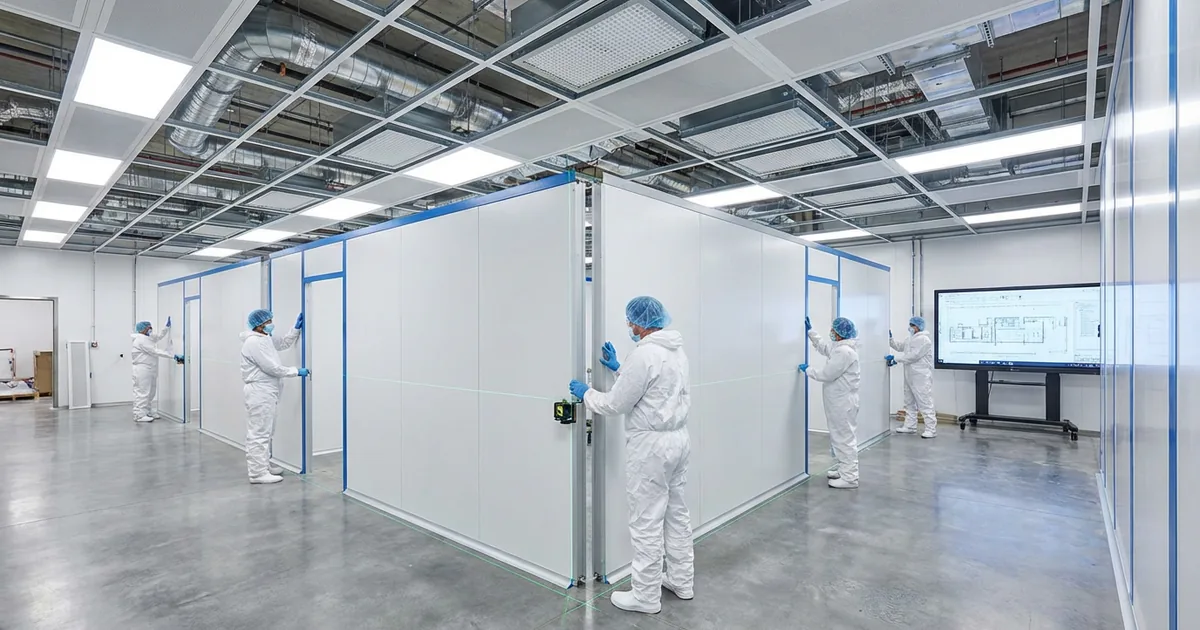
Cleanroom panels form the walls, ceilings, and room partitions. These panels consist of two coated steel sheets (galvanized, powder coated, or stainless steel) with a PU, PIR, or rockwool insulation core. Panel surfaces must be smooth, non-porous, and resistant to the cleaning chemicals used in daily sanitation protocols.
Standard panel thickness is 50 mm for internal partitions and 75-100 mm for exterior walls or areas requiring acoustic insulation. Panel joints use tongue-and-groove or cam-lock systems that produce an airtight seal. For deeper technical guidance, read our complete GMP cleanroom sandwich panel guide.
Air Filtration Systems: HEPA, FFU, and Pre-Filters
Filtration is the heart of any cleanroom system. Air passes through three filtration stages before entering the clean area. Pre-filters (G3/G4) capture coarse particles like dust and fibers. Medium filters (F7/F8/F9) remove particles sized 1-5 microns. Finally, HEPA H13/H14 filters capture 99.97-99.995% of particles at 0.3 microns.
Fan Filter Units (FFU) combine a blower fan and HEPA filter in one modular ceiling-mounted unit. FFUs are popular for their layout flexibility and easy filter replacement. For detailed specifications, see our dedicated articles on HEPA filter specifications and FFU cleanroom guide.
Pass Box: Material Transfer Without Contamination Risk
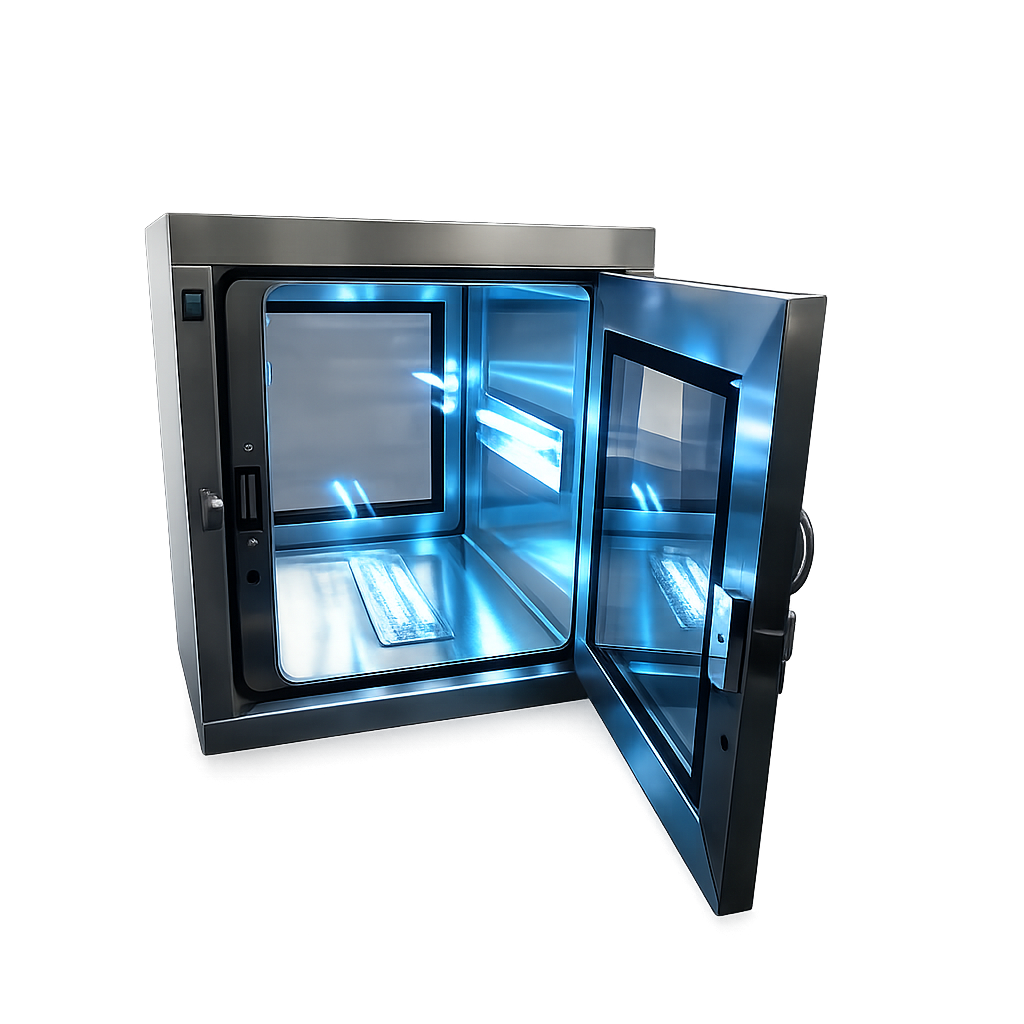
A pass box is a material transfer device used between rooms with different cleanliness levels. Its working principle is simple but effective: two doors with an interlock system ensure only one door can open at a time. This mechanism keeps the room's differential pressure stable during the transfer process.
There are three main categories of pass box based on their interlock system. Mechanical interlock uses physical locking and suits standard applications in ISO 7-8 areas. Electronic interlock includes sensors, indicator lights, and BMS (Building Management System) connectivity, suited for ISO 5-7. Electromagnetic interlock is the most complete variant with electromagnetic locks, UV sterilization, automatic timers, and optional internal HEPA filters, the standard for GMP class A/B pharmaceutical facilities.
We stock 16 pass box variants ready for shipment, from the static interlock pass box for basic needs, to the stainless steel electrical interlock pass box for laboratories, and the SUS201 electromagnetic pass box for cost-conscious pharmaceutical facilities. For a detailed comparison between types, read our complete pass box cleanroom guide.
Air Shower and Airlock Systems
Air showers serve as personnel decontamination gateways before entering the cleanroom area. High-velocity air jets (20-25 m/s) blow particles off clothing and the operator's body surface for 10-15 seconds. This system reduces surface particle contamination by up to 99% on personnel entering the room.
Air showers come in single-person, double-person, and tunnel configurations for high-traffic entry points. Construction materials include stainless steel 304 for corrosive environments or powder-coated steel for standard applications. Read our cleanroom air shower selection guide for a deeper look at the options.
Laminar Air Flow (LAF) and Clean Bench
LAF units produce unidirectional airflow that carries particles away from the work area. There are two main types: vertical laminar flow (air from top to bottom) and horizontal laminar flow (air from back to front). The choice depends on the type of work and operator position.
A clean bench or Class 100 LAF clean bench provides an ISO 5 work area for weighing, testing, or aseptic processes. For hospitals, ceiling-mounted LAF is the standard in operating rooms. See our laminar air flow specifications and pricing article for full technical details.
Modular Operating Theatre (MOT): The Modern Operating Room Solution
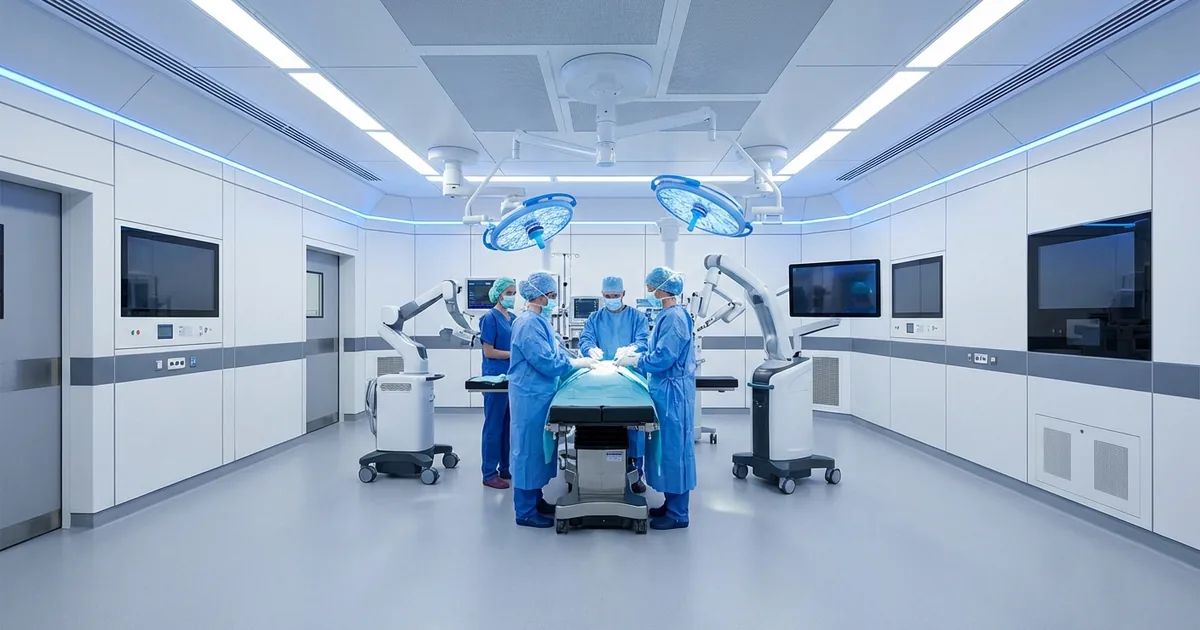
For hospitals planning to build or renovate operating rooms, the Modular Operating Theatre is a construction approach being increasingly adopted across Indonesia. MOT replaces wet construction methods (plastering, painting, ceramic tiling) with prefabricated panels and integrated components.
Why Modern Hospitals Are Switching to MOT
Installation speed is the primary factor. Conventional operating room construction takes 3-6 months including curing, painting, and finishing. MOT can be installed in 3-4 weeks because all components are factory-manufactured and assembled on site. For operating hospitals, this time difference means far less disruption to ongoing services.
Quality control is also more consistent. Each panel is manufactured to precision tolerances that are difficult to achieve through manual on-site workmanship. Panel joints produce airtight seals without gaps that could harbor bacteria. For a detailed breakdown of each component, read our MOT components and standards guide.
Five Core Components of an MOT System
A complete MOT consists of the following components that must integrate seamlessly.
1. Modular wall panels. Operating room modular wall panels with HPL or stainless steel finish, 50-100 mm thick, with coved corners for easy cleaning.
2. Laminar air flow ceiling. Operating theatre LAF ceiling with HEPA H14 filters producing unidirectional airflow in the sterile zone above the operating table.
3. Automatic hermetic door. Hermetic sliding door with airtight seal and automatic sensors, maintaining positive room pressure as personnel enter and exit.
4. Operating room control panel. Intelligent control panel managing lighting, temperature, humidity, air pressure, surgery timer, and intercom from a single touchscreen.
5. Medical scrub sink. Surgical hand wash station with hands-free operation (foot-operated or sensor-activated), stainless steel 304 construction, and splash-proof design.
We carry 14 MOT component variants in our catalog, from wall panels to 6-unit LCD control panels. All components can be combined to match your planned room layout.
Standards and Certifications to Meet
Operating rooms in Indonesia must comply with several standards. ISO 14644-1 governs airborne particle cleanliness classification, typically ISO 5 at the operating table area and ISO 7 in preparation zones. ISO 14698 covers biocontamination control. Ministry of Health regulations specify technical requirements for hospital buildings including operating room specifications.
Make sure your supplier can provide IQ (Installation Qualification) and OQ (Operational Qualification) documentation for validation. Product certifications such as CE marking and factory ISO 9001 are also indicators of production quality control standards. These documents are often required during hospital accreditation.
How to Choose the Right Cleanroom Supplier in Indonesia
Choosing a cleanroom equipment supplier is not just about comparing prices. Several factors are often overlooked during procurement but have a major impact during installation and daily operations.
Ready Stock vs. Indent Ordering
Suppliers with ready stock provide a significant time advantage. Equipment can be shipped within 3-7 business days, not 60-90 days like overseas indent orders. The risk of damage during international shipping is also eliminated.
For projects with tight deadlines, such as an operating room renovation that must be completed before accreditation, ready stock can be the difference between finishing on time and delaying by months. We keep more than 47 cleanroom products in stock in Indonesia, including 16 pass box variants and 14 MOT components, ready for immediate dispatch to your project site.
Local Technical Support and After-Sales
Cleanroom equipment requires calibration, validation, and regular maintenance. A supplier with a local technical team can respond faster when field issues arise. Also ask whether the supplier provides operational training for your staff after installation is complete.
Spare parts availability must also be confirmed. Pass box door gaskets, UV lamps, and HEPA filters are components that need periodic replacement. A supplier that stocks spare parts locally saves time and cost compared to importing every time a replacement is needed.
Product Certification and Supporting Documents
Request the following documents before finalizing a purchase: material certificates (mill certificates), product test reports, factory certifications (ISO 9001, CE), and IQ/OQ template documents. For products to be installed in pharmaceutical facilities, verify compliance with the latest GMP guidelines from BPOM.
Pass Box Type Comparison Table: Quick Selection Guide
The following table summarizes the differences between the three main pass box types to help you determine the right specification for your facility.
| Aspect | Mechanical Interlock | Electronic Interlock | Electromagnetic Interlock |
|---|---|---|---|
| Locking System | Mechanical (cam-lock) | Sensor + electronic control | Electromagnetic lock |
| UV Sterilization | Not available | Optional | Standard (built-in) |
| Internal HEPA Filter | Not available | Optional | Optional / standard on dynamic type |
| BMS Connection | No | Yes | Yes |
| Audit Trail | No | Yes (open-close log) | Yes (complete with timestamp) |
| Ideal ISO Class | ISO 7 — ISO 8 | ISO 5 — ISO 7 | ISO 5 and below |
| Primary Application | Warehouse, non-critical areas | Lab, food production | Pharma class A/B, biosafety |
| Common Material | Powder coated steel | SUS304 / powder coated | SUS304 |
| Price Range | Most affordable | Mid-range (+15-25%) | Premium (+40-60%) |
Not sure which type fits your needs? Our technical team can help you determine specifications based on your room classification and operational requirements. Free consultation via WhatsApp.
FAQ: Frequently Asked Questions Before Purchasing Cleanroom Equipment
How long is the delivery lead time for pass boxes and MOT components?
For products available in our warehouse stock, delivery can be made within 3-7 business days across Indonesia. For custom specifications (non-standard sizes, special materials, or specific configurations), lead time ranges from 4-8 weeks depending on complexity. This is significantly faster than direct overseas indent which can take 60-90 days.
Can MOT components be customized to match the room layout?
Yes. Modular wall panels, LAF ceilings, and door configurations can be adjusted to match existing room dimensions. Our engineering team will conduct a site survey and produce technical drawings before production. This flexibility is a key advantage of MOT over conventional construction which depends on on-site craftsman skills.
What is the minimum cleanroom standard required for pharmaceuticals in Indonesia?
BPOM through CPOB guidelines requires room classification based on dosage form type. Aseptic filling areas require Class A (equivalent to ISO 5) with a Class B background. Non-sterile production areas generally require Class D (equivalent to ISO 8) or Class E. Each zone must be equipped with filtration, differential pressure, and particle monitoring systems appropriate to its classification.
How can I verify pass box quality before purchasing?
First, request a factory test report covering leak tests and interlock function tests. Second, check factory certifications (ISO 9001, CE). Third, ask for material certificates to verify stainless steel grade or powder coating thickness. Finally, ensure the supplier provides a minimum 12-month warranty and local spare parts availability.
Cleanroom Equipment Checklist by Facility Type
Cleanroom equipment requirements differ depending on the type of facility being built. Here is a quick reference based on the three most common scenarios in Indonesia.
Pharmaceutical Cleanroom (GMP Compliance)
Pharmaceutical production facilities require the most complete equipment set. Aseptic filling areas (Class A/B) need electromagnetic pass boxes with HEPA filters and UV sterilization, LAF for weighing areas, air showers at every entry point, and FFU across the entire Class A ceiling grid. Non-sterile production areas (Class D/E) can use mechanical pass boxes and standard filtration.
Walls and ceilings must use cleanroom panels with finishes that withstand daily sanitization using alcohol and disinfectants. All joints must be flush with no gaps. Flooring typically uses seamless epoxy or welded vinyl sheet.
Hospital Operating Rooms
The main focus for operating rooms is the MOT system comprising modular panels, LAF ceiling, hermetic doors, and control panels. Pass boxes are needed in the sterilization area for transferring surgical instruments from the decontamination zone to the sterile zone without opening the door. Air showers are typically installed in the surgical area entry corridor.
Operating rooms also require a positive pressure control system that maintains indoor air pressure 15-25 Pa higher than the surrounding corridor. Pressure, temperature, and humidity monitoring are integrated into the operating room control panel.
Quality Control Laboratories
Pharmaceutical QC or microbiology laboratories need a clean bench or LAF for sterility testing. Electronic interlock pass boxes are adequate for sample transfer. One or two FFU units can replace a full ceiling HEPA system if the required clean area is limited. Air showers are optional depending on room classification.
Estimated Cleanroom Project Timeline from Planning to Operation
One of the most common questions from project owners is how long it takes from initial consultation to operational readiness. Here is a realistic timeline based on project experience in Indonesia.
Weeks 1-2: Survey and design. The engineering team conducts site measurements, needs analysis, and layout drawing preparation. This stage produces technical drawings and a Bill of Quantity (BOQ), which is the basis for pricing.
Weeks 3-4: Material procurement. For products available in stock, shipping can happen within the same week. Custom items require 3-6 weeks of production depending on complexity. This is where the advantage of a ready-stock supplier is most felt, as procurement lead time can be cut by up to 70%.
Weeks 5-8: Installation. Panel, ceiling, door, pass box, and air shower assembly. For a 40-60 m2 MOT operating room, installation can be completed in 3-4 weeks. Multi-room pharmaceutical cleanrooms may need 6-10 weeks.
Weeks 9-10: Testing and validation. Leak testing, particle count measurement, differential pressure calibration, and IQ/OQ documentation. This stage ensures all operational parameters meet design specifications before the facility is declared ready for operation.
Next Steps for Your Cleanroom Project
Building a cleanroom that meets regulatory standards requires careful planning from design through to the selection of every component. With 47 cleanroom products in stock, including 16 pass box variants and 14 MOT components, we are ready to support your project without the uncertain waiting times of indent orders.
Whether you are planning a new cleanroom build, an operating room renovation, or a pharmaceutical production facility upgrade, the right first step is a technical consultation to determine the specifications that match both your standards and your budget.
- Free project specification and needs consultation
- Site survey and technical drawing preparation
- Complete pricing with ready-stock and custom options
- IQ/OQ documentation support for validation
Contact our technical team via WhatsApp to start the conversation about your project. Our team responds within 1 business hour for every consultation request.