

What Is Cleanroom Classification ISO 14644?
ISO 14644 is the international standard that defines air cleanliness levels in controlled environments based on particle concentration. It is the primary reference worldwide — from semiconductor fabs in Taiwan to pharmaceutical labs in Indonesia.
A cleanroom is not just a "clean room." It is a controlled environment where the number of dust particles, microorganisms, and other contaminants is maintained below specific limits. How strict those limits are is determined by the cleanroom class.
Quick answer: ISO 14644-1 divides cleanrooms into 9 classes (ISO 1 through ISO 9). The lower the number, the cleaner the room. ISO 1 is the most sterile — only 10 particles per cubic meter at ≥0.1 µm. ISO 9 is roughly equivalent to normal outdoor air.
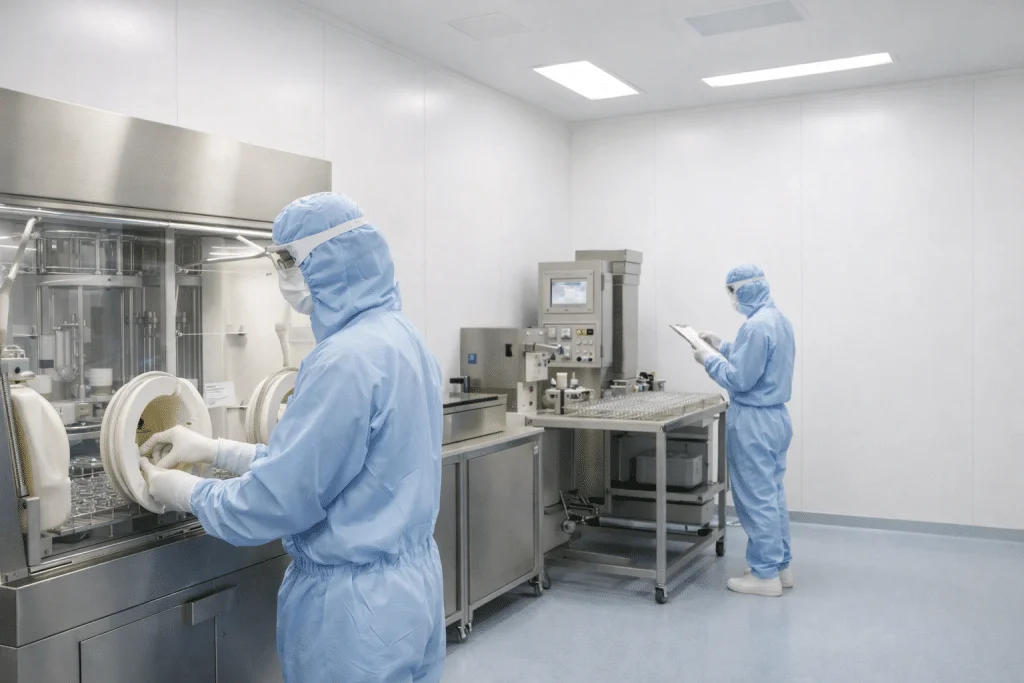
Understanding this classification is not purely academic. Your cleanroom class directly drives HVAC design, air filter selection, wall materials, and the total construction cost of your project.
ISO 14644-1 Cleanroom Classification Table
Here is the official maximum particle count per cubic meter of air for each ISO class. These figures are measured under defined conditions (at rest or operational) per ISO 14644-1:2015.
- ISO 1: ≥0.1 µm = 10 particles/m³ — nanotechnology fabrication
- ISO 2: ≥0.1 µm = 100 particles/m³ — advanced semiconductor manufacturing
- ISO 3: ≥0.1 µm = 1,000 particles/m³ — chip and wafer production
- ISO 4: ≥0.1 µm = 10,000 particles/m³ — optics and micro-electronics
- ISO 5: ≥0.1 µm = 100,000 particles/m³ — sterile pharma, aseptic filling
- ISO 6: ≥0.5 µm = 35,200 particles/m³ — drug production, biomedical research
- ISO 7: ≥0.5 µm = 352,000 particles/m³ — operating rooms, food production
- ISO 8: ≥0.5 µm = 3,520,000 particles/m³ — general assembly, packaging
- ISO 9: ≥0.5 µm = 35,200,000 particles/m³ — equivalent to normal room air
Note that the lower the ISO class, the higher the air change rate required and the stricter the air filtration requirements become.
Relationship Between ISO Classes and GMP Standards
In the pharmaceutical industry, cleanroom classification is often referenced using the EU GMP (Good Manufacturing Practice) Annex 1 system. Understanding the correlation between ISO and GMP is important because many pharma projects in Indonesia reference both standards simultaneously.
ISO to EU GMP Conversion Table
- GMP Grade A = ISO 5 (at rest and in operation) — critical zone: aseptic filling
- GMP Grade B = ISO 5 (at rest), ISO 7 (in operation) — background for Grade A
- GMP Grade C = ISO 7 (at rest), ISO 8 (in operation) — critical stage non-sterile production
- GMP Grade D = ISO 8 (at rest) — initial handling and packaging
The distinction between "at rest" and "in operation" conditions is significant. Many cleanrooms pass validation when empty but fail to meet standards during production due to contamination from personnel and equipment.
Why This Matters for Projects in Indonesia
Indonesia's BPOM adopts EU GMP principles for domestic pharmaceutical industry regulation. If you are building a drug manufacturing facility, cleanroom classification requirements are not recommendations — they are legal obligations subject to audit.
Key Components That Determine Cleanroom Class
A cleanroom class is not determined by a single factor. It results from the integration of multiple systems working together continuously.
1. Air Filtration System (HEPA/ULPA)
HEPA (High Efficiency Particulate Air) filters capture 99.97% of particles ≥0.3 µm. For ISO classes 1 through 4, ULPA (Ultra Low Penetration Air) filters with 99.9995% efficiency may be required.
Filter selection must align with your target class. See detailed filter specifications in our article HEPA Filter Cleanroom: Specification and Price Guide 2026.
2. FFU (Fan Filter Unit)
An FFU is a self-contained unit that combines a fan and HEPA/ULPA filter in a single module. Typically ceiling-mounted in cleanrooms for even distribution of clean air. ISO class 5 and above commonly use FFUs as a replacement for or supplement to ducted HVAC systems.
Read the complete guide at FFU Fan Filter Unit: Specification Guide 2026.
3. Air Change Rate (ACH)
Air change rate measures how many times the room air is replaced per hour. Higher cleanliness classes demand more frequent air changes.
- ISO 5: 240–600 ACH
- ISO 6: 90–180 ACH
- ISO 7: 30–60 ACH
- ISO 8: 10–25 ACH
These ACH figures directly impact AHU sizing, ducting capacity, and energy consumption — all of which significantly affect operational costs.
4. Wall and Ceiling Materials
Cleanroom construction materials must have smooth, non-porous, and easily cleanable surfaces. Cleanroom sandwich panels with antibacterial or food-grade coatings are the industry standard. See the specifications of our Cleanroom Panel in our product catalog.
5. Cross-Contamination Prevention Systems
Air showers, pass boxes, and airlocks prevent cross-contamination. Every time personnel or materials enter the cleanroom, contamination risk increases. Higher classes require stricter entry protocols.
Learn more about Air Shower Cleanroom and Pass Box Cleanroom in our dedicated articles.
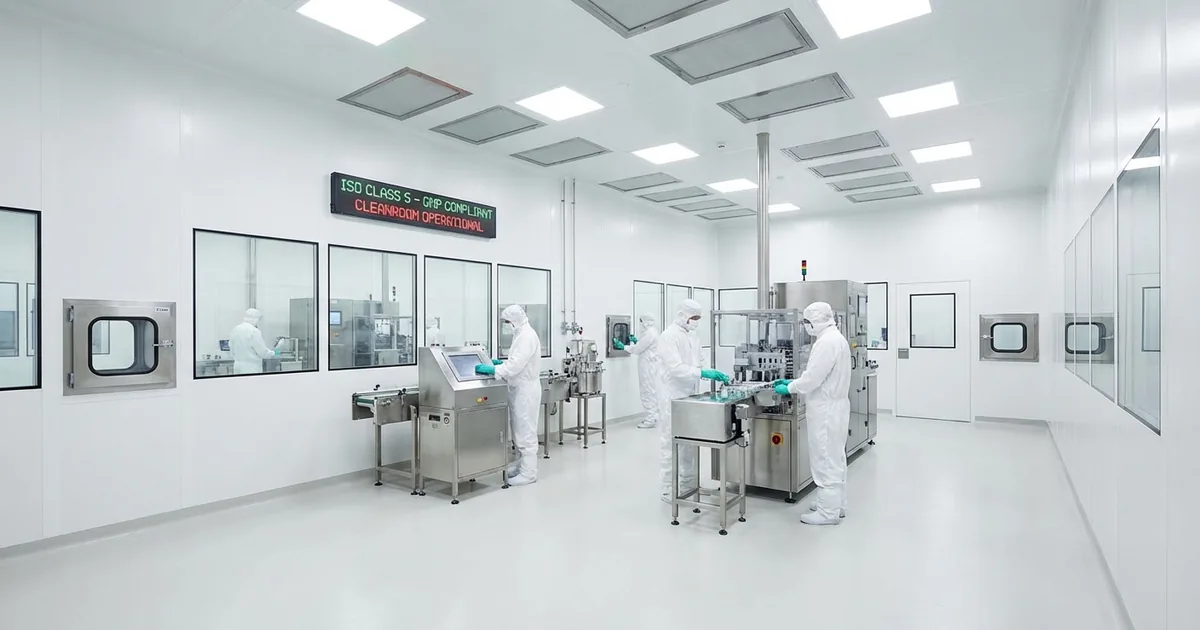
How to Choose the Right Cleanroom Class for Your Project
Over-specifying a cleanroom wastes money. Under-specifying can cause product validation failure and far greater losses. Here is a practical approach to determining the appropriate class.
Identify Applicable Regulations
The pharmaceutical industry is regulated by BPOM (GMP). The food industry follows BPOM and HACCP standards. The electronics industry follows client specifications or internal standards. Start here — not from assumptions.
Determine Your Most Critical Process
Within a single facility, not every area requires the same class. An aseptic filling room may need ISO 5, but a packaging area only needs ISO 8. Proper zoning significantly reduces both construction and operational costs.
Calculate Total Cost of Ownership
A higher class means more filters, higher ACH, larger AHUs, more electricity consumption, and greater maintenance costs. Compare 10-year costs — not just initial construction expenses.
Consult Specialists
Good cleanroom design requires collaboration between architects, HVAC engineers, and validation specialists. Do not determine class based on guesswork — involve experts from the earliest planning stage.
Cleanroom Validation and Monitoring
Building a cleanroom to a specific class is only half the journey. The next phase — often overlooked — is ongoing validation and monitoring.
Initial Validation (IQ/OQ/PQ)
Before a cleanroom enters service, it must pass three standard validation stages. Installation Qualification (IQ) verifies that installation matches design specifications. Operational Qualification (OQ) tests system performance under operating conditions. Performance Qualification (PQ) proves the cleanroom meets specifications under actual production conditions.
Particle Counters and Routine Monitoring
ISO 14644-2 governs the frequency and methods of ongoing monitoring. ISO class 5 and above generally requires continuous particle monitoring. Classes ISO 6 through 8 can use periodic sampling on a schedule determined by risk analysis.
Do not underestimate this phase. A cleanroom that passes initial validation can deteriorate if filters are not replaced on time or gowning protocols are not followed. Read our article on Laminar Air Flow Cleanroom to understand airflow systems supporting high ISO classes.
FAQ: Frequently Asked Questions About Cleanroom Classification
What is the difference between ISO 14644 version 1999 and 2015?
The 2015 version replaced the statistical U-test sampling method with a simpler and more practical approach. The particle concentration limits per class remain the same, but testing procedures and the number of sampling points are calculated using a new formula. The 2015 version also introduced the concept of "macroparticles" for particles larger than 5 µm.
Is an ISO 7 cleanroom sufficient for pharmaceutical production?
It depends on the drug type and production stage. For oral solid production (tablets, capsules), ISO 8 or GMP Grade D areas are generally adequate. For sterile injectable manufacturing, the filling area must be ISO 5 (GMP Grade A) with an ISO 7 (GMP Grade B) background. Consult a GMP specialist for your specific requirements.
How much does it cost to build a cleanroom per square meter?
Costs vary significantly depending on the ISO class, room size, and HVAC system complexity. As a rough guide: ISO 8 cleanrooms range from IDR 3–6 million/m², ISO 7 around IDR 6–12 million/m², and ISO 5 can reach IDR 15–30 million/m² or more. These figures include panels, HVAC systems, filters, and basic installation.
How long do HEPA filters last in a cleanroom?
HEPA filters typically last 3 to 5 years depending on operating conditions, pre-filter quality, and surrounding environment. In areas with high pollution or heavy particle loads, replacement may be more frequent. Differential pressure (delta P) monitoring is the standard method for determining when filters need replacement.
Conclusion
Choosing the right cleanroom class is a technical and financial decision with long-term implications. ISO 14644 provides a clear international framework — your task is to translate regulatory requirements and production processes into precise cleanroom specifications.
Start with regulations, identify critical processes, calculate total costs, and involve specialists. Do not over-specify, do not under-specify — find the precise point that matches your actual requirements.
Need consultation on determining your cleanroom classification and material specifications? Contact our technical team via WhatsApp for a no-obligation discussion.