

A modular house is sold as a package: built in a factory, shipped, then installed on your plot. Two quotations for the same size can still differ enormously. One covers window frames, electrical points, and sanitary ware; the other only walls and frame. The checklist below sets out what must be written down before you approve a quotation or pay a deposit.
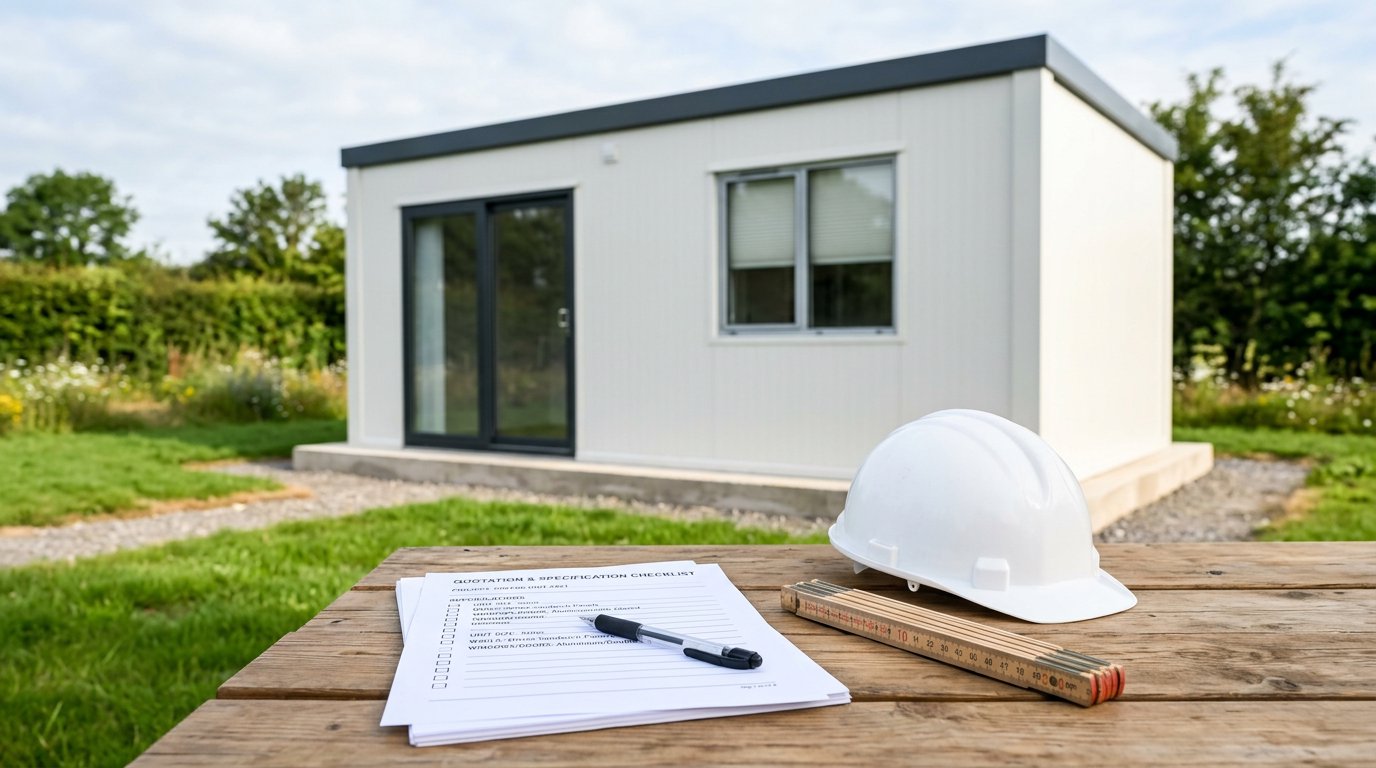
Why a modular house quotation must be read item by item
A single unit price can almost never be compared directly. A figure that looks cheap usually rests on a narrower scope: no foundation, no delivery, no electrical installation. Add those items back and the gap shrinks or disappears, so compare scope first and the figure second.
Ask for the quotation as a list of items, not one line reading "1 unit of 3x6 m". An itemised list forces the seller to name materials and quantities, and it becomes your inspection basis at delivery and at handover.
Technical specifications that must be written down
The six groups below cause most disputes. Ask for numbers, not adjectives such as "quality", "thick", or "leak proof".
- Walls and roof: panel core type (EPS, rockwool, or PIR), core thickness in millimetres, steel skin thickness, and the finish.
- Frame: the steel profile used, its dimensions, material thickness, and how modules are joined, bolted or welded.
- Frames and openings: number and size of doors and windows, frame material, glass type, and the locks included.
- Floor: floor framing, surface covering, and the live load used in the structural calculation.
- Electrical: number of lighting points, switches, and sockets; cable sizes; whether an MCB panel is included.
- Sanitary ware: toilet, basin, taps, water heater, and drain points by type or equivalent.
The two wall figures are not a formality: core type and thickness govern how the unit behaves thermally, as covered in our article on modular house insulation, ventilation, and air conditioning. Common thickness benchmarks are set out in the guide to wall panel sizes and thicknesses.
Payment terms and the production, delivery, installation schedule
Fair terms tie payment to progress, not calendar dates alone. The common pattern is a deposit at signing, a second payment once the unit is produced and inspected, then settlement after installation and handover. What matters is not the percentage but a provable event behind every instalment.
Ask for three separate dates: production complete, arrival on site, and installation complete. A single phrase such as "four weeks" makes delay impossible to discuss. Add a clause for the case where the plot is not ready on delivery day, including who carries waiting and storage costs.
Delivery scheduling also depends on unit width. A complete unit 3 m wide exceeds the 2,500 mm vehicle width limit in Government Regulation 55 of 2012, so it needs special arrangements, while the knock-down version fits an ordinary truck. Detail sits in our article on modular house delivery and installation.
Need comparable offers? Request a pricelist and a written quotation through the sandwichpanels.id contact page. State the size you have in mind and the installation address; the item list above can be attached as it stands as your request for quotation.
Scope boundary: factory work and buyer work
Almost every complaint after installation grows out of a scope boundary nobody wrote down. Separate the two sides, then ask the seller to mark what the quotation covers.
- Foundation, site levelling, and disposal of excavated material.
- Grid electricity connection, clean water, septic tank, and waste water drainage.
- Access for the delivery vehicle and lifting equipment if the site needs it.
- Building permits and the documents the landowner must prepare.
- Extra work outside the unit: canopy, terrace, fence, and landscaping.
Foundation and permits are the two items most often assumed to be included. Both are covered separately in our article on PBG permits, foundations, and site preparation, while the application itself runs through SIMBG.
Warranty, handover record, and after sales support
A usable warranty states three things: what is covered, for how long, and what voids it. Separate the structure and frame cover, the wall and roof panel cover, joint leakage, and equipment such as taps and water heaters, which carry their own manufacturer terms.
Ask for the exclusions in writing too: alterations by other parties, impact damage, or use outside the intended purpose. Exclusions named at the start protect the buyer, because the limits of a claim are clear rather than interpreted after damage has happened.
Handover closes with a record stating the date, items inspected, outstanding rectification notes, and the deadline for settling them. This is what you rely on in a claim. Keep it with the quotation, payment receipts, shop drawings, and maintenance instructions.
On after sales support, Indonesia's Consumer Protection Law 8 of 1999 requires correct information on the condition and guarantee of goods, and spare parts and after sales facilities for goods in continuing use. Ask about replacement panels, sealant, and joint accessories.
Next steps before you sign
A safe sequence: set the size from the number of occupants, lock the specification list, request two or three quotations with identical scope, then compare. The long run cost view sits in our comparison of modular and conventional construction, while payment routes are covered in the financing and budget article.
Smart Modular House comes in 3x3 m, 3x6 m, and two storey 3x6 m, a tempered glass walled version, and custom knock-down builds. For a pricelist, layout advice, and a site survey, contact us through https://sandwichpanels.id/contact and attach the checklist above so the offers you receive are directly comparable.
Frequently asked questions
Is the foundation always included in the unit price?
Not always. Many quotations stop at the unit installed on a foundation the buyer has prepared. Ask which foundation type is required and who builds it, because the cost follows the soil conditions on your plot.
How long should a modular house warranty run?
There is no single figure that applies everywhere. What matters more is how cover is split: structure, panels, joint leakage, and equipment carry different periods. Ask for each in writing, with the exclusions.
What should be inspected when the unit arrives on site?
Match dimensions, panel type and thickness, number of openings, electrical points, and sanitary ware against the quotation list. Check panel surfaces for dents and scratches before installation, then record findings in the handover note.