

Finishing a modular house unit in the factory is only half the story. The costly delays happen after it leaves the gate: cargo over the legal width, a village road no trailer can turn into, and a site that is not ready when the truck arrives.
This guide covers what landowners, contractors and project managers should settle before ordering: Indonesia's road transport dimension limits, the knock-down versus welded choice, access and foundation readiness, crane requirements, and 2026 market figures for inter-island logistics.
Transport Dimension Limits: Why a 3-Metre Unit Cannot Simply Drive Through
Freight vehicle dimensions in Indonesia are governed by Government Regulation 55 of 2012. Article 54(1) caps vehicle width at 2,500 millimetres, length at 12,000 millimetres without a trailer and 18,000 millimetres with a drawbar or semi-trailer, and height at 4,200 millimetres and no more than 1.7 times the vehicle width.
Compare that with a 3x6 metre Smart Modular House unit. At 3 metres wide it already sits 500 millimetres over the legal limit. Its 2.85 metre height plus the trailer deck also clears 3,500 millimetres, and Article 54(3) requires a warning marker in the cab for vehicles that tall.
Loads that genuinely exceed the limits need a road use dispensation. Use of national road sections is regulated by Public Works Ministerial Regulation 20/PRT/M/2010, while bridge capacity evaluation for dispensation follows Directorate General of Highways Circular 04/SE/Db/2020. The technical recommendation is issued by the regional National Road Implementation Agency.
Knock-Down or Welded: Two Different Routes to Site
Smart Modular House units are built at PT Sunrise Purification Technology's Cikarang plant using a bolted galvanised steel frame, corner fittings at every corner, and walls of EPS sandwich panel in density 10, fire-rated density 15, or rockwool. That bolted construction is what makes two shipping routes possible.
The knock-down version ships disassembled: wall panels, frame members, fibre cement board flooring, aluminium windows and steel doors stack flat inside a truck. The load stays within the legal width, so no dispensation, no escort and no large crane on site.
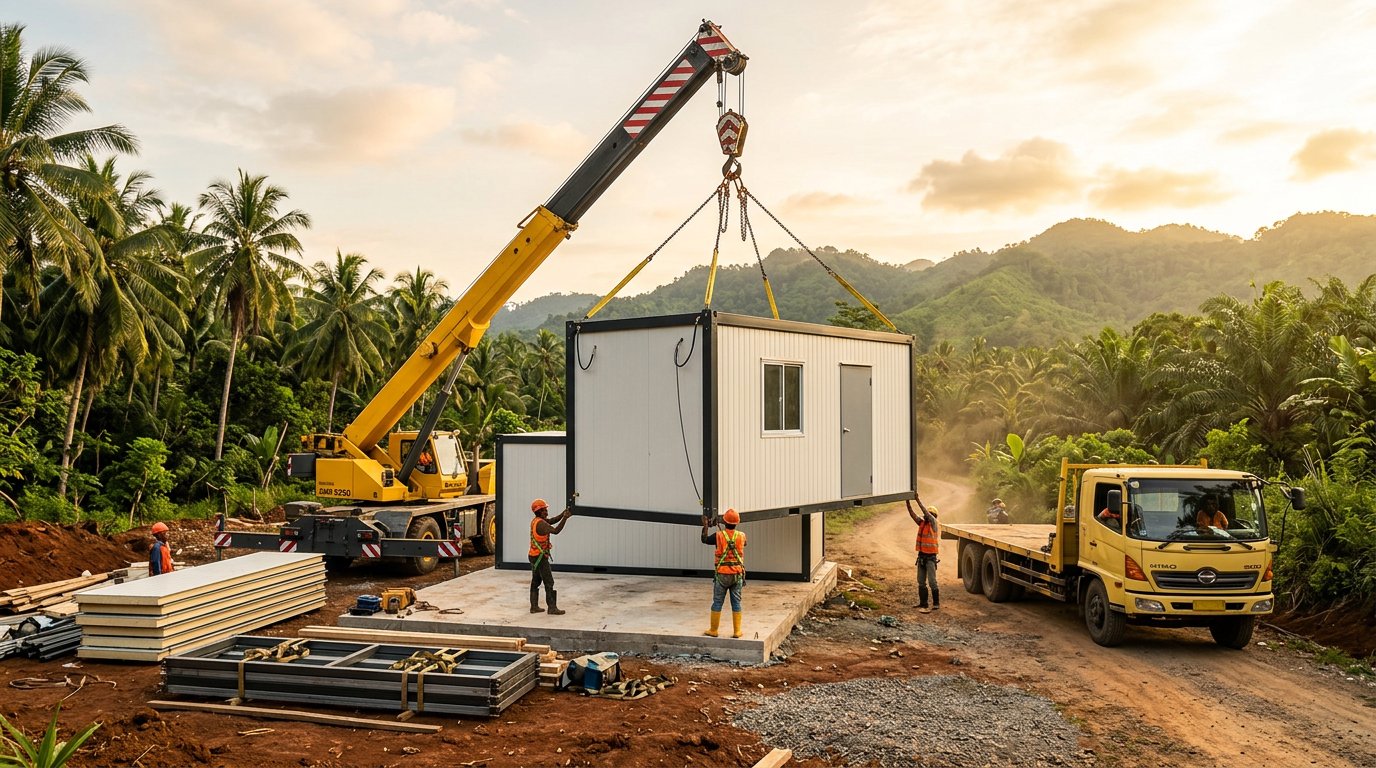
The welded version arrives whole and is usable as soon as it is set down. The trade-offs follow: oversize cargo, higher trailer and permit costs, lifting gear at the unloading point. For sites with narrow lanes, tight corners or weak village bridges, knock-down is almost always cheaper.
Preparing Road Access and the Site Before the Truck Leaves
A site survey is not a formality. Most expensive delays trace back to one small detail nobody checked before dispatch. Verify and photograph the following first:
- The narrowest point of the access road, including corner radius and gate width.
- Power lines, telecom cables and tree branches hanging below 4.2 metres.
- The capacity of any bridge or culvert on the final stretch to the plot.
- Soil bearing capacity and how level the ground is at the placement point.
- Turning space for the truck and standing space for a crane if the unit ships whole.
- Whether the local foundation, usually a concrete pad or footplate, has cured.
Foundations and permits run on their own sequence and often proceed in parallel with production. PBG requirements, the SIMBG submission route and the usual foundation types are covered separately in our guide to modular house permits and foundations.
Freight estimates get far more accurate once your unit size, options and exact site are fixed. Our team can send the current pricelist, help adapt the floor plan, and schedule a site survey to assess road access. Start from the sandwichpanels.id contact page.
Cranes, Lifting Gear and Mobilisation Costs
When a unit ships whole, crane capacity is set by unit weight together with lift radius. A large radius, because the crane cannot stand close to the placement point, often forces the next capacity class. Take the unit weight from the quotation, not from an estimate.
As a market reference, PT Indo Crane Pratama's price list shows a 10-tonne mobile crane at around Rp5,000,000 per 8 hours, 20 tonnes at Rp6,900,000, 30 tonnes at Rp7,500,000 and 50 tonnes at Rp11,000,000 per 8 hours. A 25-tonne rough terrain crane is listed at Rp7,000,000 per shift.
The notes under that list matter more than the headline rates: prices exclude mobilisation and demobilisation, fuel and operator meals, and that provider states a 200-hour minimum hire. Another provider in Bekasi quotes from roughly Rp2,500,000 per shift for small classes. Ask for a quote that prices mob-demob explicitly.
Inter-Island Shipping: Transit Times and Cost Ranges
For destinations outside Java, knock-down loads usually travel as container cargo. The 20-foot FCL tariffs published by LSJ Container in July 2026 work as a starting benchmark, with the caveat that final pricing follows addresses, volume, vessel schedules and trucking access.
| Destination from Jakarta | Estimated transit | 20-foot reference rate |
|---|---|---|
| Palembang | 5-7 days | Rp13.6 million |
| Makassar | 8-12 days | Rp18.8 million |
| Balikpapan | 7-10 days | Rp20.0 million |
| Jayapura | 16-22 days | Rp29.5 million |
Two further factors shape the arrival date. First, the freight movement restrictions set jointly by the Transport Ministry, the national traffic police and the Public Works Ministry around Eid and the Christmas and New Year period. Second, inter-island sailings are not daily, so order early if your move-in target falls near those windows.
Schedule compression remains modular's headline advantage. McKinsey's report Modular construction: From projects to products puts the saving at 20 to 50 percent of project time for housing against conventional methods. The cost comparison is set out in our sandwich panel house review.
Request a Pricelist, Floor Plan Consultation and Site Survey
A firm Smart Modular House price can only come from a quotation, because it depends on size, panel choice, options such as an internal toilet, air conditioning, stairs, a canopy or a biotech septic tank, and, most relevant here, the distance and access to your site.
Send us your location and intended use, whether that is a home, villa, homestay, staff quarters, site office or retail kiosk, through our contact page. We will prepare a pricelist, discuss the floor plan and arrange a site survey before production starts.
FAQ
Does a modular house always need a crane during installation?
No. Knock-down units are assembled on site from bolted panels and frame members, so light lifting gear and an installation crew are enough. A crane is mainly needed for welded units that arrive whole and are lifted by their corner fittings into position.
How long do delivery and installation take?
Transit time depends mostly on the destination. LSJ Container's July 2026 tariffs estimate 5 to 7 days for Jakarta to Palembang and 16 to 22 days for Jakarta to Jayapura. Production and assembly durations are separate and appear in the quotation schedule.
Who arranges the road dispensation when a unit ships whole?
Usually the transport provider, because the technical recommendation is issued by the National Road Implementation Agency for national roads and by regional road authorities for other sections. Put that responsibility in the delivery contract, including its cost and processing time.