

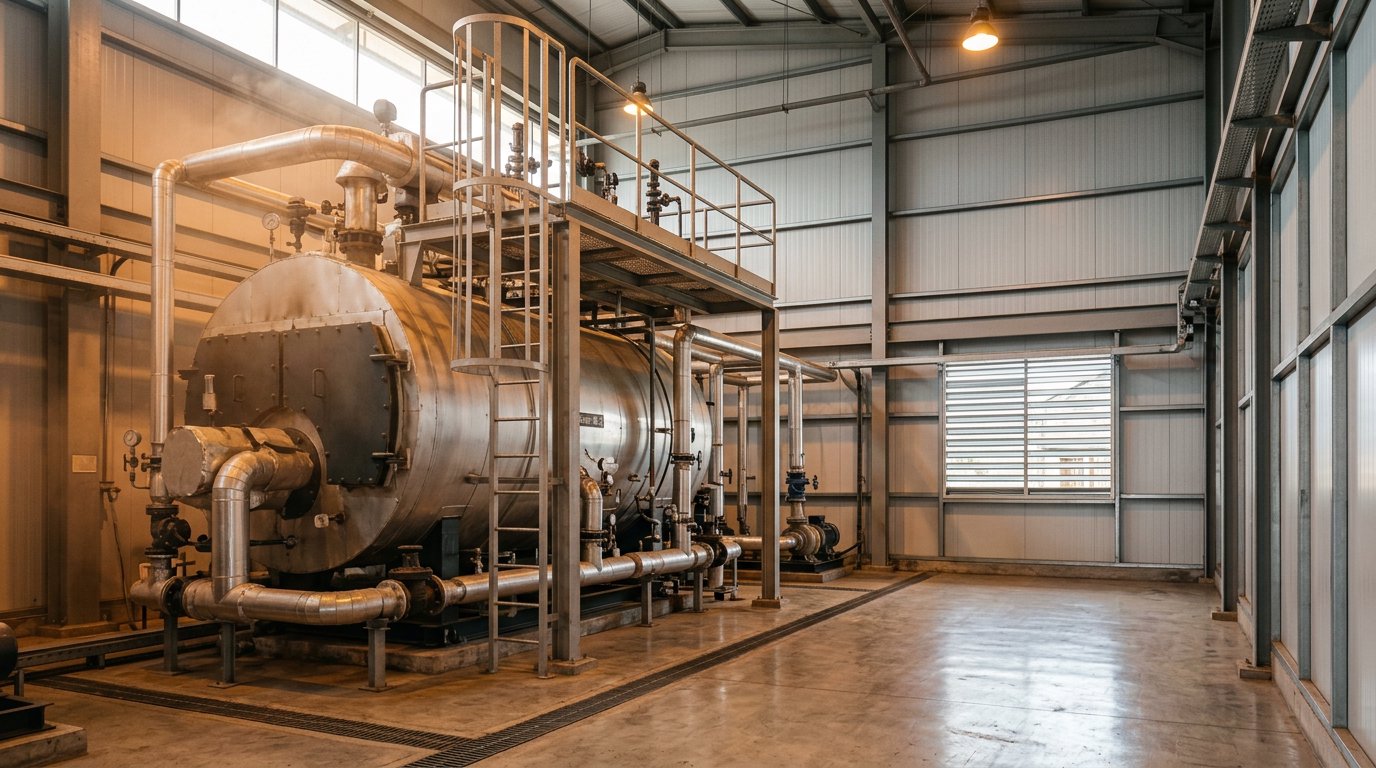
A boiler house is usually the hottest, loudest and most heavily inspected room in a factory. The question that reaches us is short: which panel may be used for its walls, how thick, and how many minutes of fire resistance. An honest answer needs three separate document trails, and one number that turns out not to exist at all.
Which rules actually govern a boiler room
Indonesia still regulates steam boilers through two 1930 documents: the Steam Ordinance (Staatsblad 225/1930) and the Steam Regulation (Staatsblad 339/1930). The JDIH Kemnaker catalogue still lists both as in force. Ministerial regulation Per-01/MEN/1988 on steam plant operator qualifications also cites those two documents as its legal basis.
Regulation 37 of 2016 is often quoted for boilers, yet its scope covers pressure vessels and storage tanks instead. The BPK record notes that several of its articles were revoked by regulation 11 of 2026, while other copies list no revocation at all. We do not pick a version: take the status from JDIH Kemnaker before any specification is written.
Boiler room fire resistance: two numbers that collide
The foreign references in circulation openly contradict each other. A Wisconsin state building FAQ citing IBC Table 509 says a boiler room above 15 psi and 10 horsepower needs either a one hour separation or an automatic extinguishing system. A supplier article instead claims two hours under NFPA 85 and NFPA 101 for boilers above 400,000 BTU per hour.
We do not choose between them: the number that binds your project sits in the building fire protection design and in the local permit review. Ask for it first, then select core and thickness.
A2-s1,d0 is not EI: two standards that get swapped
Two different questions are often answered with one figure. EN 13501-1 rates reaction to fire, meaning how much a material feeds a fire; stone wool core wall panels are usually classified A2-s1,d0, that is, non-combustible. EN 13501-2 rates something else entirely: the fire resistance of the wall assembly, expressed as EI in minutes from an EN 1364-1 test.
Rockwool specification notes give indicative benchmarks of EI 60 from 80 mm and EI 120 from 120 mm, while stating themselves that the figures differ between manufacturers. A thickness of 100 mm therefore falls between the two benchmarks. The binding number exists only in the classification report of the tested product, never in a brochure.
Ask for the following before you sign an order:
- The EN 13501-2 classification report for the exact product and thickness being shipped
- The span, orientation and exposure direction used when that panel was tested
- Joint, fastener and sealant details as built into the test specimen
Service temperature: the number missing from panel datasheets
Our survey of publicly available datasheets found no sandwich panel that publishes a continuous service temperature. The figures of 650 degrees Celsius (ASTM C411/C447), 500 degrees (EN 14706 on ProRox SL 960) and 250 degrees on a stone wool blanket all belong to technical insulation for boiler shells, furnaces and pipework. One felt datasheet prints two numbers at once: 250 degrees for the wool, but 80 degrees for the faced side.
That 80 degree figure is the real key. What limits a panel is not its core but the facing paint, the adhesive and the joint sealant. This is why panels are installed as a room enclosure at a safe distance from hot surfaces, rather than fixed against a boiler shell or a flue.
A wall specification that makes sense for a boiler room
For boiler rooms we steer buyers towards a stone wool core rather than EPS or PIR. The reason is not that unpublished service temperature but the reaction to fire class and the behaviour of the core in a real fire. Our panel line is available from 50 to 150 mm for every core, and the EI figure requested by the designer decides which thickness applies.
- Stone wool core with an A2 reaction to fire class taken from a test report, not a catalogue
- Thickness of 50-150 mm, chosen from the EI figure your designer requires
- Steel facing of 0.3-0.5 mm, with coating selected by ISO 12944 corrosion category
- Sealant and joint accessories rated for the working temperature of the room
Cost ranges from a public price list survey
Our survey of public supplier price lists between June and August 2026 recorded 75 mm stone wool core panels at around IDR 485,000 per linear metre at a 1,050 mm cover width. Since one linear metre equals 1.05 square metres, that is roughly IDR 462,000 per sqm for the panel sheet alone.
- 75 mm stone wool core panel: about IDR 462,000 per sqm equivalent, sheet only
- PU core panel installed at 50-75 mm: IDR 350,000 to 550,000 per sqm
- Installation labour without material: IDR 150,000 to 230,000 per sqm
- Flashing, heat rated sealant, doors and supporting framework are all extra
Some things are outside this product line
Insulating the boiler shell, steam pipework and flue is mechanical contractor work using lagging materials such as calcium silicate or technical stone wool. Combustion air, room heat ventilation, feedwater treatment, the concrete floor and its bund, and heat resistant electrical installation also sit outside our scope.
Our panel line covers external walls, partitions and room ceilings; we do not sell roof panels. A boiler room is almost always built inside a factory or utility building whose roof already stands, so what you buy really is the walls and partitions. A comparable utility room is covered in our electrical and transformer room guide.
FAQ: Frequently asked questions
How thick should a boiler room wall panel be?
No single figure is right for every project. Thickness follows the EI number your building fire protection designer requires, matched against the EN 13501-2 classification report of the product being shipped. Indicative manufacturer benchmarks put EI 60 from 80 mm and EI 120 from 120 mm; our line stops at 150 mm.
May panels be fixed directly onto the boiler shell?
No. A panel is a room enclosure, not hot surface insulation. The limit comes from the facing paint, the adhesive and the joint sealant rather than the core, and one faced stone wool datasheet even states an 80 degree Celsius limit on its faced side. Boiler shell insulation uses lagging from the mechanical package instead.
Next step
If your boiler room is in design or renovation, send us the EI figure from your fire protection designer, the room dimensions and the wall height. Our team will put together a panel, accessory and sealant specification and return a quotation. Start a consultation about your project through the sandwichpanels.id contact page.