

Bakery and biscuit plants rarely fail because the walls were not good enough. They fail because of one decision made too fast: using a single panel specification for the whole building. The dough area, the oven bay, and the cooling and packing rooms carry different loads, so a panel that fits one zone can be wrong next door.
Demand is growing. The Indonesian flour millers association expects national wheat flour consumption to reach 7.82 million tonnes in 2026, about 5 percent above the 7.41 million tonnes recorded in 2025. Statistics Indonesia put bread and pastry exports at 400 million US dollars for January to June 2025, with China the largest destination at 63.5 million dollars.
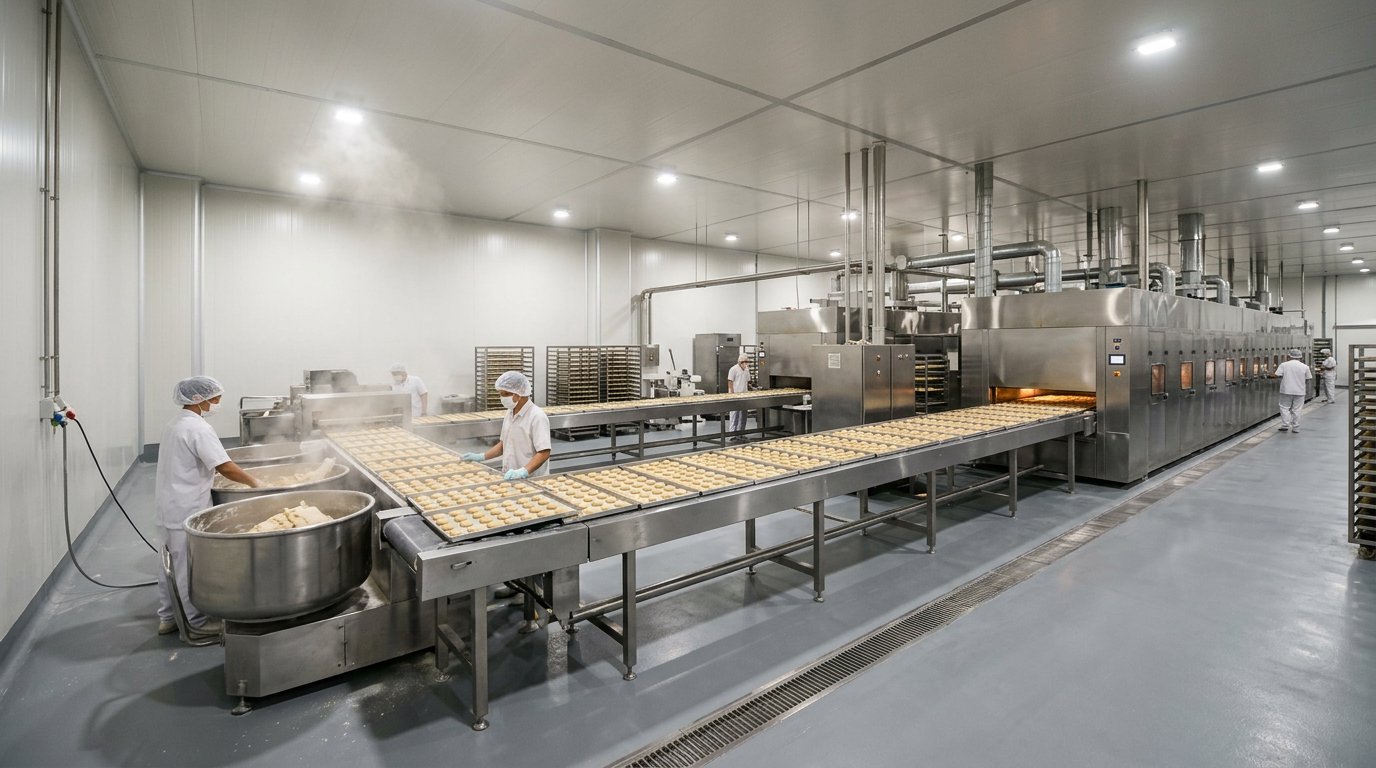
How we set core and thickness per zone
Our quoting sequence is simple: map the design temperature, the cleaning method, and the trolley traffic of each room first, then choose the core and thickness. Our panel line runs from 50 to 150 millimetres, and almost every bakery requirement lands between 50 and 100 millimetres.
Dough room: flour dust drives the joint detail
Wheat flour dust is combustible and sits in class St1 under the Kst classification. Published severity figures disagree: the GESTIS-DUST-EX database lists 41 and 59 bar metre per second for two samples, a conference handout gives 87, and an industry article cites 112. Minimum ignition energy is usually quoted around 50 to 60 millijoules.
Because the spread is wide and strongly driven by particle size, do not design from those secondary numbers. Have your own flour sample tested under the EN 14034 series or use an official database, then hand the result to whoever designs dust extraction and explosion protection. What the wall decides is something else: where dust can settle.
Bakery fire analyses single out dust resting on horizontal ledges above ovens and on roof framing as a fire source and a secondary explosion hazard. Flush panel ceilings and tight panel joints remove those shelves. That is why we push for a full panel ceiling in the dough room rather than open framing with plates.
Oven bay: service temperature limits that contradict each other
Every core has a service temperature limit, and this is where public sources collide. One technical source puts EPS near 80 degrees Celsius and PIR near 120 degrees, while a vendor brochure claims PIR holds 230 to 250 degrees. Mineral wool is described as tolerating far more, with Euroclass A1 or A2 reaction to fire.
A gap that wide is not a detail. Ask for the manufacturer datasheet stating maximum service temperature, plus the EN 13501-1 reaction to fire report for the panel that will actually be delivered, not a generic table from any website. For walls next to a tunnel oven we recommend a rockwool core and the clearance the oven maker specifies.
Cooling and packing: the real issue is condensation
Biscuits leaving the oven release heat and moisture. If the cooling or packing room is chilled, the dew point can land on wall and ceiling surfaces. Panels with a 75 to 100 millimetre core, tightly insulated joints, and coated steel faces that dry quickly reduce that risk compared with rendered masonry.
Which document governs your walls
Good manufacturing practice for processed food sits in Ministry of Industry regulation 75/M-IND/PER/7/2010, still in force according to the ministry legal database. That is where the building clauses live: wall and partition construction must be durable, easy to clean and disinfect, free of sharp internal angles, and made of non-toxic material.
One point is widely missed. The text uses three levels of obligation: must, should, and may. The clause on production room walls reaching at least two metres from the floor sits in the should category, so it is guidance rather than a legal duty. We set out food grade surface requirements in more detail in our food grade wall guide.
The biscuit SNI governs product quality, not construction, and its edition status is messier than consultancy sites suggest. Regulation 60/M-IND/PER/7/2015, amended by 96/M-IND/PER/11/2015, made SNI 2973:2011 mandatory, and some sources say enforcement was once deferred by circular. Regulation 11/2020 refers to SNI 2973:2018 or its revision, while the current edition in circulation is SNI 2973:2022. We found no rule naming the 2022 edition as mandatory, so verify with the ministry legal database and the national standards body before repeating that claim.
Market cost ranges and how to budget
The figures below are public market ranges from commercial sources, not our quotation, and they move with steel prices and project location.
- EPS installed: 50 mm about 250,000-350,000 rupiah per sqm, 75 mm 300,000-400,000.
- PU installed: 50 mm about 350,000-500,000 rupiah per sqm, 75 mm 400,000-550,000.
- Rockwool 50 mm about 400,000-550,000 rupiah per sqm, usually chosen for the oven bay and fire separating walls.
- Installing standard walls costs about 60,000-120,000 rupiah per sqm, high precision chilled rooms 150,000-250,000.
A rough example for a 12 by 8 metre dough room with 4 metre clear height: roughly 160 sqm of wall plus 96 sqm of ceiling, about 256 sqm in total. With EPS 50 mm installed that lands around 64 to 90 million rupiah before doors, accessories and floor works.
What this panel line does not cover
The following sits outside the panel scope and belongs with other suppliers: epoxy floors and drainage, the ovens plus air handling and dehumidification, dust extraction with explosion venting, pest control, scales and packing machinery, and trolley impact protection.
Our line is external walls, partitions and room ceilings, and we do not sell roof panels. In bakery projects that is rarely a problem, because dough, oven and packing rooms are usually built inside a factory building whose roof already stands, so what you buy really is partitions and ceilings.
FAQ: Frequently asked questions
Can an EPS core panel be used in the oven bay?
For walls directly facing an oven we do not recommend it. The published service temperature limit for EPS is the lowest of all cores, and vendor figures for PIR contradict each other. Choose rockwool in that zone, then ask for the service temperature datasheet and the EN 13501-1 test report for the panel being shipped.
How thick should panels be for a biscuit packing room?
Most projects settle at 75 to 100 millimetres where the room is chilled, and 50 millimetres for a dry partition without cooling. More decisive than thickness is joint tightness and the detailing where walls meet floor and ceiling, because that is where condensation and dust collect.
Request a quotation for your production rooms
Send us the zone layout, design temperatures and cleaning method for each room, and we will map core and thickness per zone with an indicative cost. Discuss your bakery or biscuit plant requirement and request a quotation through our contact page.