

Sugar is one of the most moisture-sensitive commodities a food plant handles. Once room humidity climbs, crystals absorb water vapour, clump, and set into hard lumps that jam bagging lines. That is why sugar packing rooms and warehouses need walls and ceilings that are vapour-tight, flush, and easy to clean, not merely partitions between work areas.
Demand is rising. Indonesia's Ministry of Agriculture targets three million tonnes of consumption-grade sugar in 2026, while other reporting cites 3.04 million tonnes for white crystal sugar. Both figures circulate at once, so use official documents if you need one for a feasibility study. What is firmer: the government says ten sugar mills will be built or reactivated.
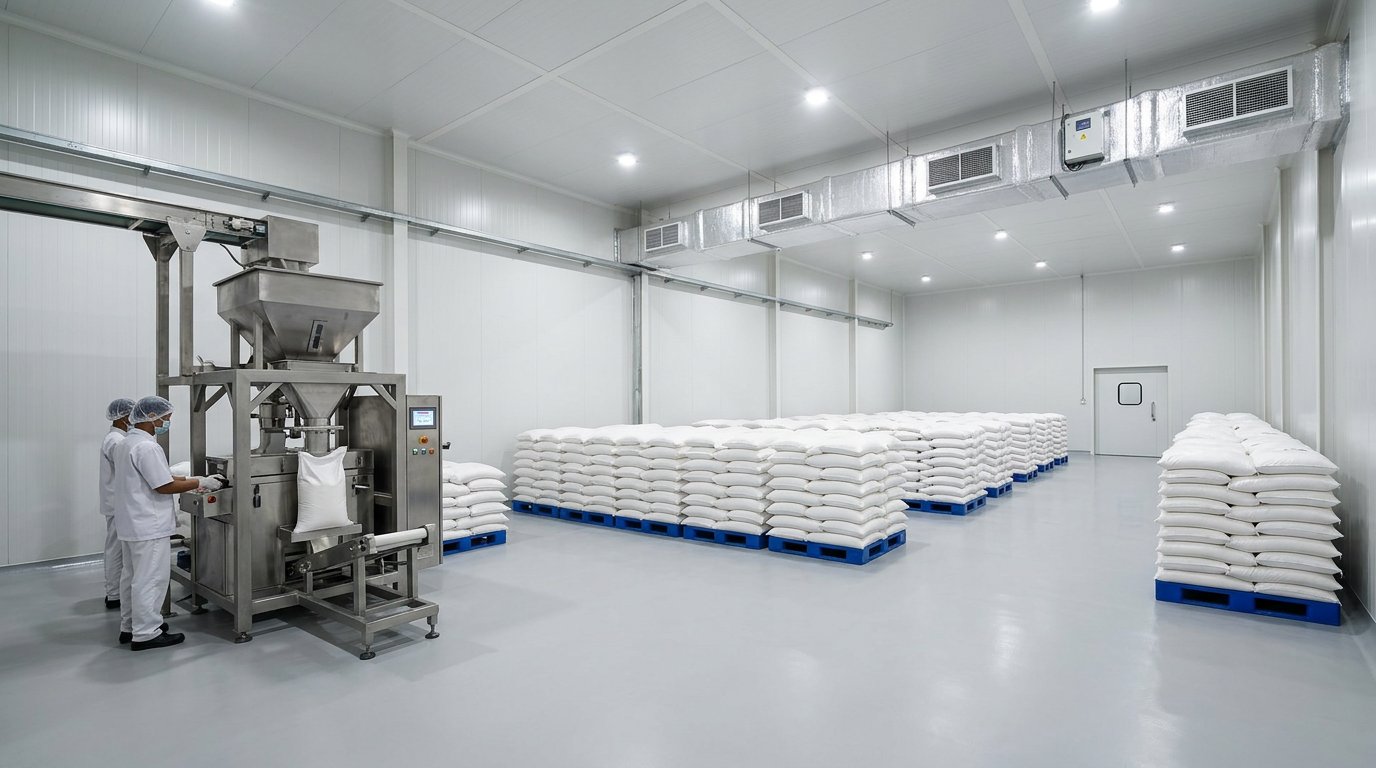
Sugar pulls water out of the air, and the envelope decides how fast
Storage research describes caking as a chain of events. Crystals take up water once humidity passes their critical moisture content, crystal surfaces dissolve into a thin film that bridges neighbouring particles, and those liquid bridges harden again as the air dries. Sugar logistics sources put the onset of noticeable uptake above roughly 60 to 65 percent relative humidity. No binding Indonesian limit for warehouse humidity emerged in our research, so treat any target you adopt as your own design parameter.
Which SNI is mandatory: refined sugar is not white crystal sugar
This is the most common slip in tender documents: writing "sugar SNI" without naming the part and edition. The mandatory standard for refined crystal sugar comes from Industry Ministry Regulation 2 of 2025, which makes SNI 3140.2:2018 compulsory. It was issued on 17 January 2025, took effect on 24 July 2025, and revoked Regulation 83/M-IND/PER/11/2008.
Two cautions. First, Regulation 2 of 2025 has already been amended by Regulation 4 of 2026, and we could not open the amending text, so do not copy clauses from the 2025 version without checking the official legal database. Second, the obligation attaches to the sugar product itself, not to the building materials of the room.
For consumption-grade white crystal sugar the standard number differs again, and its edition is not single. The national standards information system lists SNI 3140.3:2010, while the standards sales catalogue lists SNI 3140-3:2020. If you are drafting specifications, name the edition you rely on explicitly and ask suppliers to confirm the same one.
Panel specification for sugar packing rooms and warehouses
The following is our catalogue practice for dry packing rooms, not a quotation from regulation. Adjust it to the temperature and humidity targets you have fixed in the contract.
- Core: EPS for partitions and ceilings in ambient dry rooms; PU or PIR where the room is actively dehumidified or cooled, because insulation value per millimetre is higher; rockwool where fire separation between areas is the requirement.
- Thickness: our line runs 50 to 150 mm across every core. Fifty to 75 mm suits partitions and ceilings in ambient packing rooms; 100 to 150 mm is used when the room is conditioned or held at low temperature.
- Steel skin: ask for base metal thickness stated separately from the paint system, and pick a coating that matches exposure, polyester indoors or PVDF where there is outdoor exposure.
- Joints: a flush interior face with no open gaps, joints closed with food-grade sealant, and coved profiles at wall-to-floor and wall-to-ceiling junctions so sugar dust cannot settle.
Reading the GMP wording: must, should, and may
Indonesia's good manufacturing practice guideline for processed food sits in Industry Ministry Regulation 75/M-IND/PER/7/2010, still in force according to the ministry's legal database. It requires walls and room dividers to be durable and to meet food hygiene, meaning easy to clean and disinfect. Other clauses cite a production room wall height of at least two metres and junctions without sharp corners.
What readers often miss is that the text uses three levels of obligation: must, should, and may. A clause written as "should" is a recommendation, not a duty. When an auditor and a contractor disagree, that single word decides who carries the cost. Check the wording in the original text before you pull a clause into the scope of work.
Worth knowing too: food packing rooms are not required to hold a cleanroom cleanliness class, and figures such as a 30 millimetre cove radius come from service providers as catalogue practice, not from regulation.
Market cost ranges per square metre in 2026
Public 2026 price guides give a rough picture for installed panel per sqm: EPS 50 mm around IDR 250,000 to 350,000, EPS 75 mm 300,000 to 400,000, PU 50 mm 350,000 to 500,000, PU 75 mm 400,000 to 550,000, and rockwool 50 mm 400,000 to 550,000.
Installation in the same sources runs about IDR 60,000 to 120,000 per square metre for standard walls, rising to 150,000 to 250,000 for high-precision work such as cold storage. We break the components down in our sandwich panel price per metre guide.
Treat all of these as market ranges, never as a quotation. Real pricing moves with base metal thickness, coating system, panel length, and delivery distance.
What we state plainly is out of scope
Some things are not this product line's business, and it is better to say so plainly. Our line is wall panels, partitions, and room ceilings. We do not sell roof panels, so long-span roof structures and canopies are handled by separate roofing materials outside this line.
Also outside scope: floors and foundations, drainage, dehumidifiers, bagging machinery, and forklift impact protection. For a packing room inside a building that already has a roof, what you buy really is partitions and a ceiling.
FAQ: Frequently asked questions
How thick should panels be for a sugar warehouse that is only dehumidified, not cooled?
For an ambient warehouse kept dry by dehumidifiers, 50 to 75 mm is usually adequate for partitions and ceilings. Thickness rises to 100 to 150 mm when the room is conditioned at a lower temperature or the gap to outdoor air is large, because the real target is keeping interior surfaces above the dew point.
Can EPS panels be used in a sugar packing room?
Yes, provided the face is flush and easy to clean, joints are sealed, and the room does not require fire separation. The more decisive questions are usually joint quality, corner profiles, and the base metal thickness of the steel skin.
Next step
If you are planning a new sugar mill, a reactivation, or simply fixing a warehouse where the product keeps caking, send us room dimensions, target temperature and humidity, and the project schedule. Our team will help shape the wall, partition, and ceiling specification, then prepare a quotation. Please discuss your requirements and request a quote here.