

A compressor room is the one factory utility space that carries two demands pulling in opposite directions. An air-cooled compressor rejects almost all of its motor energy as heat into the room air, so it demands very large ventilation openings. At the same time the plant owner wants that room sealed, so its noise does not reach the work areas around it.
The numbers that separate the two cases are blunt. An air-cooled unit rejects close to 100 percent of motor energy into the room, while a water-cooled unit rejects only about 10 percent. Atlas Copco's compressor room design guidance works from the same basis. The cooling choice, not panel thickness, sets how large a hole must be cut in the wall.
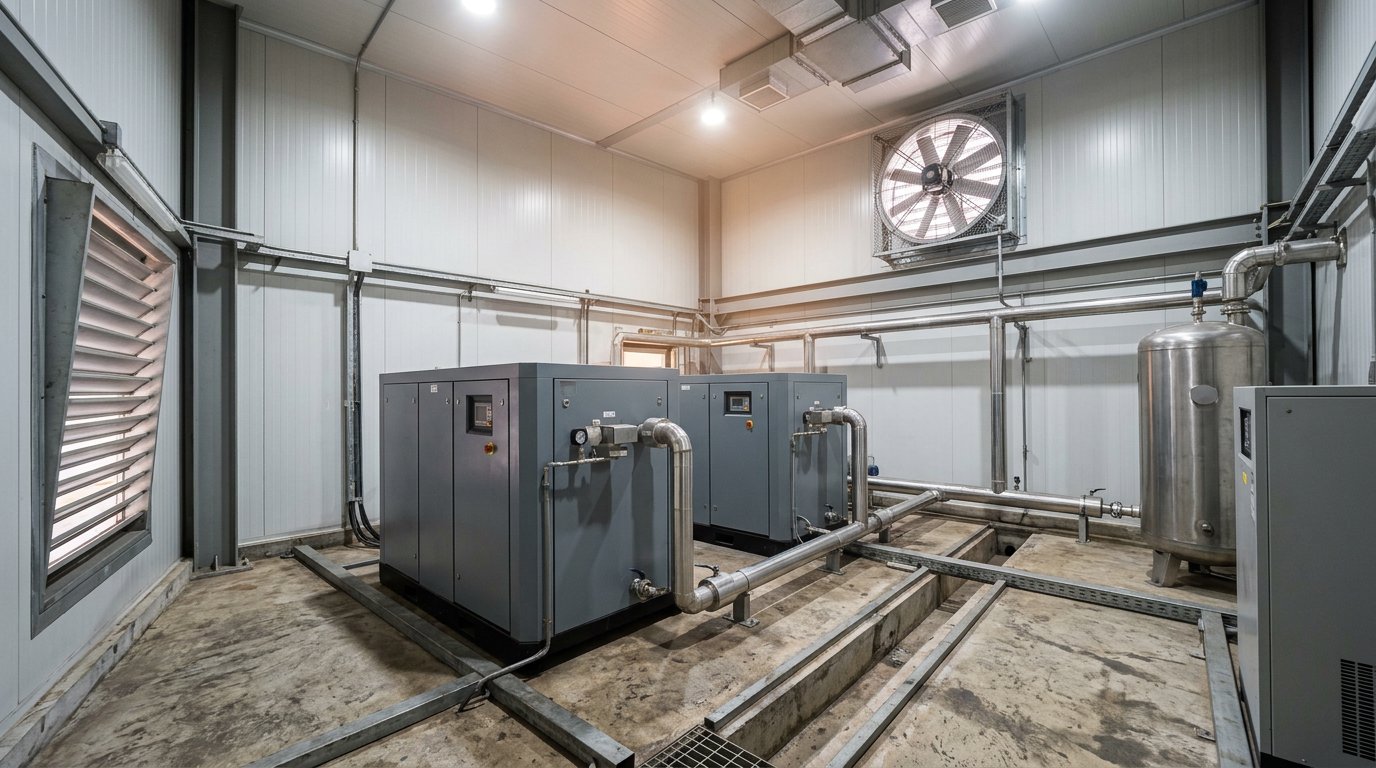
That is where acoustics lose. An opening of just one percent of the wall area already caps combined wall performance in the region of 20 dB, whatever Rw figure the panel data sheet shows. The answer is therefore not a thicker panel, but acoustic louvres and lined ductwork with turns in it.
Size the ventilation first, choose the panel second
The correct order of work starts with airflow, not with a panel catalogue. Airflow is estimated by dividing the heat load by the product of air density, specific heat, and the target temperature rise. The figures in the table below are our own design estimates using a density of 1.2 kg/m3 and a specific heat of 1.005 kJ/kg.K, not manufacturer test data.
| Compressor | Temperature rise | Airflow | Net free opening |
|---|---|---|---|
| 37 kW screw, air | 10 C | ~11,000 m3/h | ~0.76 m2 |
| 75 kW screw, air | 10 C | ~22,400 m3/h | ~1.55 m2 |
| 75 kW screw, air | 7 C | ~32,000 m3/h | ~2.2 m2 |
| 160 kW screw, air | 10 C | ~47,700 m3/h | ~3.3 m2 |
| 75 kW screw, water | 10 C | ~2,240 m3/h | ~0.16 m2 |
The net opening areas above apply an intake air velocity limit of 4 m/s. Louvres and weather screens typically leave only about half the area free, so the 75 kW case needing 1.55 m2 net actually calls for a rough opening of around 3 m2 in the panel wall. That is the figure which drives the wall design.
Room temperature and what poor ventilation costs
Machine manufacturer guidance recommends keeping the compressor room between 10 and 29 degrees Celsius, with the ventilation volume chosen so the room temperature rise stays within 7 to 10 degrees. Tightening that target from 10 to 7 degrees raises the airflow requirement by roughly 43 percent at the same power.
When ventilation falls short, the losses arrive in sequence and they are expensive:
- compressor output drops because hot intake air is less dense;
- units trip out on their own thermal protection;
- dryer, filter, and oil separator efficiency falls;
- wear on bearings, motor, lubricant, and seals accelerates.
The right panel specification
For a compressor room a rockwool core is the sensible choice, because it delivers mass, damping, and better reaction to fire than an EPS or PIR core. The thicknesses we install for walls, partitions, and ceilings run from 50 to 150 mm. Our own U-value calculations to ISO 6946 give 0.70 at 50 mm and 0.26 W/m2K at 150 mm.
On the acoustic numbers, an ordinary sandwich wall panel sits in the Rw 25 to 32 dB range, with rockwool cores at the upper end. An acoustic panel with a perforated inner liner and rockwool at 48 to 64 kg/m3 reaches around Rw 34 dB with absorption approaching 1.00. Those Rw figures refer to ISO 10140-2 and ISO 717-1.
Do not mix Rw and STC in one comparison table. STC is the North American equivalent under ASTM E90 and E413, and its weighting algorithm is different. Ask the vendor to name the test standard alongside the number, rather than claiming soundproofing in general terms.
Our product line covers wall, partition, and ceiling panels for rooms. We do not offer roof panels for this application.
The details that decide pass or fail
The most common failure in a machine room is not the panel but the joints and openings left untreated. The fan is best mounted high on one end wall with the intake opening on the opposite wall, controlled by a thermostat, and sized to carry the pressure loss of the ductwork and the external wall louvre.
- ductwork with at least two 90 degree turns, lined internally with at least 5 cm of rockwool;
- acoustic louvres with angled blades, not a straight screen;
- cable and pipe penetrations sealed tight, door gaps fitted with gaskets;
- a floor drain for condensate from compressor, aftercooler, air receiver, and dryer;
- enough spacing between units that one unit's discharge does not enter another's intake.
Cost, and how to request comparable quotations
From our June to August 2026 price survey, 75 mm rockwool panel sits around Rp485,000 per running metre at a 1,050 mm cover width, equivalent to about Rp462,000 per m2. Installed PU panel at 50 to 75 mm runs Rp350,000 to Rp550,000 per m2, while installation labour without material is Rp150,000 to Rp230,000 per m2.
Those figures cover walls and ceilings only. Acoustic louvres, attenuators, acoustic doors, and vibration isolators are excluded, and in a compressor room those are precisely the components that decide the outcome. To make quotations comparable, ask each vendor for the following:
- declared noise figures to ISO 2151, together with the measurement distance;
- Rw test reports to ISO 10140-2 and ISO 717-1;
- rockwool density in kg/m3, not only the panel thickness;
- louvre free area as a percentage, so the rough opening can be calculated.
FAQ: Frequently asked questions
Is a sandwich panel alone enough to bring a compressor room within the 85 dB(A) exposure limit?
No. The panel contributes wall mass, but the ventilation openings that must exist cap combined performance in the region of 20 dB. Without acoustic louvres, lined ductwork with turns, gasketed doors, and sealed cable penetrations, the panel's Rw figure will not materialise on site.
How thick does a compressor room panel need to be?
The 50 to 150 mm range covers almost every case, and adding thickness returns steadily less. Raising the rockwool core density and improving how the openings are treated buys far more improvement per rupiah than thickening the panel does.
Next step
If you are planning a new compressor room or fixing one that is too loud, send us the compressor power, its cooling type, and the room dimensions. The closest comparison is our generator room article and the electrical room piece in the same utility cluster. Request a quotation through our contact page.