

The first question most modular house buyers in Indonesia ask is whether the unit can be paid off through a mortgage. The answer is not a simple yes or no. Indonesian banks do not sell a product called a modular house mortgage, but several credit lines are routinely used to fund building a house on land you already own, including container-type modular units.
This guide summarises the realistic routes in 2026, the documents banks ask for, and the legal groundwork to settle first. Every figure below comes from official bank pages or current regulations.
Banks finance land and buildings, not the box
The key lies in security law. Law Number 4 of 1996 on Mortgage Rights, Article 4 paragraph (4), states that a mortgage right may be imposed on land rights together with buildings that form a single unit with the land and belong to the holder of those land rights, provided this is stated expressly in the deed of mortgage.
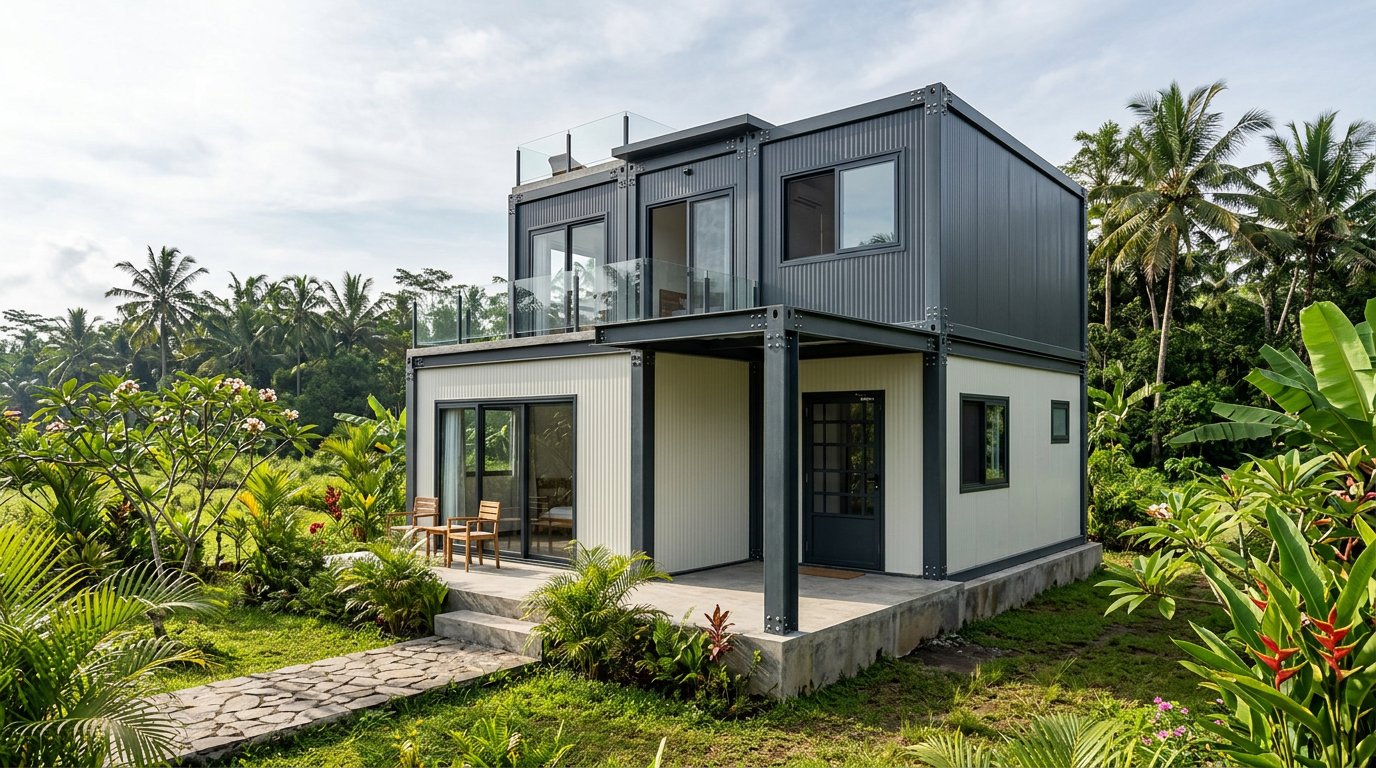
In practice the primary collateral is certified land, and the building follows only when it is united with that land. A modular unit standing on a concrete foundation, connected to utilities and not meant to be relocated, fits this framework far better than a unit simply parked on a plot.
For objects that cannot carry a mortgage right, Law Number 42 of 1999 provides fiduciary security, covering movable goods and buildings that cannot be encumbered with a mortgage right, with the object remaining in the debtor's possession. That scheme is more common for business assets than for homes.
Four financing routes used in practice
These are the routes landowners use most often in 2026, with the caveat that every approval still rests on each bank's own credit analysis:
- Commercial home-building credit (KBR). BTN describes this product as a facility for building a house on your own land, with a term of up to 10 years. Its official FAQ states that disbursement is staged and capped at 70 percent of the bank's appraisal of the budget of works, provided construction progress has reached at least 30 percent of that budget.
- KBR Tapera for civil servants enrolled in Tapera. The BTN product page lists a fixed rate of 5 percent until settlement, a term of up to 20 years, and zone-based limits: Rp132 million for Zone 1, which covers 32 provinces including all of Java, and Rp171 million for Zone 2, the six provinces in Papua. Applicants and spouses must not already own a home, and the ceiling follows the budget of works.
- Property-backed or multipurpose loans. This route pledges an existing land or house certificate and leaves the use of funds open, including buying a modular unit. Rates run higher than subsidised housing credit, but disbursement is not tied to construction progress.
- KUR for units used commercially. The government set the 2026 people's business credit ceiling at Rp308.41 trillion, up from Rp270.08 trillion actually disbursed in 2025, with a flat 6 percent annual rate and the cap on application frequency removed. The figures were given by Ferry Irawan, a deputy at the Coordinating Ministry for Economic Affairs, on 25 February 2026 and reported by Kompas.com. Within that ceiling sits a housing programme worth Rp28.1 trillion for 65,627 borrowers.
The fourth route matters when the unit serves as a kiosk, a site office or rental housing. We work through the revenue side in our article on modular boarding houses.
Before you calculate instalments you need firm numbers. Our team can send the current pricelist, adapt a floor plan to the size of your plot, and schedule a site survey through the sandwichpanels.id contact page, so the budget you bring to the bank rests on a real quotation.
Building a budget and floor plan the bank will accept
Two documents decide most applications: the budget of works and the floor plan. The BTN KBR Tapera document list names the applicant and spouse identity cards, three months of payslips, three months of bank statements, proof of land title, a photograph of the land in its initial condition, the budget and house drawings, and a copy of the building permit.
A modular budget should separate five items: earthworks and foundation, the unit itself with delivery, unloading or crane hire, electricity and water connections, and yard works. That split lets the bank's appraiser match each disbursement to visible progress on site.
As a market benchmark, published price lists from prefabricated housing suppliers in Indonesia in 2026 run from about Rp2 million to Rp3.5 million per square metre for single-storey units, widening to roughly Rp8 million per square metre for high specifications.
Legal groundwork: title, building permit and knock-down status
Banks want a certificate in the applicant's name, usually freehold or right-to-build title. Undivided inherited land or a certificate still in a parent's name has to be resolved first, because only the rights holder can sign a deed of mortgage.
A building permit is still required even where bank forms use the older term IMB. Since Government Regulation Number 16 of 2021 the permit takes the form of a building approval processed through the SIMBG portal, while its levy is governed by Law Number 1 of 2022. We set out the steps in our guide to modular house building permits.
Knock-down construction is not an obstacle as long as the technical file is clear: shop drawings, panel specifications and a foundation plan. Smart Modular House units use a bolted galvanised steel frame with corner fittings at every corner, EPS or fire-resistant rockwool sandwich panel walls, and fibre cement board flooring, so the specification translates directly into budget lines.
Next step: pricelist, floor plan and site survey
Banks do not assess brochures; they assess numbers. The fastest sequence is to obtain a written quotation first, build the budget from it, and only then apply for credit. We do not publish unit prices here because the catalogue changes and excludes tax, installation and delivery.
Contact us through the contact page to request the Smart Modular House pricelist, discuss a floor plan for your plot, and arrange a site survey. Our factory team in Cikarang can prepare the details loan officers usually ask for.
FAQ
Can a modular unit serve as the only collateral?
Usually not. Under Article 4 paragraph (4) of Law Number 4 of 1996, a mortgage right attaches to land rights together with buildings united with the land. Without certified land, banks almost always decline or steer applicants towards other schemes that carry higher interest.
How long does it take from application to a standing unit?
Credit analysis times differ by bank and depend on how complete your file is. What you can speed up is the technical side: certificate ready, the building permit processed in parallel, and a budget built from a formal quotation. Manufacturing and installing a modular unit is far quicker than conventional construction.
Do modular houses qualify for subsidised FLPP mortgages?
Subsidised mortgages fund the purchase of houses from registered developers, not self-building. To build on your own land the comparable scheme is home-building credit, including KBR Tapera for civil servants with its fixed 5 percent rate. Confirm current terms directly with the lending bank.