

Modular homes go up in weeks, and that speed is exactly why owners forget to ask how the unit will look in year ten. Service life for a container-type modular house is not a factory figure. It is set by the site, the steel coating specification, and a simple maintenance routine that has to be kept.
This guide turns that into a schedule an owner can follow, grounded in ISO 9223, EN 10169, EN 14509 and field exposure data from the West Java coast.
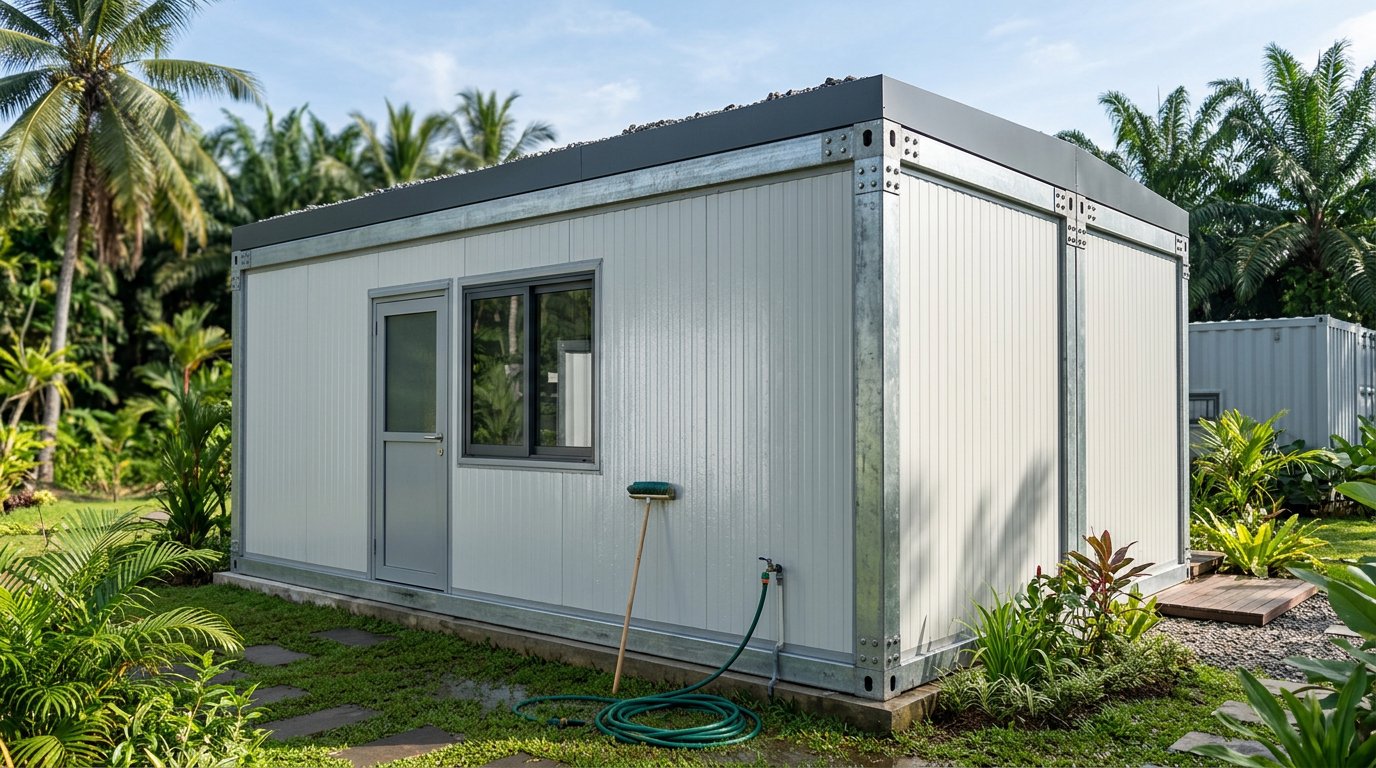
Three Layers of Defence Decide the Lifespan
A container-type unit such as the Smart Modular House built at our Cikarang plant has three systems that age at different rates. The bolted galvanised steel frame with corner fittings is the first layer. The envelope, sandwich panels in EPS density 10, fire-rated density 15 or rockwool, is the second. The joints, sealant, aluminium flashing and screws, form the third.
Failure almost always starts in the third layer. Cracked sealant and loose flashing let water reach panel edges and frame bolts, and corrosion works from the inside out. Maintaining a modular house is mostly about keeping joints tight, not repainting walls.
EN 14509, the European standard for metal-faced insulating panels, requires panels to keep their insulating capacity for at least five years, with a useful life of at least 25 years for the insulation material. That assumes the facing stays intact, which only holds if the joints are maintained.
Corrosion: Read Your Site Category First
ISO 9223:2012 sorts atmospheric corrosivity into categories C1 through CX using time of wetness, sulphur dioxide pollution and airborne salinity. It also gives first-year zinc corrosion rates per category, which remain the most honest tool for estimating how long a galvanised layer will last on frame and facing.
- C2 (rural, relatively dry): 0.1 to 0.7 micrometres of zinc per year.
- C3 (urban, light industry, humid tropics): 0.7 to 2.1 micrometres per year.
- C4 (industrial zones, moderately saline coast): 2.1 to 4.2 micrometres per year.
- C5 (heavy industry, high-salinity coast): 4.2 to 8.4 micrometres per year.
- CX (tropical marine, offshore): 8.4 to 25 micrometres per year.
The budget consequence is immediate. An industrial estate plot and a shoreline plot cannot share one coating specification even when the unit is identical. C4 and C5 consume zinc several times faster than C2.
Indonesian field data supports the picture. An exposure study on galvanised steel at Pelabuhan Ratu, West Java, recorded a corrosion rate of 0.64 mpy at day 27 easing to 0.12 mpy by day 76 as a protective corrosion-product layer formed, with a predicted zinc coating life of about 18 years at that location.
Choosing the Coating Class Early Costs Less
EN 10169, the standard for organic coated steel flat products, groups coating corrosion resistance into RC classes. Standard polyester at 25 microns sits low, around RC2 to RC3, while PVDF at 25 to 35 microns reaches RC4 and thicker PVDF reaches RC5. The price gap is small at purchase and large at the first repair round.
For C4 and C5 sites, raise the facing coating class and specify corrosion-resistant screws and flashings. Inland C2 and C3 sites usually manage with standard polyester.
Our team can help read the corrosivity category of your site before the unit is ordered, then adjust the panel, coating and accessory specification. Send your location pin and space requirements through the sandwichpanels.id contact page to request a pricelist, a layout consultation and a site survey.
A Realistic Maintenance Schedule
Prepainted steel makers treat periodic washing as a warranty condition, not advice. Guidance for coated steel products sets washing at six-monthly minimum, and three-monthly on coastal, dusty or industrial sites. Surfaces rain never washes should be wiped yearly.
- Every 3 months on coastal or industrial sites: wash walls and roof with clean water and neutral soap, use a soft brush, rinse top to bottom.
- Every 6 months: inspect sealant at aluminium windows and steel doors, retighten roof screws, clear gutters and drainage paths.
- Every 12 months: check frame bolts and corner fittings, wipe sheltered unwashed areas, inspect the fibre cement board floor in wet zones.
- Every 2 to 3 years: spot-repair scratches that cut through the paint and replace sealant that has hardened or cracked.
Sealant, Flashing and the Usual Leak Points
Elastomeric sealant is often imagined to last twenty years. In practice it rarely does. The Construction Specifier notes that sealant joints should last 20 years or more but rarely do, and that ASTM C920, the specification architects almost always cite, requires only 250 hours of accelerated weathering.
Treat sealant as a consumable. Never lay fresh sealant over an old bead that has lost adhesion: cut it out, clean, dry, then reapply. Fine cracks around frames are the most common source of micro-leaks.
Roof coatings differ by type. Acrylic coatings generally last three to five years, while elastomeric or liquid bitumen systems last around five to seven years when applied correctly. Schedule recoating before the film turns brittle, not after the ceiling drips.
FAQ
How long does a sandwich panel modular house last?
There is no single number. EN 14509 assumes at least 25 years of useful life for the insulation material, while the zinc layer depends on the ISO 9223 category at your site; the Pelabuhan Ratu study predicted about 18 years. Care and coating class extend both.
Can a modular house be built near the beach?
Yes, with adjustments. Coastal plots usually fall in C4 or C5, calling for a higher coating class, corrosion-resistant accessories and washing every three months. Without those, repair costs arrive much sooner.
Is modular maintenance more expensive than conventional housing?
The work differs rather than automatically costing more. A modular unit needs regular but light washing and joint checks. See also our notes on insulation and thermal comfort in modular homes and on PBG permits and foundation preparation.
Plan Maintenance Before You Order the Unit
The right specification at the start is the cheapest maintenance of all. The Smart Modular House comes in 3x3 m, 3x6 m, two-storey 3x6 m and tempered glass walled 3x6 m sizes, plus custom knock-down or welded builds, with options such as an internal toilet, air conditioning, canopy, PVC ceiling and a biotech septic tank.
Tell our team your site location, distance from the shoreline and intended use. Through the contact page you can request the current pricelist, a layout consultation and a site survey, plus a coating class matched to your corrosivity category.