

A panel that bulges, or sounds hollow when tapped, is not a cosmetic defect. It is delamination: the bond between the steel facing and the insulation core has let go. Unlike rust or condensation, it attacks the very thing that makes a sandwich panel strong, namely two thin sheets working together with a core between them.
Below are the causes, how to find it before the facing lifts, the test standards that measure it, and how far manufacturers usually cover it under warranty.
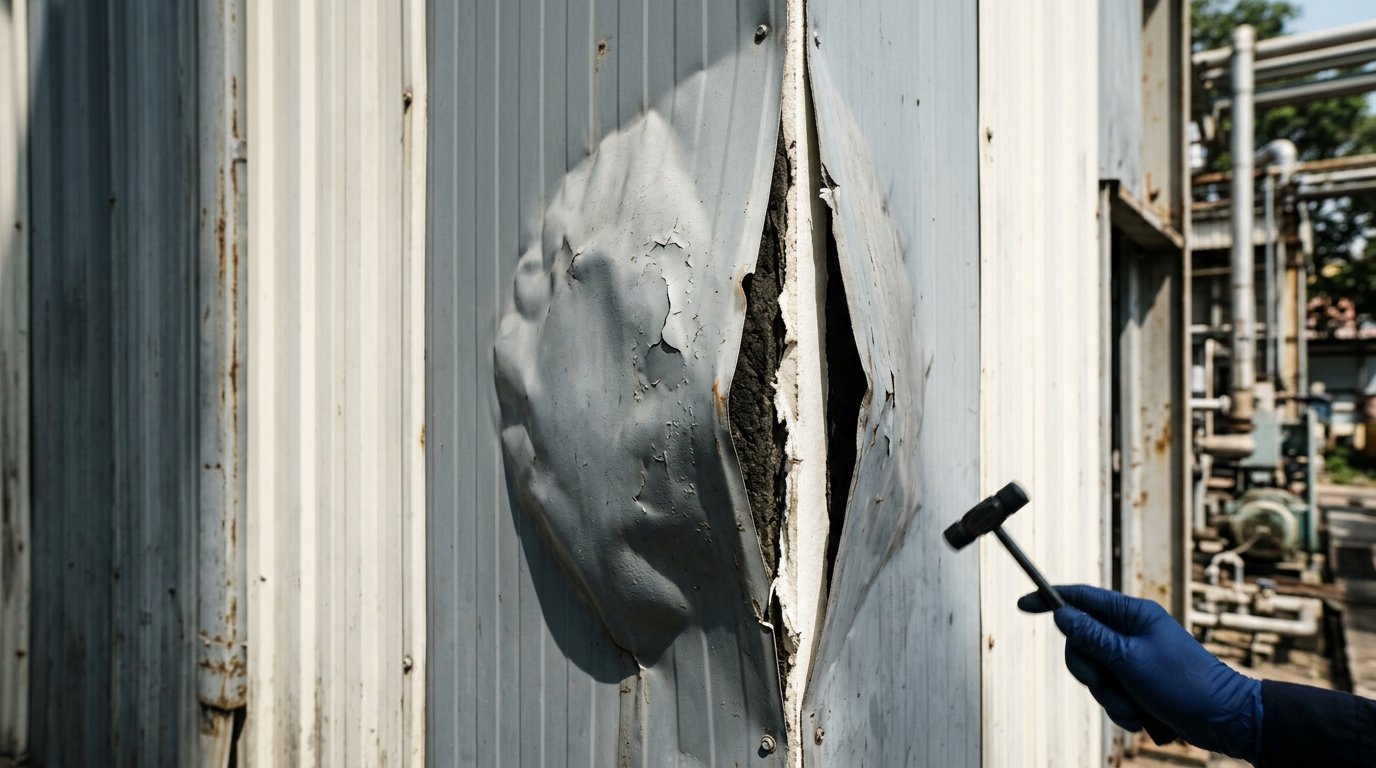
Why Delamination Is More Serious Than Rust
A sandwich panel works as one structural unit. The outer steel sheet carries tension and compression, while the EPS, PIR or rockwool core carries shear and holds the sheets apart. Once the bond fails, the sheets move independently and bending capacity drops far faster than the bulge suggests.
The consequences stack up. A delaminated roof panel loses wind uplift resistance at its fixings. A separated cold room wall panel creates an air void where vapour condenses and ice grows from inside. Insulation performance falls with it.
Five Causes Found Most Often
Delamination rarely has a single cause. These five usually pile up until the bond gives way:
- Excess surface heat. EN 14509 uses design surface temperatures of +55 °C for very light colours, +65 °C for light colours and +80 °C for dark colours. In a tropical climate, dark panels sit near that upper bound for years and adhesive ages faster.
- Moisture entering at the edges. Unsealed site cuts let water reach the facing-to-core interface, weakening adhesion. Heat-cool cycling then pumps it deeper.
- Thermal cycling and thermal bowing. The outer sheet expands more than the cooler inner sheet. That difference bows the panel daily and grinds away the bond at its edges.
- Over-tightened screws. Excess torque crushes the core around the hole, creating a soft spot that spreads. A common range is 4 to 6 Nm for screws with EPDM washers.
- Production and storage defects. Uneven adhesive, insufficient press pressure, or panel stacks left uncovered in direct sun.
Early Detection on Site
Delamination rarely appears overnight. There is almost always a salvageable stage, months before the facing lifts. This sequence is cheap and your own maintenance team can run it:
- Look along the surface. Stand parallel to the wall and watch the light reflection. Gentle waves show clearly from a low angle, yet are nearly invisible head on.
- Tap test. Tap the surface with a coin or small test hammer. Bonded areas ring clearly, debonded areas sound dull. Fast and non-destructive, but qualitative and inspector-dependent.
- Mark and measure. Chalk the boundary of the dull area, photograph it, and record the date. Its growth over three months is the most convincing evidence at claim time.
- Thermography if needed. Active thermal imaging maps debonding that tapping cannot reach, especially in thick panels.
Inspect three places more often: around fasteners, at site-cut edges, and on the elevation taking the afternoon sun. That is where delamination starts. A similar approach applies when judging whether used sandwich panels are fit for reuse.
The Test Standards That Measure the Bond
Bond strength between facing and core does not have to be taken on trust; there is a number for it. EN 14509 covers double skin metal faced panels with rigid cores: PUR and PIR, EPS, XPS, phenolic foam, cellular glass and mineral wool. The parameter relevant to delamination is tensile strength perpendicular to the faces, tested to EN 1607. The American counterpart is ASTM C297.
More importantly, EN 14509 does not stop at initial strength. Durability is the change in tensile strength after specimens complete the DUR1 ageing programme, with six specimens for the initial value and at least five per later stage. Dimensional change must not exceed 5 percent. Test houses such as Instron summarise the method.
When comparing quotations, ask for the perpendicular tensile value with its laboratory report number, and whether the panel has passed DUR1. A quotation citing European standards with no figures and no report number cannot be verified.
When Delamination Is a Valid Warranty Claim
Sandwich panel warranties almost always split in two: a coating warranty on the steel sheet, and a product warranty on the panel. What is typically covered is cracking, peeling or separation of the polymer coating from the steel surface, plus substantial and uneven colour change.
Service life benchmarks common in the industry: panels should keep insulating capacity and mechanical properties in normal use for at least five years, with insulation material life around 25 years. Five years is a floor, not a ceiling.
The exclusions are equally standard: installation outside the manufacturer instructions, wrong screw torque, unsealed site cuts, loads beyond the published tables, and undocumented maintenance. Scope and exclusions like these are covered further in our notes on panel warranties and maintenance contracts.
Prepare four things before filing: the original warranty on supplier letterhead with order number and dates of manufacture and delivery; the product datasheet; dated photographs with a map of the dull areas; and installation records including screw torque. Claims usually fail because nothing on file proves the installation was correct.
Repair or Replace
A delaminated panel cannot be re-bonded in place to factory quality, because the press pressure and temperature control of a production line are not available on site.
If the dull area is small, away from supports, and has not grown in three months, the panel can stay in service under observation, provided open edges are resealed. If it crosses the fastener line, sits in a roof panel, or keeps growing, replacement is the correct call. A roof whose bond has failed at the fixings is a safety risk in high wind.
Prevention costs far less than replacement: controlled screw torque, sealed cut edges, lighter colours on fully sun-exposed elevations, and a scheduled tap inspection twice a year. Correct installation sequence is covered in our panel installation guide, while vapour control in cold rooms is handled in the cold storage condensation article.
FAQ
Does a bulging panel always mean delamination?
Not always. Blisters confined to the paint layer indicate coating failure, not a broken core bond. The tap test separates them: if the sound stays clear, the facing-to-core bond is probably intact.
How long does delamination take to become dangerous?
No honest general figure exists, because the rate depends on temperature, humidity and load. So the tool is measurement, not estimation: mark the dull area, re-measure three months later, decide from its growth.
Is an EPS core more prone to delamination than PIR?
The bonding mechanisms differ. EPS is glued, so adhesive quality and press pressure decide the outcome. PIR is foamed directly onto the facing, giving a chemical bond. What decides it in the field is factory process control and the test report number.
Can a claim be filed without the original warranty document?
It is difficult. Industry practice requires the warranty on supplier letterhead, signed by an authorised officer, stating the order number and the dates of manufacture and delivery. Without it, claims stop at product verification.