
The market for used sandwich panels heats up every time a factory relocates, a warehouse is dismantled, or a cold storage facility changes hands. The offer is tempting: steel facings and insulation core still intact, at half the price of new panels or less. What sellers rarely explain is the part that decides your real cost, namely the remaining service life of the panel and the paperwork that disappears once a panel changes hands without a manufacturer behind it.
Why serviceable panels end up on the second-hand market
Panels are rarely removed because they have failed. A 2026 study in the journal Sustainability, "Enabling Circular Reuse of Sandwich Panels Through UAV Inspection, Deep Learning, and BIM-Based Material Passports", notes that steel-faced panels are commonly taken down before any technical failure. End-of-life decisions are driven by changes in how the asset is used, such as relocation or refurbishment, rather than by exhausted material.
The on-site physical checklist
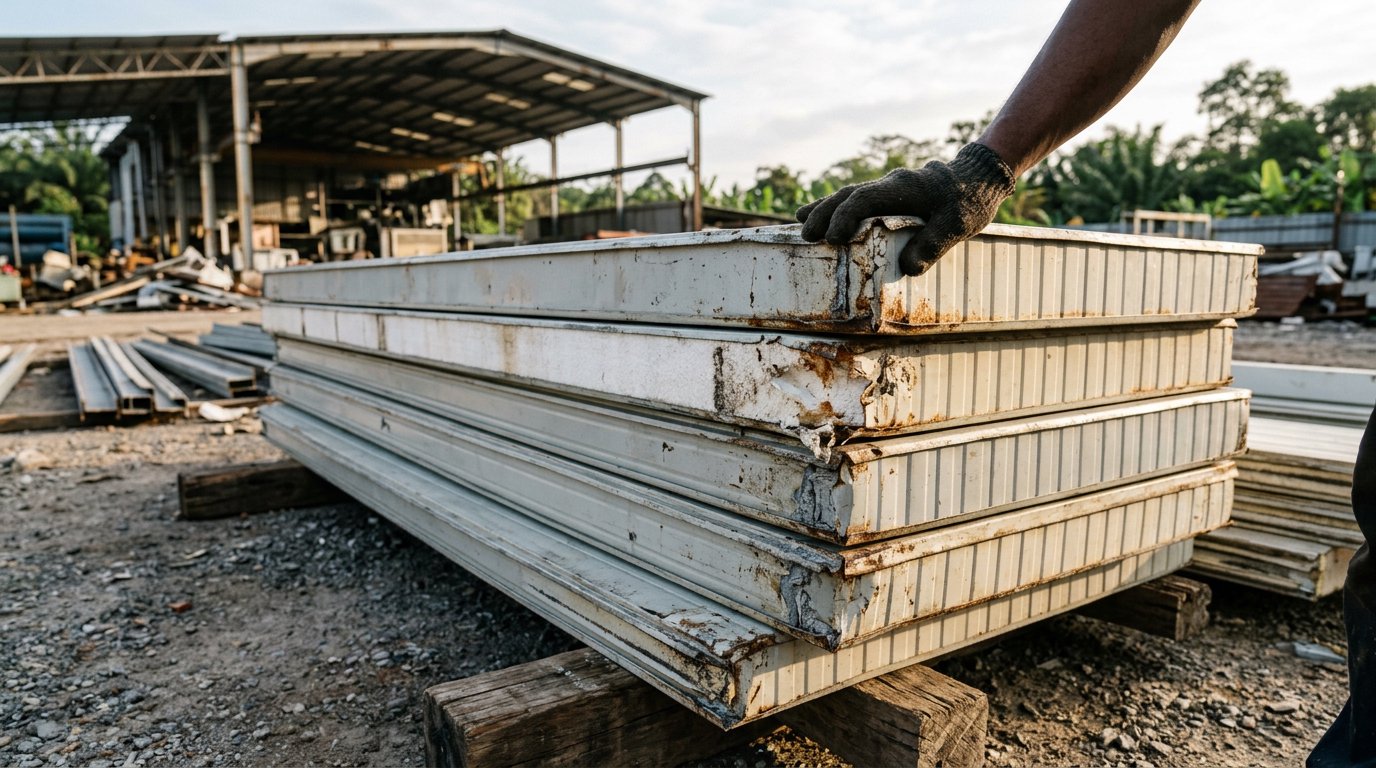
Bring a torch, a tape measure, a simple caliper and a small magnet. Five minutes per stack is enough to screen out panels that are not worth taking home.
- Edge delamination. Press the steel facing along the long edge. If the facing moves independently of the core, feels hollow, or sounds like paper, the bond between facing and core has failed. Such a panel no longer works as a composite element and cannot be repaired on site.
- Rust at cuts and bends. Zinc or aluminium-zinc coating protects the surface, but field-cut edges are almost always left bare. Fine rust lines at the edge are normal; blistering, pitting or thinning steel means corrosion has moved into the body of the panel.
- Dented joint locks. Tongue-and-groove profiles and cam-lock fittings are the reason panels close tightly. A dent a few millimetres deep stops the joint from locking, and that gap is where condensation and air leakage start.
- Signs the core has been wet. Look for brown staining between facings, a musty smell, and water tracks along the edges. A soaked core never fully recovers, least of all rockwool, which loses its shape once saturated.
- Facing thickness. Panels on the Indonesian market typically use 0.3 to 0.5 mm steel. Facings far thinner than that, or inconsistent within one stack, indicate panels mixed from several sources.
The insulation numbers you cannot see
When dry, manufacturer data sheets put thermal conductivity at roughly 0.033 to 0.038 W/mK for EPS, 0.022 to 0.026 W/mK for polyurethane and PIR, and 0.038 to 0.042 W/mK for rockwool. Those are the figures a buyer of new panels pays for, and they are the figures most likely to have changed in a used panel without any outward sign.
Water is the main cause. Research on water sorption in EPS, published as "Analysis of water sorption and thermal conductivity of expanded polystyrene insulation materials", reports that each one percent of absorbed moisture raises thermal conductivity by about 3.8 percent. A used panel that once leaked can therefore look flawless and still perform well below the value quoted to you.
In a plain warehouse that difference shows up as a slightly higher electricity bill. In a chilled room it means longer compressor runtimes and a higher risk of condensation inside the wall. That is why used panels are almost never rational where wall thickness has actually been calculated.
Paperwork: the costliest thing that does not transfer
Factory panels come with documents often worth more than the panel itself. The harmonised European standard EN 14509 covers factory-made metal-faced panels, and the manufacturer must issue a Declaration of Performance stating the product's measured performance, including its reaction-to-fire class. The testing and marking route is explained by fire testing body Efectis.
One point is widely misunderstood by used-panel sellers: reaction to fire and fire resistance are not the same document. A Declaration of Performance states how the material responds to fire, whereas EI 60 or EI 120 comes from a fire resistance test on a complete wall system including framing, fasteners and trims. That system certificate does not travel with dismantled panels.
Once a panel leaves its original building you lose the factory warranty, any basis for a delamination claim, and the right to quote fire resistance figures for your new wall. Further reading: our guides to fire rated panel specifications and panel warranty and maintenance contracts.
Recalculate the price before you bargain
Used panels are quoted per sheet or per stack, while project budgets are built per installed square metre, so the two units must be aligned first. A 2026 survey of public supplier price lists puts new EPS wall panels at roughly Rp150,000 to Rp250,000 per square metre depending on thickness, with installation labour alone at Rp150,000 to Rp230,000 per square metre.
After the panel price, these costs still appear: dismantling and loading, transport, recutting to a uniform size, edge trims and sealant that are practically always new, new fasteners, and the panels that turn out to be unusable. Waste and new accessories frequently consume the discount that looked so large at first.
A safe rule of thumb: used panels deserve consideration only when the all-in total lands below roughly half the installed price of new panels. Above that, you carry every condition risk and lose every document for a small saving.
When used panels make sense, and when they do not
- Reasonable: unconditioned storage, temporary site partitions, guard posts, yard boundary walls, tool sheds and open workshops.
- Better avoided: cold storage and other chilled rooms; food, pharmaceutical and healthcare spaces that require hygienic surfaces; walls that must prove fire resistance; long-span roofs that need manufacturer load and deflection tables.
- Always required: inspect panel by panel rather than by the stack, then price the net area after damaged sections are discarded.
FAQ
How long do used sandwich panels last?
There is no single figure, because history matters more than age. A used panel from a dry warehouse with intact facings can serve for years, while one from a coastal or wet environment may be spent already. All you can measure is today's condition: edge rust, delamination, dented joints and water tracks.
Can used panels be used for cold storage?
Better not. Chilled rooms demand perfectly tight joints and intact insulation values, the two properties that degrade first in used panels. Dented locks and a previously wet core turn directly into condensation, ice build-up and an electricity bill that never comes back down.