

The question lands on our desk almost every week: is it cheaper to buy a modular house or to build the conventional way? The honest answer is not a single number. What decides it is not the bare unit price but the total cost of ownership until the house is genuinely livable. This article compares both routes using the same cost lines, 2026 market figures and official government benchmarks.
Compare total cost, not the unit price
The costliest mistake is putting a modular unit price next to a per square metre contractor rate. They cover different things. A contractor rate usually includes the foundation and all site work, while a modular unit price normally stops at the factory gate. To compare fairly, build one list of cost lines and fill in a column for each route.
The lines that must appear: the unit or building structure, foundation, delivery, crane or lifting equipment, the PBG building permit, the electricity connection, clean water, a septic tank and interior finishing. Only once every column is filled does the difference mean anything. Without that, a comparison simply moves cost somewhere you cannot see it.
Conventional build cost per square metre in 2026
For the conventional route, an open market reference comes from Mitra10 (March 2026). A simple house runs at Rp3–4.5 million per sqm, mid range at Rp4.5–6.5 million per sqm and premium at Rp6.5–9 million per sqm. Those figures include materials and labour, but exclude land, permits and utility connections.
Their own simulation works well as a rough anchor. A 60 sqm house at an assumed Rp4 million per sqm comes to Rp240 million. A 120 sqm two storey house at Rp5.5 million per sqm comes to Rp660 million. These two numbers are the ones owners most often hold up when they start asking for modular quotes.
| Cost line | Conventional | Modular |
|---|---|---|
| Building | Rp3–9 million per sqm | Prefab range Rp2–3.5 million per sqm |
| Foundation | Inside contractor rate | Separate, still required |
| Delivery and crane | Small, bulk materials | Significant, depends on access |
| Permit and utilities | Separate | Separate |
| Schedule | Baseline | 20–50 percent faster |
Modular cost and the lines people forget
On the modular side, the Indonesian prefabrication market in 2025–2026 sits at roughly Rp2–3.5 million per sqm for the building itself. Finished products give further context: Tradecorp ModHouse is marketed at Rp220–457 million per unit, while simple container houses start around Rp80 million. We do not quote Smart Modular House prices here because they depend on layout, panel specification and delivery location.
- Foundation: a module still needs a level, square base before it is set down.
- Delivery: costs climb sharply for inter island shipping or narrow site access.
- Crane: daily hire plus the mobilisation cost of bringing equipment to site.
- Permits: a PBG is still required; factory fabrication does not waive it.
- Utilities: the PLN electricity connection, clean water and a biofilter septic tank.
These lines do not erase the modular advantage, but they relocate part of the saving. We cover the detail in our modular delivery and installation guide and in the PBG permit and site preparation guide.
The gap that shows up most clearly is time
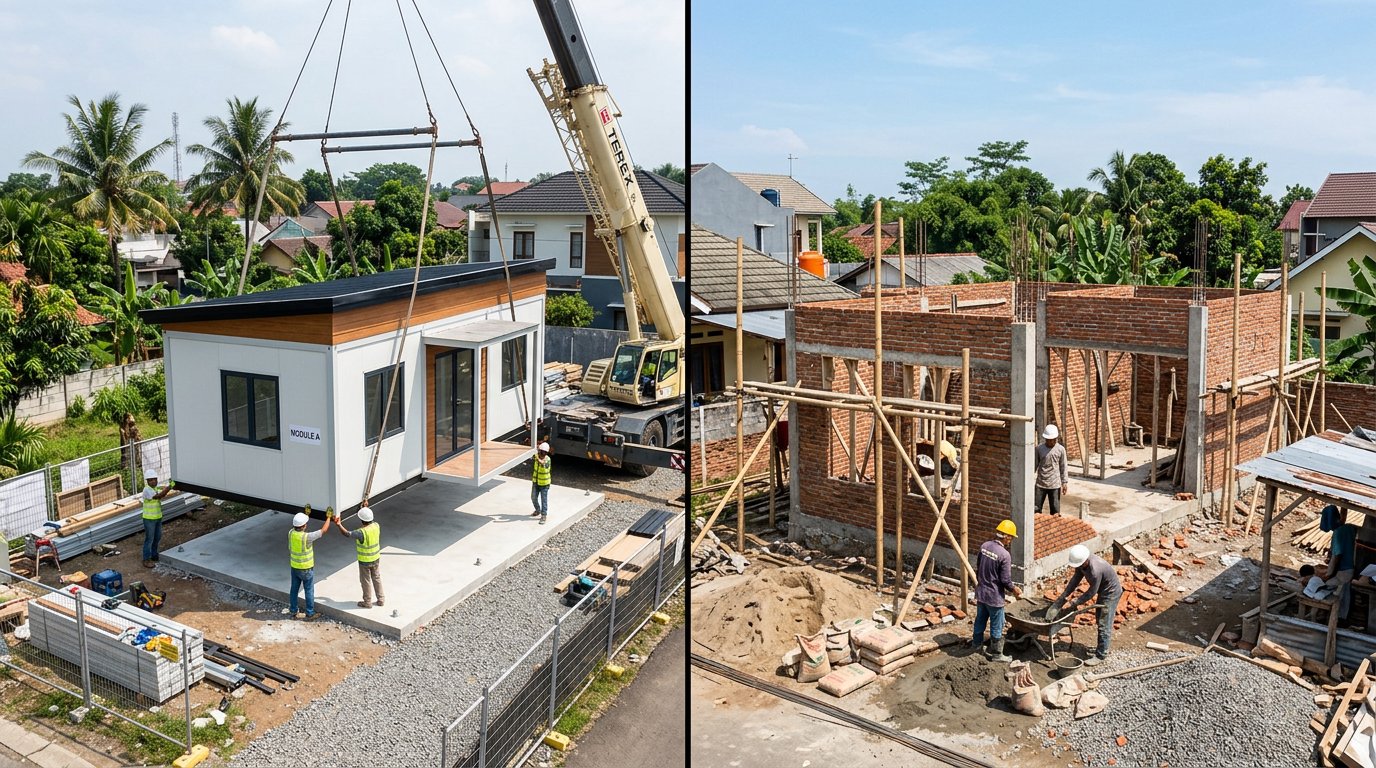
The most consistent difference is not price but schedule. McKinsey, in "Modular construction: From projects to products", and data from Dodge Data and Analytics record that prefabrication cuts project duration by 20–50 percent. The reason is mechanical: module fabrication runs in parallel with foundation work on site instead of waiting its turn in sequence.
For an owner, time carries money. Temporary accommodation is rented for fewer months. For rental units such as boarding houses or homestays, income starts several months earlier. Count that difference as part of the cost comparison rather than as a pleasant bonus that never reaches the spreadsheet.
An official budget anchor
To keep the budget discussion grounded, use an official benchmark. Ministerial Decree PKP No. 1722/KPTS/M/2026, signed on 6 August 2026, sets maximum sale prices for subsidised landed housing by region. Sumatra and Java Rp166 million; Riau Islands, Bangka Belitung, Mentawai and Sulawesi Rp173 million; Kalimantan Rp182 million; Jakarta, Bali, NTB, NTT and the Malukus Rp185 million; all of Papua Rp240 million.
That is not our product price but a comparison anchor: it is what the state treats as a decent landed home per region. If your planned total cost of ownership runs far above it without a clear reason, one line is usually swelling quietly, most often finishing or earthworks.
When modular wins, when conventional wins
Modular wins when skilled labour is hard to find locally, when the schedule is tight, when the requirement repeats such as boarding rooms and garden pavilions, or when the building may later be relocated. Conventional wins for highly custom layouts, steeply contoured land, sites a truck and crane cannot reach, or when the owner already has a trusted crew at a controlled price.
One more factor rarely reaches the spreadsheet: price certainty. On the modular route most of the cost is locked into the quotation from the start because the work happens in a factory. On the conventional route the true volume of work is only known once building is under way. For owners on a fixed budget that certainty is sometimes worth more than a few million rupiah of difference.
We treat the material comparison separately. See sandwich panel versus lightweight brick so this article stays focused on cost and time. For funding, read our modular house financing and mortgage guide. Need numbers for your own case? Our team provides a pricelist, layout consultation and a site survey through the contact page.
Frequently asked questions
Is a modular house always cheaper?
Not always. For a small house on a site with good road access and low labour rates, the conventional route can win narrowly. Modular usually wins on repeated projects, tight schedules, or locations where labour and logistics are expensive.
Do you still pay for a foundation with a modular house?
Yes. A module needs a level, square base before installation. What shrinks is the volume of wet work on site, not the obligation to build a foundation.
How large is the time difference?
Industry references put it at 20–50 percent faster than the conventional route. The actual figure depends on site readiness, permits and vehicle access.
Next step
Build two total cost columns using identical lines, fill them with the figures in this article, then request a quotation for the modular column. Send your layout and site address through the sandwichpanels.id contact page for a pricelist, a layout consultation and a site survey date.