

Introduction: Choosing the Right Wall Material
In the modern construction world of 2026, choosing the right wall material is a crucial decision that determines cost efficiency, construction speed, and the long-term comfort of your building. Two of the most debated options are sandwich panel vs lightweight brick. Both materials offer distinct advantages and often leave project owners confused about the best choice.
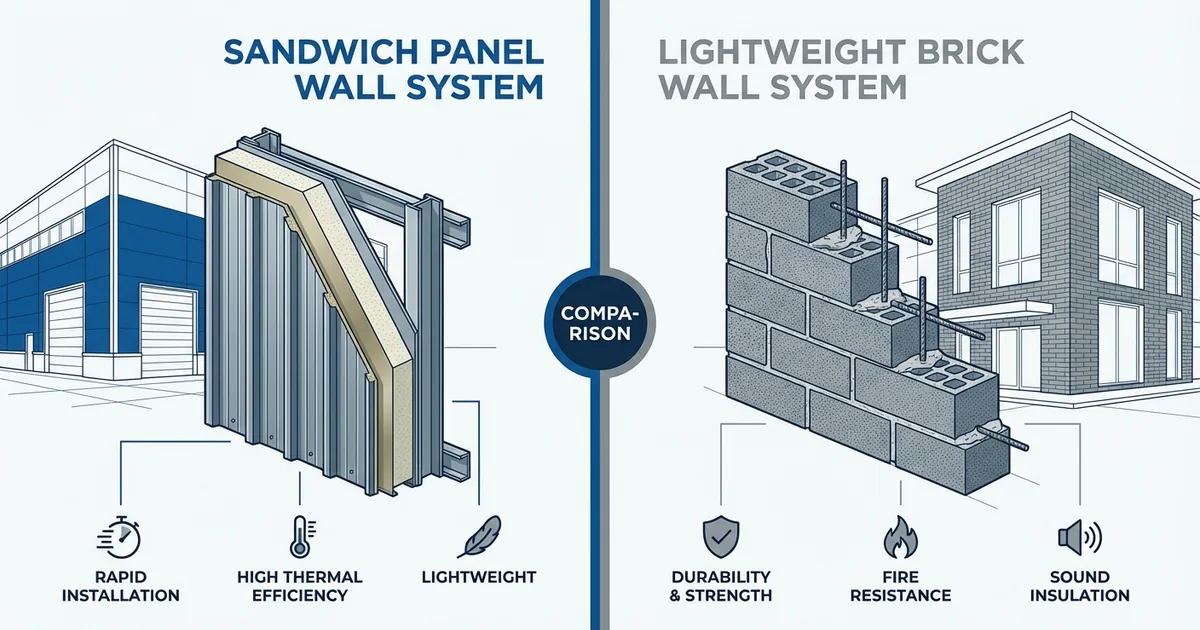
This article provides an objective, in-depth comparison based on technical data and on-site reality. We will dissect parameters ranging from material prices and labor costs to installation speed and thermal insulation performance. Our goal is simple: to help you make a smart decision based on facts, not just per-unit price assumptions.
What are Sandwich Panels and Lightweight Bricks?
1. Sandwich Panels: Prefabricated Modular Solutions
Sandwich panels are modern building materials consisting of three main layers: two outer sheets of galvanized steel enclosing a core material in the middle. The core material can be EPS, Polyurethane (PU), or PIR. Manufactured in factories with high quality control, each panel has precise dimensions and is ready for installation without needing additional finishing processes like plastering or painting.
2. Lightweight Bricks: Modern Porous Masonry
Lightweight bricks, often referred to as Hebel or AAC (Autoclaved Aerated Concrete), are an evolution of conventional red bricks. Made from a mixture of cement, silica sand, and lime processed under high-pressure steam, lightweight bricks are significantly lighter than red bricks but still require manual installation using mortar (instant cement) and a final finishing stage.
Cost Comparison: Material, Labor, and Time
Project owners often only look at the material price per square meter without calculating the Total Cost of Construction. Let's break down the comparison:
| Cost Parameter | Sandwich Panel | Lightweight Brick |
|---|---|---|
| Material Price / m2 | IDR 250,000 - IDR 450,000 | IDR 120,000 - IDR 180,000 |
| Labor Cost / m2 | IDR 60,000 - IDR 90,000 | IDR 130,000 - IDR 180,000 (inc. plastering) |
| Additional Material Costs | Minimal (Sealant & Screws) | High (Cement, Sand, Paint) |
| Estimated Total / m2 | IDR 320,000 - IDR 550,000 | IDR 300,000 - IDR 450,000 |
Cost Conclusion: While the price of lightweight brick materials appears much cheaper initially, once you add the costs of cement, sand, paint, and the longer labor time, the total cost per square meter becomes nearly equivalent to sandwich panels. In fact, for large warehouse projects, sandwich panels are often cheaper due to savings on foundation structural costs.
Construction Speed: The ROI Determinant
Time is money, especially in commercial and industrial projects. Installation speed is where sandwich panels truly shine:
- Sandwich Panels: A small team (3-4 people) can install up to 50-80 m2 of walling per day. Because the system is modular, the wall is finished immediately and can be used without waiting for drying.
- Lightweight Bricks: The same team can only install about 15-20 m2 per day. Furthermore, there is waiting time for the plastering process (curing time) and painting, which can take weeks.
For a 1,000 m2 warehouse project, using sandwich panels can speed up project completion by over 2 months compared to lightweight bricks. This means your business can operate earlier and generate revenue sooner.
Thermal and Acoustic Insulation Performance
Thermal Insulation (Heat)
Sandwich panels are specifically designed for temperature isolation. PIR or PU materials have very low thermal conductivity. Buildings with sandwich panels stay significantly cooler during the day, which automatically lowers AC electricity costs by 40-60%. Lightweight bricks have better insulation than red bricks but are still far behind sandwich panels.
Acoustic Insulation (Sound)
Lightweight bricks excel at sound dampening due to their denser material mass, making them a favorite for residential homes or apartments. However, for noisy industrial needs, Rockwool-type sandwich panels provide sound insulation comparable to or even better than bricks for certain frequencies.
Structural Strength and Durability
Lightweight bricks offer excellent compressive strength for permanent boundary walls. However, sandwich panels have advantages in flexibility and earthquake resistance. Due to their lightweight nature and flexible joint systems, sandwich panels do not crack or collapse during earthquake tremors, unlike brick walls which tend to develop hair-line cracks or even crumble.
Ideal Applications: Which Should You Choose?
Choose Sandwich Panels If:
- Building Warehouses, Factories, or Cold Storage.
- Chasing a very short construction timeline (tight deadlines).
- Requiring high energy efficiency (energy-saving buildings).
- Building on ground with low bearing capacity (needs lightweight loads).
- Desiring a clean workspace (minimal dust and construction waste).
Choose Lightweight Bricks If:
- Building a permanent single-story residential home.
- Wanting maximum sound privacy between rooms economically.
- Initial material budget is very limited and project timeline is flexible.
- Desiring the thick appearance of conventional wall paint finishes.
Case Study: Logistics Warehouse in Cikarang Industrial Estate
A logistics company compared using lightweight bricks and sandwich panels for a 2,000 m2 warehouse. The analysis showed that by using sandwich panels, they saved IDR 150 million in foundation costs and accelerated warehouse operations by 45 days. The profit from being operational 1.5 months early far exceeded the initial material price difference.
FAQ: Frequently Asked Questions
Are sandwich panels durable for outdoor use?
Yes, with protective coatings like PVDF, sandwich panels resist corrosion and extreme weather changes for 20-30 years. Ensure professional installation to guarantee sealant adhesion.
Can lightweight brick walls be replaced by sandwich panels during renovation?
Absolutely. Many modern offices are now renovating their room partitions using sandwich panels because the process is fast, clean, and does not interfere with ongoing office operations.
Which is more fire-resistant?
Lightweight bricks are naturally fire-resistant. For sandwich panels, you must choose the PIR or Rockwool types if fire safety is a primary project requirement.
Conclusion
There is no absolute winner in the sandwich panel vs lightweight brick debate. The final decision depends heavily on the building's function, total budget, and time urgency. However, if you are looking for speed, energy efficiency, and the construction technology of the future, sandwich panels are an unmatched choice.
Remember to always calculate your needs in detail to avoid material waste. Learn how to calculate panel requirements to get an accurate estimate for your project.
Still unsure about your choice? Consult your project needs with the sandwichpanels.id technical team for free. We will help you analyze which material is most beneficial for your long-term investment. Contact us now and get the best price offer!