

Land prices are rising faster than incomes, and the number of Indonesian households that rent keeps growing. For a landowner, boarding rooms and rental houses are among the fastest ways to turn idle land into monthly cash flow. The real question is how long capital stays locked up before the first room earns.
That is where container-type modular buildings come in. Units are built in a factory, delivered, then bolted onto pad footings, so site work is far shorter than laying brick rooms. This guide covers units per plot, revenue, tax and permits rather than definitions.
Where rental demand actually sits
Statistics Indonesia (BPS), in its Housing and Environment Indicators 2024 report, recorded that 5.06 percent of Indonesian households live in rented or contracted homes. The national figure hides a wide gap: Jakarta leads at 21.30 percent, while West Sulawesi sits at just 0.51 percent.
Rental demand therefore clusters around industrial estates, campuses, hospitals and service districts. Map your target tenant before you build: students, factory workers, nurses or young families. Room size, private bathrooms and parking all follow from that answer.
Listing data compiled by the boarding platform Mamikos and summarised by Brighton in 2026 puts the average male room in Jakarta near Rp1.49 million per month, female rooms near Rp2 million, and en-suite rooms near Rp2.5 million. Outside Greater Jakarta the figures drop sharply, so a price survey within one kilometre is still mandatory.
How many units fit on your plot
The starting point is not the unit catalogue but the building coverage ratio (KDB) and floor area ratio (KLB) in your city detailed spatial plan. KDB caps the ground floor footprint, KLB caps total floor area. These two numbers decide your room count long before design does.
A rough example: a 300 sq m plot at 60 percent KDB allows 180 sq m of ground floor. A 3x6 m unit covers 18 sq m, so ten units fit in theory. After corridors, stairs, drying areas, motorcycle parking and setbacks, seven to eight single-storey units is the realistic figure.
- 3x3 m unit (9 sq m) — single room without an internal toilet, suited to worker housing with shared bathrooms.
- 3x6 m unit (18 sq m) — studio room with internal toilet and mini pantry; the highest rent bracket in the market.
- 3x6 m two-storey unit — doubles the room count on the same footprint where KLB and structure allow.
- Custom knock-down or welded — for family rental houses that merge several modules into one dwelling.
Revenue, operating cost and payback
Work in this order. First, gross annual income equals unit count times monthly rent times twelve times occupancy. Eight units at Rp1.5 million with 85 percent occupancy produce roughly Rp122 million a year.
Second, subtract operating costs: shared electricity and water, internet, cleaning, neighbourhood dues and a maintenance reserve. In practice these absorb 25 to 30 percent of gross income. Third, divide total capital by annual net profit to estimate the payback period in years.
Capital is only certain once unit size, interior options, foundation and delivery location are known. Send your plot size and target room count through our contact page and our team will return the current pricelist and a layout proposal, so your payback maths uses real numbers.
Tax: boarding rooms are not rental houses
Many owners treat the two as identical, yet Indonesian tax law does not. Leasing a whole house or shophouse counts as land and building rental, taxed under Article 2(1) of Government Regulation 34/2017 at a final 10 percent of gross rent.
Boarding houses are explicitly excluded. Article 2(3) and its elucidation classify a rumah kos as a lodging service, so its income is treated as business income. The Directorate General of Taxes explains the distinction in its official article on rental and boarding house income tax.
That works in a small owner favour. An individual taxpayer with gross turnover below Rp4.8 billion a year may use the 0.5 percent final MSME rate, and the first Rp500 million of annual turnover is not taxed at all. Eight rooms grossing Rp122 million sit well below that threshold.
For local tax, Law 1/2022 on central and regional fiscal relations repealed the older rule in Law 28/2009 that treated boarding houses with more than ten rooms as hotels. Several regions still regulate private homes used as lodging through their own bylaws, so confirm with the local revenue agency.
Permits: PBG, SIMBG and KBLI
The belief that container units need no permit because they can be moved is wrong. Law 28/2002 defines a building as a physical construction result that is attached to its location. A unit bolted to a foundation meets that definition.
Article 7(1) of Government Regulation 16/2021 requires a building approval, or PBG, for every construction, with no exemption for wall material or assembly method, and Article 326(1) routes the process through SIMBG. Our article on modular house PBG permits covers this in full.
- The PBG levy is a regional levy under Law 1/2022, so rates differ from city to city.
- Boarding houses and worker dormitories fall under KBLI 55900; the NIB is issued through OSS.
- Foundations use pad footings or concrete blocks placed exactly under the corner fittings, not continuous stone footings.
- Request the anchor layout drawing from the factory before pouring, so units land on target.
Smart Modular House specifications
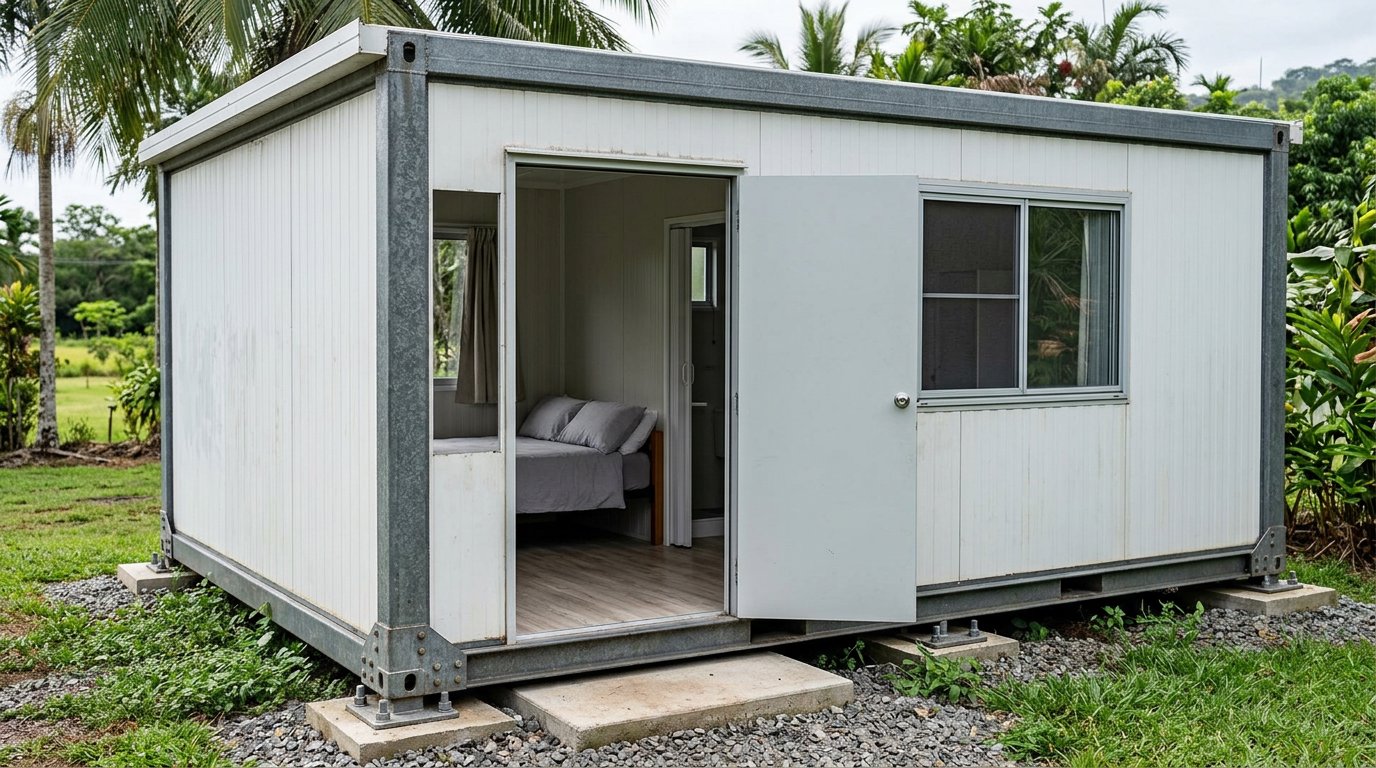
Smart Modular House, built by PT Sunrise Purification Technology in Cikarang, uses a bolted galvanised steel frame with corner fittings at every corner, so units can be dismantled and reassembled. Walls are EPS sandwich panel at density 10, or density 15 and rockwool where fire resistance is required.
Ceiling height is 2.85 metres, with fibre cement board flooring, aluminium windows, steel doors and electrical installation included. For rental rooms the most requested options are an internal toilet, air conditioning, PVC ceiling, vinyl or ceramic flooring, partitions, a mini pantry, a canopy and a biotech septic tank.
The build pattern resembles what we described for worker housing and site barracks, except that commercial rooms demand more: sound separation between rooms, cross ventilation and an independent lock on every door.
FAQ
Are modular boarding rooms quiet enough?
EPS panel performs better than plywood partitions, but for commercial rooms sharing walls, specify rockwool panel on the dividing walls. Its dense fibre blocks conversation-level noise far better and raises the fire resistance of the unit at the same time.
How long does installing eight units take?
On-site installation is far shorter than building brick rooms because units arrive finished. The real schedule still depends on foundation readiness, road access for trucks and cranes, and the production queue. Ask for a written schedule alongside the quotation.
Can units be moved if the land is leased?
Yes, that is the advantage of the bolted knock-down system. Units are unbolted, transported and reinstalled on a new foundation. For leased land, budget dismantling, haulage and a second foundation from the start, and confirm the lease permits removing the building.
Request a pricelist, layout and site survey
Your payback figure is only as accurate as the capital figure behind it. We do not print prices in articles because the final cost depends on unit size, interior options, quantity and delivery distance to your site.
Send your plot dimensions, target room count and destination city through the sandwichpanels.id contact page. You will receive the current pricelist, a layout consultation and a site survey booking before any concrete is poured.