

What Are Fire-Resistant Sandwich Panels?
Fire-resistant sandwich panels are construction materials for walls and roofs with a core specifically engineered to withstand heat and fire. Unlike standard panels, these are designed to slow fire spread over a defined period — typically 30 minutes to 4 hours — according to applicable testing standards.
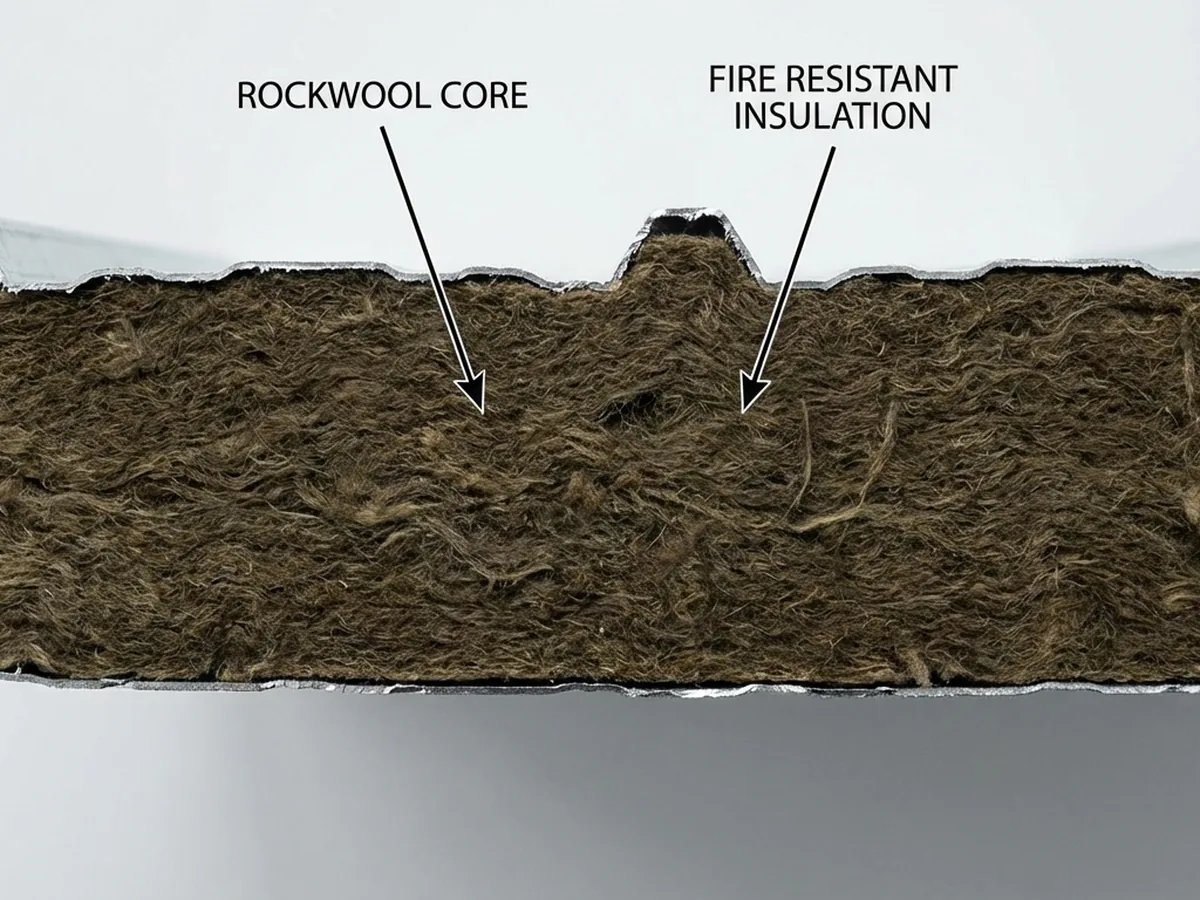
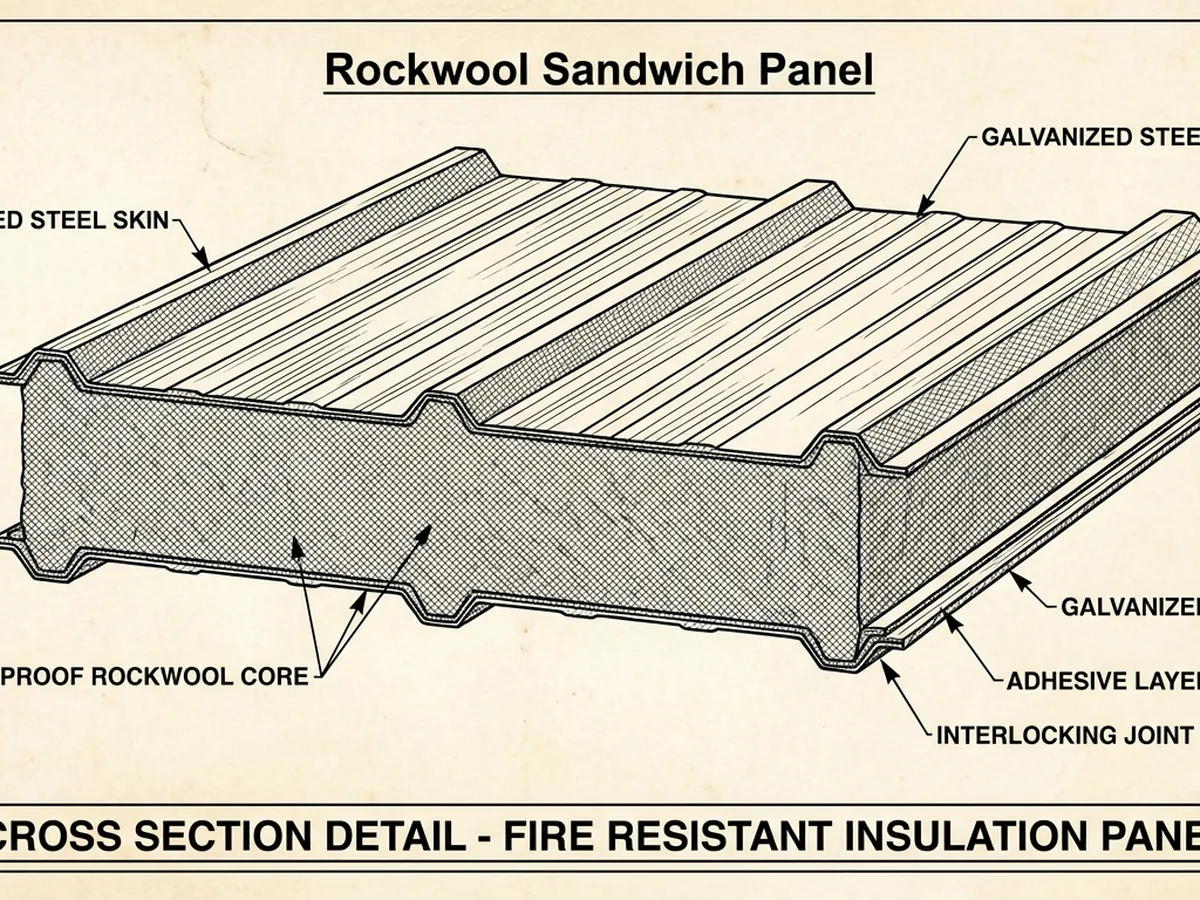
The basic structure remains the same: two steel facings sandwiching an insulation core. The difference is the core material. Fire-resistant panels use non-combustible or low fire-reaction materials such as rockwool (mineral wool), PIR (Polyisocyanurate), or specialized composites.
The short answer: if your project requires fire protection — factories, chemical warehouses, cleanrooms, industrial kitchens, or public buildings — a fire-resistant sandwich panel is not optional. Choosing the wrong panel can lead to billions in losses and life-threatening risks.
Core Material Types and Fire Rating Comparison
Not all sandwich panels perform equally against fire. Here are the three main core types available in the Indonesian market with a direct comparison.
Rockwool (Mineral Wool) — Class A1 Non-Combustible
Rockwool is a mineral fiber made from basalt rock melted at temperatures above 1,500°C. It is classified as non-combustible with Euroclass A1 — the highest class under European fire reaction standard EN 13501-1.
- Fire rating: up to 4 hours (EI 240) depending on thickness
- Fiber melting point: >1,000°C
- Does not produce toxic smoke when exposed to fire
- Typical density: 80–120 kg/m³
- Best for: chemical plants, hazardous material storage, cleanrooms, medical facilities
The downside: rockwool panels are heavier than PU/EPS and cost more per square meter. But for projects requiring high fire ratings, rockwool has no equal substitute. See the full specifications of our Fire-Proof Rockwool Panel in the catalog.
PIR (Polyisocyanurate) — Medium Fire Rating
PIR is often considered an "upgraded" version of conventional PU (Polyurethane). Its manufacturing uses a higher isocyanate ratio, producing a chemical structure with better heat resistance.
- Fire rating: typically 15–60 minutes (EI 15 – EI 60)
- Classification: Euroclass B-s1,d0 or B-s2,d0
- Lighter than rockwool panels
- Better thermal insulation (U-value) per mm of thickness
- Self-extinguishing — fire stops once the source is removed
PIR works well for commercial buildings and light industrial projects that need a balance between fire protection, insulation, and structural weight. Read the full comparison in PIR vs PUR: Complete Comparison 2026.
EPS (Expanded Polystyrene) — Low Fire Rating
EPS is the most budget-friendly option but has the weakest fire resistance of the three. Without flame retardant treatment, EPS is classified as highly flammable. Even FR (Fire Retardant) variants only reach Euroclass E.
For projects that require certified fire ratings, EPS is generally not recommended. Compare all three materials in detail at EPS vs Rockwool vs PU: Complete Comparison.
Applicable Fire Rating Standards in Indonesia
Understanding fire rating standards is critical before choosing any panel. Indonesian regulations reference a combination of national and international standards.
SNI 1741:2008 — Fire Resistance Test Method for Structural Components
This national standard governs fire resistance testing methods for building components, including partition walls. Test results are expressed in minutes of fire endurance (e.g., 30, 60, 120 minutes).
BS 476 Part 22 — Non-Load Bearing Element
Widely used across Southeast Asia including Indonesia. This British standard tests non-structural elements for their ability to resist fire, heat, and maintain integrity. Results are reported as EI (integrity + insulation) in minutes.
EN 13501-1 — Euroclass Reaction to Fire
A European standard that classifies materials by their reaction to fire from A1 (non-combustible) to F (highly flammable). It is important to understand that Euroclass evaluates how a material reacts to fire — not how long an assembled element resists a full-scale fire.
Fire Rating Summary Table by Core Type
Below is a direct comparison of the three main core types based on commonly referenced standards.
- Rockwool 50mm: BS 476 = EI 30, Euroclass = A1
- Rockwool 100mm: BS 476 = EI 120, Euroclass = A1
- Rockwool 150mm: BS 476 = EI 240, Euroclass = A1
- PIR 50mm: BS 476 = EI 15, Euroclass = B-s1,d0
- PIR 100mm: BS 476 = EI 30–60, Euroclass = B-s1,d0
- EPS 50mm: BS 476 = does not pass, Euroclass = E
- EPS FR 100mm: BS 476 = EI 15 (limited), Euroclass = E
How to Choose the Right Fire-Resistant Sandwich Panel
Selecting a fire-rated panel is not just about picking the highest fire rating number. Several technical and commercial factors need simultaneous consideration.
1. Identify Your Project's Regulatory Requirements
Each building type has different minimum fire rating requirements. Hazardous material storage needs EI 120 or above. Food manufacturing may only need EI 60. Medical facilities and cleanrooms typically require EI 60–120 plus non-combustible core material.
Check local building codes and project specifications before making a decision. Do not assume — consult a fire safety engineer or contact our technical team directly.
2. Consider Structural Load
Rockwool has a density of 80–120 kg/m³, significantly heavier than PIR at 40–45 kg/m³. For buildings with lightweight steel structures, this added weight can impact frame design and foundation requirements.
If your structure has load limitations, PIR may be a reasonable compromise — provided its fire rating meets your project requirements.
3. Evaluate Thermal Insulation Needs
PIR outperforms rockwool in thermal insulation per millimeter of thickness. If you are building cold storage or temperature-controlled rooms, the combined fire rating + thermal insulation efficiency of PIR may result in lower total costs. Read the selection guide at Cold Storage Panel: Complete Guide 2026.
4. Calculate Total Cost of Ownership
Rockwool costs more per square meter upfront. But if regulations demand high fire ratings, using PIR at increased thickness could result in comparable — or even higher — total costs due to extra material volume needed.
Request quotations for both options and compare total costs including supporting structures, installation labor, and certification expenses.
Primary Applications of Fire-Resistant Sandwich Panels
Fire-rated sandwich panels are used across various industrial sectors. Here are the most common applications found in Indonesia.
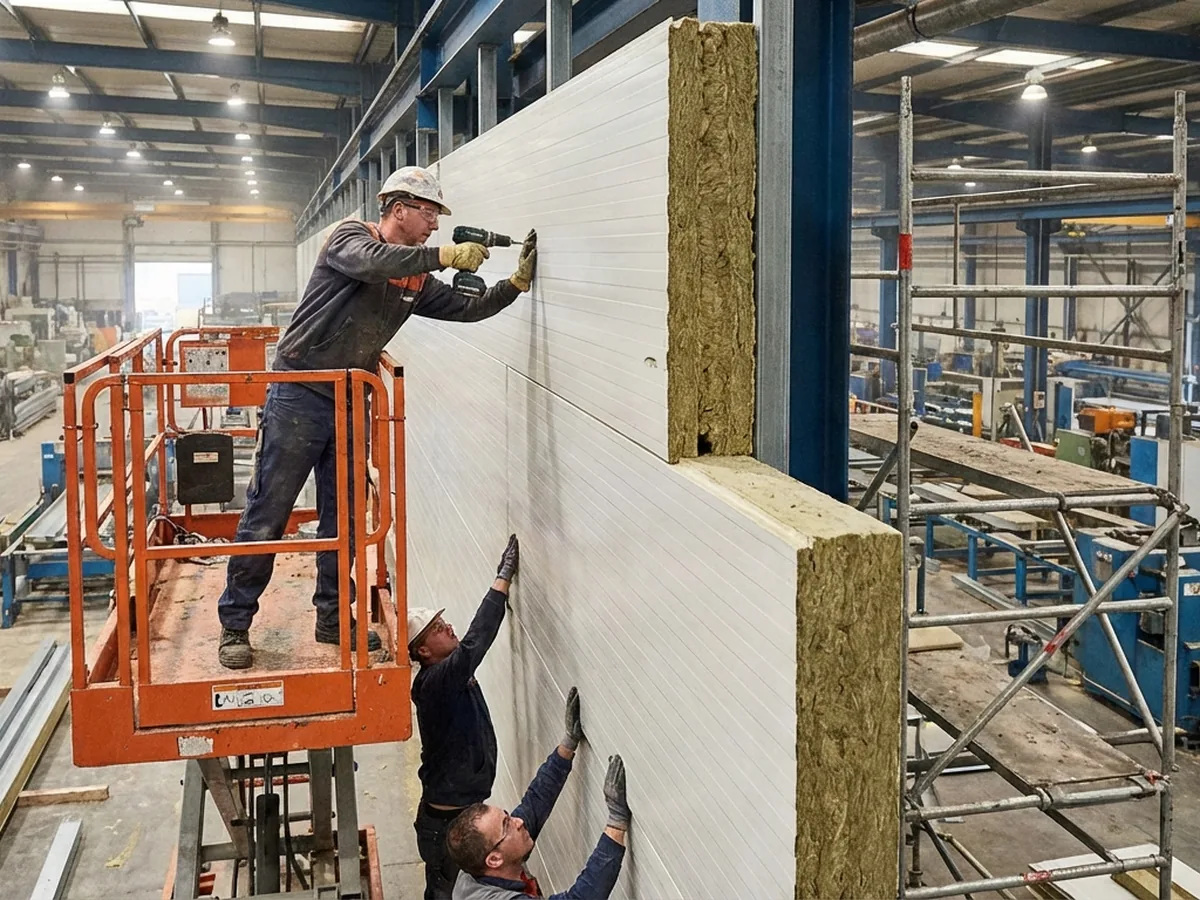
- Factories and warehouses: inter-area partitions, external walls, chemical storage compartments
- Pharmaceutical cleanrooms: sterile room walls and ceilings meeting GMP standards
- Medical facilities: modular operating theatres, ICU rooms, laboratories
- Cold storage: walls and ceilings for refrigerated rooms needing both insulation and fire rating
- Public buildings: shopping centers, schools, office buildings with strict building codes
- Industrial kitchens: large-scale cooking areas in hotels, catering operations, or food factories
See a broader overview of sandwich panel advantages and disadvantages for industry for wider context.
General Technical Specifications for Fire-Rated Rockwool Panels
Below are specifications commonly available in the Indonesian market for initial project planning reference.
- Panel thickness: 50mm, 75mm, 100mm, 150mm, 200mm
- Effective width: 950mm–1,150mm (varies by profile design)
- Length: custom as required (maximum ~12 meters)
- Steel facing: PPGI/PPGL, thickness 0.4–0.6mm
- Core density: 80–120 kg/m³ (rockwool)
- Thermal conductivity: 0.034–0.040 W/mK
- Fire rating: EI 30 to EI 240 (depending on thickness)
- Joint system: tongue & groove, hidden screw, or cam lock
The specifications above are indicative. Always confirm with official test certificates from the manufacturer before including them in tender documents.
FAQ: Frequently Asked Questions About Fire-Resistant Sandwich Panels
How long can a rockwool panel withstand fire?
It depends on thickness. A 50mm rockwool panel typically achieves EI 30 (30 minutes), while a 150mm panel can reach EI 240 (4 hours). These figures are based on BS 476 Part 22 laboratory testing. Actual field performance may vary depending on installation conditions and joint details.
Can EPS panels be used in areas requiring a fire rating?
Technically, EPS panels — including Fire Retardant variants — have significantly lower fire resistance than rockwool and PIR. For projects that legally require specific fire ratings (e.g., EI 60 or higher), EPS is not recommended. Choose rockwool or PIR based on your specific requirements.
What is the difference between fire rating and reaction to fire?
Fire rating (e.g., EI 60) measures how long a building element can resist fire spread and heat transmission. Reaction to fire (e.g., Euroclass A1) measures how a material behaves when exposed to fire — how easily it ignites, how much smoke it produces, and whether it spreads flames. Both are important and complementary.
How can I verify a panel's claimed fire rating?
Request the official test certificate from an accredited laboratory. Ensure the certificate includes the test report number, the standard used (BS 476, EN 1366, or SNI 1741), and detailed specimen information including core thickness and density.
Conclusion
Choosing the right fire-resistant sandwich panel is not just a technical decision — it is a critical step in protecting assets and building occupant safety. Rockwool remains the gold standard for the highest fire ratings (A1 non-combustible, up to EI 240), while PIR offers a practical compromise between weight, insulation, and moderate fire protection.
The key: start with your project regulations, determine the minimum required fire rating, then select the material that meets those requirements at the most efficient total cost.
Need technical consultation on selecting the right fire-rated panel for your project? Contact our technical team via WhatsApp for a no-obligation discussion.