

The Importance of Choosing the Right Sandwich Panel Material
In modern construction, sandwich panels have become a popular solution for various industrial and commercial building applications. With three main materials—EPS (Expanded Polystyrene), Rockwool, and PU (Polyurethane)—contractors and project owners often face confusion in selecting the best option. This article provides a comprehensive comparison of these materials, complete with technical data, advantages, disadvantages, and specific application recommendations.
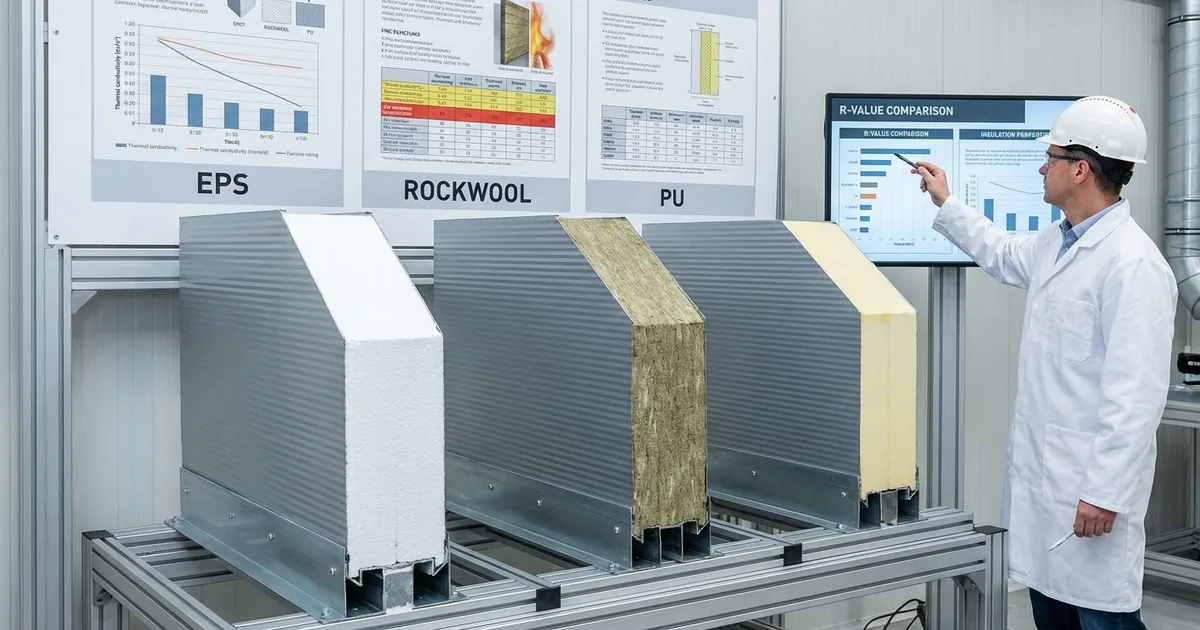
Comparison Table: EPS vs Rockwool vs PU
| Parameter | EPS | Rockwool | PU |
|---|---|---|---|
| Thermal Conductivity (W/mK) | 0.033 - 0.038 | 0.034 - 0.040 | 0.022 - 0.028 |
| Fire Rating | B2 (Flammable) | A1 (Non-combustible) | B1 (Flame retardant) |
| Density (kg/m³) | 15 - 30 | 40 - 200 | 30 - 50 |
| Water Resistance | Good | Poor | Excellent |
EPS: Economical Choice with Adequate Performance
EPS is the most economical material, popular for budget-conscious projects. Its closed-cell structure provides good water resistance, making it suitable for humid environments. Lightweight construction facilitates transportation and installation.
Rockwool: Best Fire Resistance Solution
Rockwool offers superior fire resistance with A1 rating (non-combustible), ideal for applications requiring high fire safety standards. It also provides excellent acoustic insulation and can withstand temperatures up to 1000°C.
PU: Top Thermal Performance
PU delivers the best thermal insulation performance with conductivity of only 0.022-0.028 W/mK. Its closed-cell structure ensures excellent water resistance and dimensional stability. Although more expensive, it offers long-term energy savings.
Application-Specific Recommendations
Cold Storage & Refrigerated Rooms
PU is the best choice for cold storage applications due to its superior thermal efficiency and moisture resistance.
Industrial Buildings & Warehouses
EPS provides the best value for conventional industrial buildings. For areas with fire risks, Rockwool should be used in critical zones.
Clean Rooms & Laboratories
PU is the only adequate choice for clean rooms requiring strict contamination control and temperature stability.
Conclusion
Each material serves specific needs: EPS for economical applications, Rockwool for fire safety and acoustic insulation, and PU for maximum thermal performance. The final decision should consider budget, insulation requirements, fire safety standards, and long-term operational costs.
For cold storage projects, we highly recommend PU sandwich panels for proven energy efficiency. For industrial buildings with fire risks, consider Rockwool sandwich panels for maximum protection.
Need help choosing the right material for your project? Our expert team is ready to provide free consultation and specific recommendations based on your unique project needs. Contact us at sandwichpanels.id or via WhatsApp for further discussion and the best pricing.