

PIR vs PUR: A Comprehensive Comparison of the Best Sandwich Panels 2026
Choosing the right material for industrial walls or roofs is more than just picking a color or steel thickness. Beneath that metallic skin lies the 'heart' that determines your building's energy efficiency, safety, and insurance costs: the insulation core material. The two most common names in the market are PUR (Polyurethane) and PIR (Polyisocyanurate).
While they look remarkably similar—usually a dense yellowish foam—they possess very different performance profiles. In 2026, as building standards in Indonesia and globally become increasingly stringent, understanding these differences is an investment in your business's future. This guide provides an in-depth technical analysis to help you make the right choice.
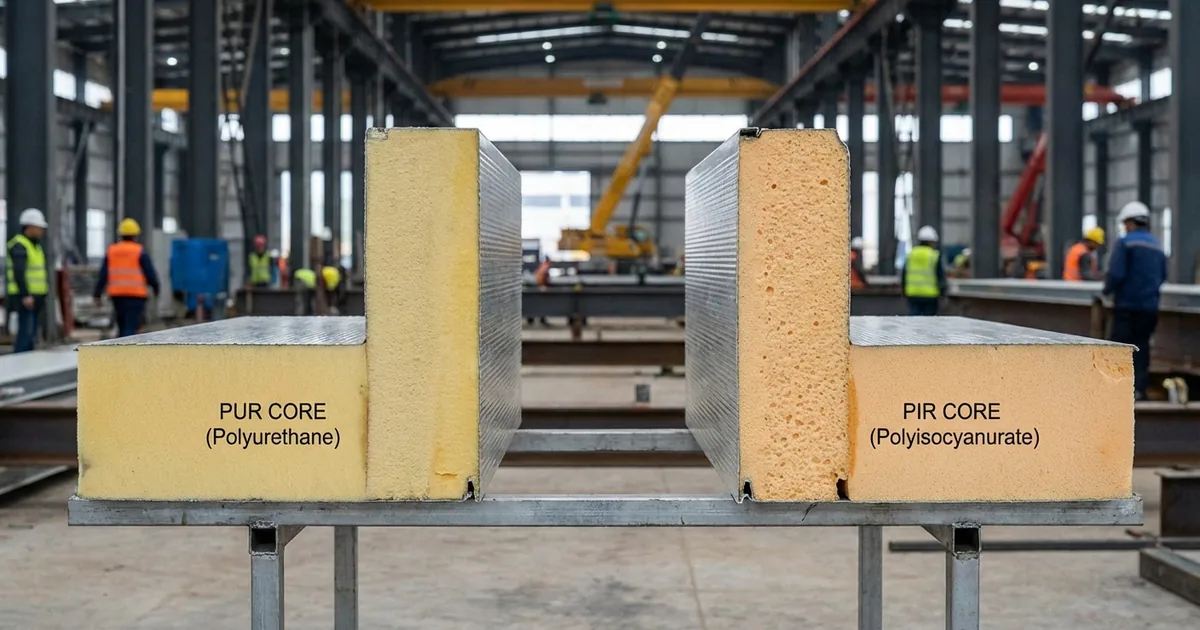
What is PUR (Polyurethane) Sandwich Panel?
PUR has been the gold standard in the insulation industry for decades. This material is created through a chemical reaction between polyols and isocyanates. The result is a closed-cell foam that is highly effective at resisting heat transfer, allowing for excellent thermal performance with minimal thickness.
Advantages of PUR:
- Low Thermal Conductivity: PUR has a very low lambda value (approx. 0.022 W/mK), making it one of the best insulators for low-temperature applications such as cold storage.
- Economic Cost: Compared to PIR, the production process for PUR is simpler, leading to a market price that is typically 10-15% lower in Indonesia.
- Structural Strength: PUR provides an exceptionally strong bond with the steel skins of the sandwich panel, ensuring good structural integrity and resistance to wind loads.
However, the primary drawback of PUR lies in its fire performance. In fire conditions, PUR tends to soften and can contribute to flame spread if not properly managed with fire-retardant additives.
What is PIR (Polyisocyanurate) Sandwich Panel?
PIR is often described as the tougher 'elder brother' of PUR. Chemically, PIR uses a higher ratio of isocyanates and special catalysts that create isocyanurate ring structures, which are extremely stable. This evolution was driven by the industry's need for materials that are not just thermally efficient but also fire-safe.
Why PIR is Becoming the New Standard:
- Superior Fire Safety: The primary advantage of PIR is its ability to form a 'char' layer when exposed to fire. This carbonaceous layer protects the core of the panel from further heat, preventing rapid flame spread. Many PIR panels now achieve fire resistance ratings from EI30 to EI60.
- Dimensional Stability: PIR is more resistant to extreme temperature fluctuations without significant shrinkage or expansion, critical for maintaining airtight joints.
- Long-term Energy Efficiency: The more stable cell structure of PIR ensures that insulation performance remains consistent over decades of intensive use.
Chemical Analysis: Why the Ring Structure Matters
To understand why PIR is superior in terms of fire, we must look at the molecular level. Both PUR and PIR use Isocyanate (MDI) and Polyol as primary raw materials. However, the difference lies in the 'Isocyanate Index'.
In PUR, the ratio of MDI and Polyol is nearly balanced, creating strong but linear polyurethane bonds. In PIR, the amount of Isocyanate is much higher (Index > 250). With the help of special catalysts, this excess isocyanate reacts with itself to form very strong Isocyanurate ring structures.
These rings require much higher thermal energy to decompose. This is why, when burned, PIR does not melt like ordinary plastic but turns into solid carbon (char) that acts as a natural fire barrier. This is crucial for buildings housing high-value assets or facilities requiring longer evacuation times.
Technical Comparison: PIR vs PUR
| Feature | PUR (Polyurethane) | PIR (Polyisocyanurate) |
|---|---|---|
| Thermal Insulation | Excellent (0.022 W/mK) | Superior (0.020 - 0.021 W/mK) |
| Fire Resistance | Low (Class B3/B2) | High (Class B1 / Fire Rated) |
| Operating Temperature | -50°C to +80°C | -150°C to +150°C |
| Cost | More Affordable | Higher Investment |
Environmental Impact and Sustainability
In 2026, sustainability is no longer just a trend but a business necessity. Our sandwich panel materials are produced with environmentally friendly blowing agents, with very low Global Warming Potential (GWP) and zero Ozone Depletion Potential (ODP).
The energy efficiency offered by PIR and PUR directly reduces the operational carbon footprint of your building. With minimal temperature leakage, cooling machines do not need to work as hard, meaning lower electricity consumption. In the long term, using PIR can help your company meet Green Building standards or LEED certification in Indonesia.
Specific Applications in the Indonesian Industry
Indonesia has unique challenges: high humidity and hot outdoor air temperatures. Choosing the wrong material can lead to skyrocketing operational costs due to thermal leaks.
- Food Processing Industry (Surabaya & Medan): For fish or meat processing plants, temperature control is everything. PUR is often chosen for cost efficiency in large process rooms, while PIR is used in main cold storage areas.
- Cikarang & Karawang Industrial Estates (Data Centers & Electronics): For high-tech facilities, PIR is a must. The risk of electrical failures triggering sparks must be mitigated with walls that have high fire ratings.
- Pharmaceutical Sector: Here, cleanliness and thermal stability are crucial. The smooth surface of sandwich panels combined with PIR cores ensures a sterile environment and strictly maintained temperatures according to GMP standards.
For a comparison with other materials, you can read EPS vs PU vs Rockwool: Complete Advantages & Disadvantages Comparison 2026.
Maintenance Guide for Sandwich Panels
To ensure your investment lasts for 25-30 years, routine maintenance is required. Although sandwich panels are weather-resistant, dirt accumulation can damage the coating over time.
- Regular Cleaning: Use low-pressure water and neutral detergent to clean the steel surface. Avoid abrasive chemicals that can damage the anti-corrosion coating.
- Sealant Inspection: Ensure the joints between panels remain airtight. If the sealant appears cracked, immediately re-coat to prevent thermal leaks.
- Thermal Audit: Use a thermal camera every 2 years to detect 'cold bridges' or areas where insulation may have internal damage.
Detailed information on costs per meter can be found in Sandwich Panel Price per Meter Terbaru 2026.
Which One Should You Choose?
The decision between PIR and PUR should be based on three main factors: Building Function, Fire Regulations, and Budget. If you are in a densely populated area or high-rise building, PIR is the mandatory choice for safety reasons.
Learn more about the technical properties of PIR in our article on Material PIR: Properties and Applications.
Conclusion
At sandwichpanels.id, we are seeing a clear trend: more and more business owners in Indonesia are switching to PIR. Although the initial cost is slightly higher, the peace of mind and long-term energy savings far outweigh the price difference. PUR remains a solid choice for basic functional applications, but PIR is the future of safe industrial construction.
Be sure to consult with our technicians to calculate the correct thickness for your project. Contact our team today for the best quotes and a free material needs analysis.