

Fishermen along Java's northern coast routinely hold their catch for hours before a collector's truck arrives. Horticulture growers face the same squeeze. Permanent cold storage sits too far from the harvest point, its capacity is oversized for their volume, and the economics never quite work. Container cold storage and mobile cold rooms fill that gap: refrigerated space you can transport, commission within days, and relocate when production moves elsewhere.
The numbers explain why demand keeps climbing. Figures from the Logistics Directorate of Indonesia's Ministry of Marine Affairs and Fisheries show that in 2024 the country had 2,110 cold storage units with roughly 813,966 tonnes of capacity. Distribution is badly skewed. Java holds 944 units totalling 557,214 tonnes, while Maluku and Papua together have only 303 units and 55,481 tonnes. The regions landing the most fish have the least cold space.
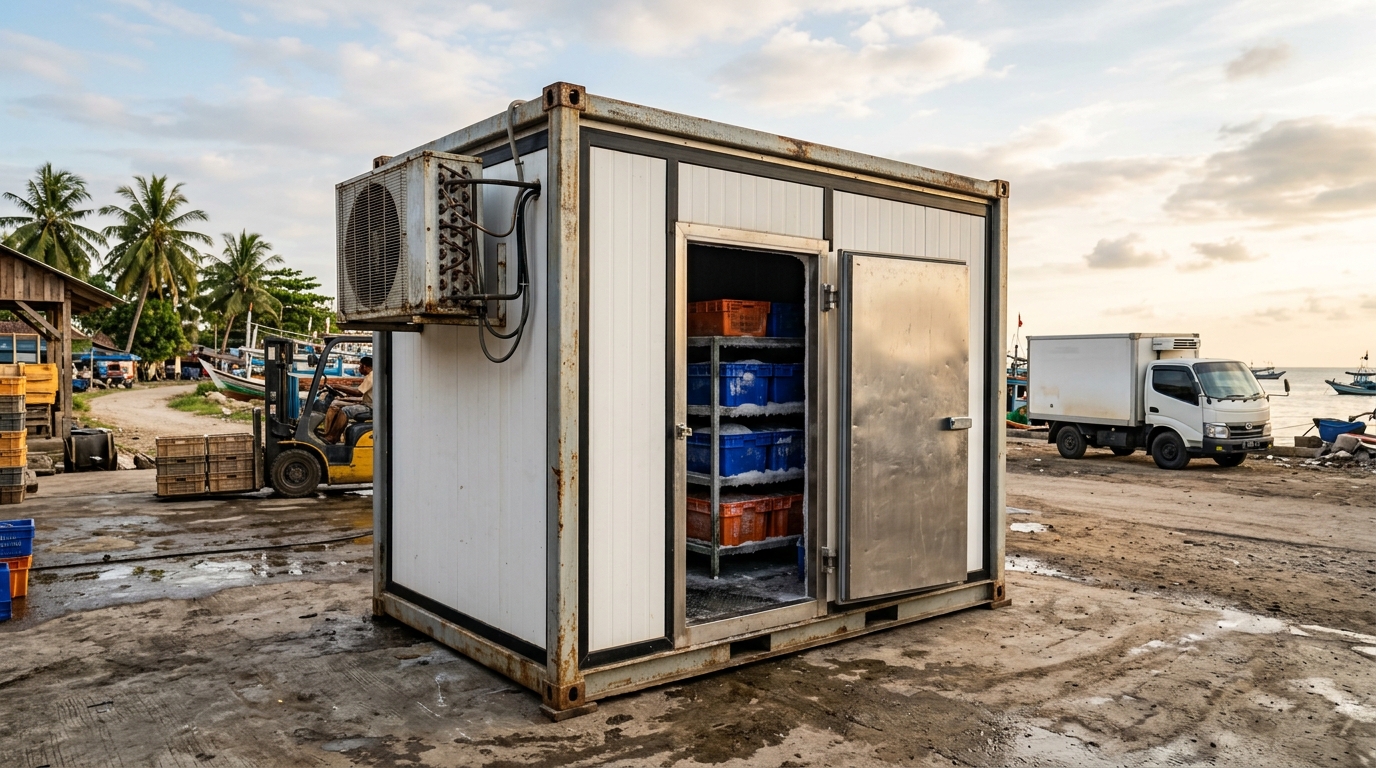
Reefer Containers Versus Panel-Built Mobile Cold Rooms
The two terms get used interchangeably in the market, but they are different products. A reefer container is a refrigerated shipping unit built to ISO 1496-2. External dimensions are fixed at 6,058 × 2,438 × 2,591 mm for the 20-foot type, giving roughly 28–33 m³ of internal volume. The 40-foot version offers 67–72 m³. Operating range typically spans −30°C to +25°C depending on the onboard machinery.
A panel-built mobile cold room works the other way around. The steel frame comes first, then walls, roof, and floor are assembled from PIR or PU sandwich panels joined with cam-lock connections. Nothing ties the footprint to container dimensions. You can specify a 3 × 6 metre module, or two modules that join on site into a single 40 m² room. Refrigeration is selected separately to match the product load.
The practical difference shows up once the unit is working. A used reefer arrives complete and fast, but internal clear height runs only about 2.2 metres and the floor is ribbed for cargo airflow. A panel cold room lets you set ceiling height, door position, and a flat floor that a pallet jack can cross. For a unit handling daily loading, that gap matters more than the price difference suggests.
Panel Thickness Decides Your Electricity Bill
The costliest mistake on mobile cold room projects is rarely the refrigeration plant. It is insulation specified too thin. PIR cores deliver thermal conductivity around 0.022 W/mK, among the lowest of any building insulation. That figure only pays off at the right thickness, though. Thin panels keep the compressor running longer, and the saving you booked at purchase leaves again every month through the meter.
The working guidance used across the cold room panel industry runs roughly as follows:
- 50–75 mm — dry stores, transit areas, and anterooms that are not fully refrigerated.
- 100 mm — chillers at +2°C to +8°C for vegetables, fruit, dairy, and short-hold fresh fish.
- 120–150 mm — freezers at −18°C to −20°C; this band is commonly recommended to reach a U-value near 0.15 W/m²K.
- 150–200 mm — −25°C frozen storage, blast freezing, and any unit standing unshaded in tropical conditions.
Mobile units add one more consideration. Panels flex and twist during transport, so cam-lock joints need tight tolerances backed by elastic sealant rather than plain filler foam. Dimensional standards and tolerances are covered in more depth in our guide to standard wall sandwich panel sizes and thickness.
Weak Points Buyers Tend To Miss
Cold rooms almost never leak through the panel face. They leak at junctions, and a relocatable unit has more of them because the modules must come apart again. Worth checking before you sign off on handover:
- Thermal bridging at the base steel frame — without a thermal break you will get condensation and rust under the floor.
- Door gasket heaters on anything below −18°C, so the seal does not freeze shut.
- Pressure relief valves, which stop walls from being pulled inward after the door closes at low temperature.
- Vapour barrier on the warm side of the panel; installing it the wrong way round traps moisture in the core.
- Lifting points and corner castings on the frame if the unit will be craned regularly.
Budgeting and Testing the Business Case
Market surveys of Indonesian cold storage construction in early 2026 put chiller rooms at roughly Rp4–7 million per square metre and freezer rooms at Rp6–10 million per square metre, inclusive of panels, evaporator, and condensing unit. Mobile units usually land at the upper end of those ranges because they need extra steel framing, a load-bearing floor, and structural stiffening for road transport.
Testing the case is straightforward. Total the product value currently lost or downgraded because no cold space exists near the harvest point, then set it against capital cost plus monthly power. In fisheries the price gap between export-grade fish and downgraded fish is often wide enough to recover the investment within two or three seasons. The broader market picture is covered in our article on cold storage investment in 2026.
Policy direction helps too. The ministry is concentrating cold chain development in its Kampung Nelayan Merah Putih fishing village programme, pairing cold storage of about 10 tonnes per site with ice plants and refrigerated vehicles. Ministry officials quoted by CNBC Indonesia said construction was under way at 65 sites, and that the concept deliberately avoids giant freezer warehouses in favour of small units matched to local output. That 10-tonne bracket is precisely where mobile cold rooms operate.
One permitting note: a relocatable unit still stands on land and draws grid power. Clarify its building status with the local authority early, particularly if it will stay put for more than one season. For fisheries operators targeting export buyers, the applicable quality standards are treated separately in our guide to export-standard fisheries cold storage.
FAQ
How long does a 20-foot mobile cold room take to build?
For a standard configuration with 100–150 mm PIR panels, frame and panel fabrication typically runs two to four weeks, plus several days for on-site assembly and commissioning of the refrigeration plant. Custom footprints, double doors, or heavy-duty floor specifications extend that. Reconditioned reefers can move faster, though units with genuinely healthy machinery are not always available.
Can a container cold storage unit be relocated repeatedly?
Yes, provided it was designed for it from the start. The frame needs lifting points and corner castings, panel joints need elastic sealant, and refrigerant lines need flexible sections near connections. Units built as fixed cold rooms and later forced onto a truck usually start showing corner condensation after the second or third move.
What panel thickness suits frozen fish at −25°C?
Start at 150 mm, and step up to 200 mm if the unit stands unshaded in tropical heat or doubles as a blast freezer. The floor needs matching insulation thickness and a panel with adequate compressive strength, since forklift wheels and stacked pallets bear directly on it.