

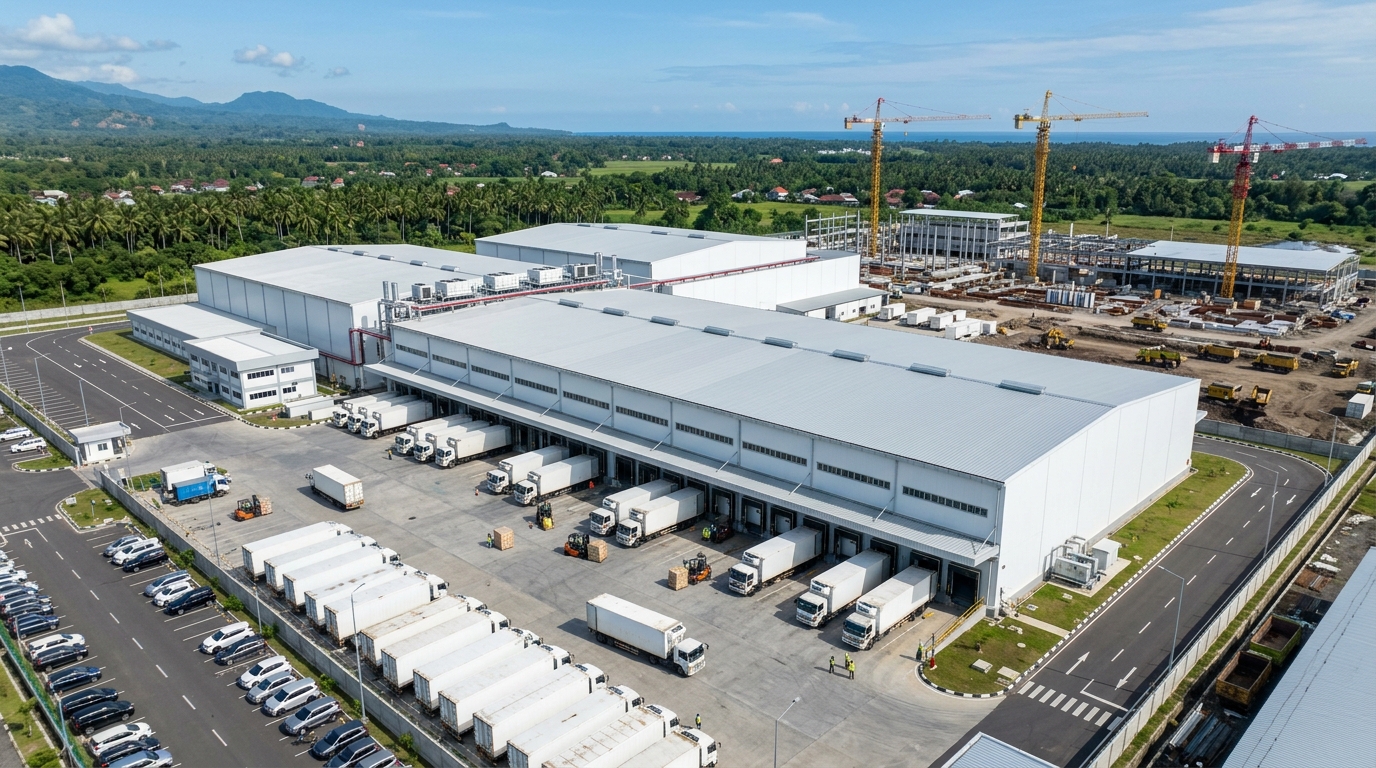
Indonesia's cold chain industry grew 25% in the first half of 2026 according to the Indonesian Cold Chain Association (ARPI), far outpacing the initial 18% forecast. The surge is being driven by three forces at once: aggressive expansion of fresh-food e-commerce platforms such as Sayurbox and Segari, wider vaccine distribution into remote regions, and rising seafood exports to Japan and China. For contractors and landowners, this momentum opens a real business window: new cold storage facilities that must be built fast before the demand window closes.
Market research projects the cold chain logistics industry to climb from roughly USD 7.19 billion in 2025 to USD 9.24 billion by 2031, a CAGR of about 4.23%. Growth at that scale cannot happen without a large addition of refrigerated warehouse capacity across the archipelago, from industrial estates to secondary port cities that big investors have largely overlooked until now.
Who Is Behind the Big 2026 Investments
At least three major players announced new cold storage expansions through 2026. PT ColdHub Indonesia is building three new facilities in Makassar, Medan, and Surabaya with a combined capacity of 45,000 pallet positions, targeting secondary cities that have long lacked refrigerated infrastructure. Singapore-based Freight Logistics is expanding its cold warehouse network in Cikarang and Cakung by another 30,000 pallets, chasing the Greater Jakarta industrial belt's dense export-import activity.
Sinarmas Agribusiness, meanwhile, is planning cold storage facilities for CPO and olein in Dumai and Belawan, reinforcing a plantation supply chain that needs temperature control from upstream to downstream. Together these three projects show that new cold storage demand is no longer confined to one sector — it now spans fresh food, pharmaceuticals, and plantation commodities at the same time.
The investment pattern is consistent: companies are no longer centering only on Jakarta and Surabaya, but spreading into secondary cities with port access or industrial zones. That means demand for fast cold storage construction will grow more evenly across regions rather than staying concentrated in the main economic hubs, opening doors for local contractors in cities like Medan, Makassar, Dumai, and Belawan.
The Capacity Gap: An Untapped Opportunity
Behind this wave of investment, Indonesia still trails its neighbors badly. National cold storage capacity is currently estimated at only around 350,000 pallet positions, equal to roughly 3% of total national cold storage demand. Compare that with Thailand at 15% and Malaysia at 12%. Market research projects Indonesia will need more than 200,000 additional pallet positions within the next three years just to start closing that gap.
This capacity gap means every warehouse developer, contractor, and food-and-beverage processor has a genuine window to build new facilities before the market gets saturated. The slower an industrial region responds to this need, the greater its risk of losing distribution contracts to areas that already have adequate cold infrastructure in place.
Why Sandwich Panels Are the Go-To Choice for New Facilities
When the investment window is limited, construction speed becomes the deciding factor. Cold storage facilities built with PU or PIR sandwich panels can be completed in 3-4 weeks, far faster than conventional brick-and-concrete methods that take 3-4 months. For investors racing to be operational before export or harvest season, that time difference translates directly into revenue.
On the material side, PIR panels offer the best thermal conductivity, in the range of 0.019-0.023 W/mK, a B1 fire rating, and suitability for freezer rooms down to -40°C. PUR panels are better suited to chillers running 0°C to 10°C at a lower upfront cost. PU panel prices run roughly IDR 200,000-350,000 per square meter depending on thickness, while 100mm PIR panels sit around IDR 550,000-680,000, and 150mm freezer-grade panels reach IDR 650,000-780,000 per square meter.
PIR does cost 20-30% more than PUR, but long-term energy savings make it more economical for round-the-clock operation. Since cold storage facilities typically run nonstop seven days a week, the electricity savings from better insulation performance can offset the panel price difference within the first few years of operation, especially for very low-temperature freezers.
Sandwichpanels.id supplies certified PU and PIR panels for industrial-scale cold storage projects, the kind of expansion undertaken by ColdHub, Freight Logistics, and agribusiness players alike. Our team helps calculate the right panel thickness for each operating temperature, so new facilities can start operating without compromising on energy efficiency.
Key Checks Before Starting a New Cold Storage Project
Before signing a construction contract, a few things need to be confirmed so the investment does not miss its operational target:
- Decide the operating temperature (chiller 0-10°C or freezer down to -40°C) early, since it determines whether PUR or PIR is the right choice
- Check land access for large container trucks and reefer vehicles
- Make sure the contractor has real cold storage project experience, not just standard warehouse work
- Calculate the pallet position capacity needed based on a 3-5 year volume projection
- Consider the building quality certification relevant to the target sector, whether seafood export, pharma, or retail
Full specifications on panel thickness and material for different operating temperatures are covered in Panel Sandwich Cold Storage: Spesifikasi, Ketebalan & Harga. For seafood businesses chasing export standards, a dedicated guide is available at Cold Storage Perikanan: Panel Sandwich Standar Ekspor.
FAQ
How long does it take to build a cold storage facility with sandwich panels?
A mid-sized sandwich panel cold storage facility typically takes 3-4 weeks to complete, depending on building size and the complexity of the refrigeration system installation. That is far faster than conventional brick-and-concrete construction, which can take 3-4 months.
Is small-scale cold storage investment still profitable against big players like ColdHub?
Yes, very much so. A national capacity gap covering only 3% of demand means demand still far outstrips supply, especially in secondary cities that big players have not yet reached. Small-to-mid-scale facilities in strategic locations near production centers still have their own solid market.
Should a new cold storage project use PU or PIR panels?
It depends on the operating temperature. PUR is more economical for chillers at 0-10°C, while PIR performs better for freezers down to -40°C thanks to lower thermal conductivity and a B1 fire rating, though it costs 20-30% more than PUR.
Which cities look most promising for new cold storage investment in 2026?
Based on the investment patterns of ColdHub, Freight Logistics, and Sinarmas Agribusiness, secondary port cities such as Medan, Makassar, Surabaya, Dumai, and Belawan are the prime targets since refrigerated infrastructure there remains thin compared to Jakarta. Industrial zones like Cikarang and Cakung also remain in demand due to their proximity to major export-import distribution routes.