

Indonesia's fishery industry is transforming through a government-driven downstream program, prioritizing commodities such as shrimp, seaweed, tilapia, and tuna. The Ministry of Marine Affairs and Fisheries (KKP) launched a Warehouse Management System in early 2026 to map real-time fish stock availability across the nation's cold storage facilities. Amid this push, the quality of frozen storage infrastructure has become the deciding factor for whether a catch can move up from raw material to export-ready value-added product.
Cold storage for fish and seafood carries far heavier demands than typical frozen food warehouses. Beyond an ultra-low temperature that must stay stable around the clock, these facilities must also resist high humidity, corrosive fishy vapor, and intensive loading-unloading traffic. This article covers the cold storage sandwich panel specifications suited for fish freezer warehouses, the regulations that must be met, and a 2026 construction cost estimate.
Why Fishery Cold Storage Needs Special Specifications
Fish and seafood spoil faster than most other frozen commodities because of their high water content and active autolysis enzymes. Once the cold chain breaks, even for a few hours, organoleptic quality drops immediately and the product risks rejection during export inspection. That is why fish freezer warehouses need tighter insulation and completely gap-free joint sealing compared to cold storage for dry goods or pharmaceuticals.
Corrosion is the second major factor. Fishy vapor and salt residue from seafood, combined with frequent water washdowns, degrade walls and floors faster than in other cold storage applications. Choosing the right panel skin — food grade, corrosion resistant, and easy to clean — is a hard requirement, not merely a nice-to-have, especially for fish processing units targeting export markets with strict audits.
Regulations and Mandatory Temperature Standards
Fishery cold storage construction in Indonesia is governed by Ministerial Regulation of Marine Affairs and Fisheries No. 61/Permen-KP/2018 on Fish Processing Units and Cold Storage, which sets technical requirements for frozen storage facilities handling fishery products. In addition, SNI 01-4114-1996 regulates how frozen food, including fish, should be stored inside cold storage, covering layout, air circulation, and product separation by type.
Operating temperatures for fish freezer warehouses typically range from -18°C to -30°C, depending on the commodity and whether storage is short-term or long-term. Unstable temperature not only degrades product quality but is also a leading finding during HACCP audits and competent-authority inspections before export clearance. Maintaining stable temperature in this range is only achievable when the building envelope — wall panels, ceiling, and doors — delivers consistent insulation without weak points.
Sandwich Panel Specifications for Fish Freezer Warehouses
For fish freezer applications, polyurethane (PU) or polyisocyanurate (PIR) core is preferred over EPS because of its lower thermal conductivity at the same thickness. PU suits small-to-medium facilities with good cost efficiency, while PIR offers better stability under extreme temperatures and higher fire resistance, relevant for large facilities undergoing strict international buyer audits.
Common technical specifications used for fish freezer warehouses include:
- PU/PIR core density around 40-45 kg/m³ for optimal structural strength.
- Minimum 100mm wall and ceiling panel thickness for freezer areas below -18°C.
- Food-grade panel skin, typically pre-painted steel with added anti-corrosion coating on surfaces in direct contact with water or raw material.
- Camlock or tongue-and-groove joint systems with low-temperature sealant to eliminate cold bridges at connection points.
- Sliding or swing doors with heater strips on the frame to prevent ice buildup at the door jamb.
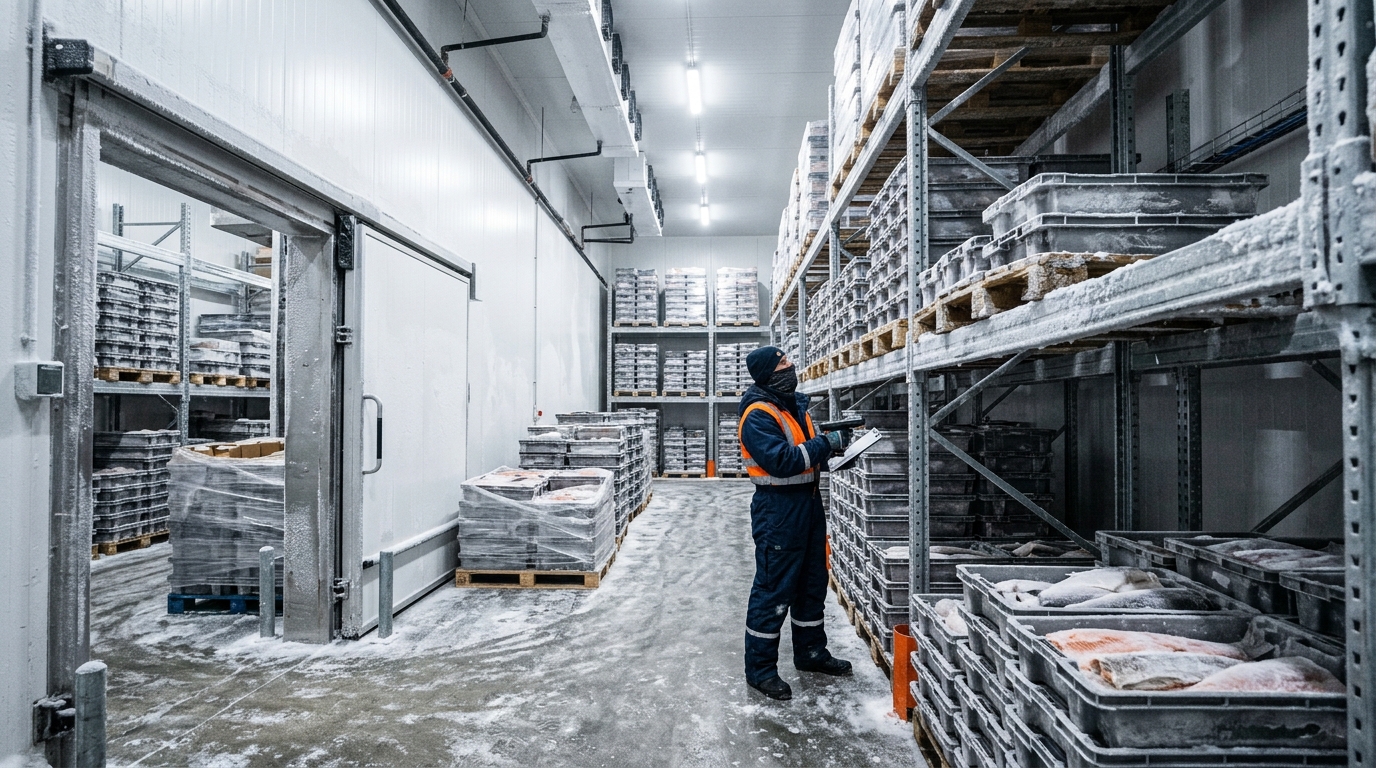
Flooring also needs special attention. Unlike pharma cold storage, which stays relatively dry, fish freezer warehouses face standing water and ice from loading-unloading operations, so waterproofing layers and correct drainage slope matter as much as wall panel specification itself. Installation mistakes at the floor-wall junction are a common source of cold leaks that only surface years into operation — to avoid them, review the most frequent cold storage wall panel installation mistakes found in the field.
HACCP and Fishery Export Requirements
For fish processing units targeting export markets such as China, Saudi Arabia, or Taiwan, a Hazard Analysis and Critical Control Point (HACCP) certificate is a mandatory quality guarantee. A Health Certificate can only be issued once a facility holds HACCP, and shipped products also need a Loading Approval Letter from the local Fish Quarantine, Quality Control, and Fishery Product Safety Agency (BKIPM) technical service unit.
Building design is itself part of the HACCP assessment, particularly regarding cross-contamination prevention. Gap-free panel joints, hygienic rounded corners that are easy to clean, and non-porous, odor-resistant materials all fall under audit criteria. According to an official KKP statement, strengthening national cold storage infrastructure, including a real-time stock information system, is a priority to support fishery downstream development and stabilize prices at the fisherman level.
Fishery Cold Storage Construction Cost Estimate
Construction cost for fish cold storage is driven mainly by three factors: room area and volume, the thickness and core type of the panel chosen, and the refrigeration capacity needed to reach the target temperature. Facilities with lower operating temperatures (closer to -30°C) require thicker panels and larger-capacity compressors, pushing the cost per square meter higher compared to a -18°C cold storage.
Other budget factors include project location, material delivery accessibility, and supporting systems such as automatic temperature monitoring units, cooling-failure alarm systems, and backup generators — components increasingly requested by export buyers as part of cold chain quality assurance. Consult your project's specific requirements with a technical team to get an accurate cost estimate matching your capacity and target storage temperature.
FAQ
What is the ideal sandwich panel thickness for a fish freezer warehouse?
For freezer areas below -18°C, a minimum 100mm wall and ceiling panel thickness with PU or PIR core generally meets the required insulation standard. Projects targeting lower temperatures or larger room volumes may need thicknesses up to 150-200mm to keep the refrigeration system's workload efficient.
Is HACCP certification mandatory for fish cold storage?
HACCP is mandatory for export-oriented fish processing units, since the certificate is required before a Health Certificate can be issued for shipment to destination countries. For the domestic market, HACCP is still strongly recommended as it is an increasingly demanded quality assurance standard among large buyers and modern retailers.
How does fish cold storage panel specification differ from pharma cold storage?
Fish cold storage deals with far higher humidity and standing water, requiring stronger floor waterproofing and corrosion-resistant panel skins, while pharma cold storage places more emphasis on particle contamination control and high-precision temperature validation under CDOB and WHO PQS standards.