

Indonesia's electric vehicle (EV) battery industry has entered a new phase. The battery plant of PT CATL Amperex Technology Indonesia Battery (CATIB), a joint venture between Contemporary Amperex Technology Co. Limited (CATL) through its subsidiary CBL and Indonesia Battery Corporation (IBC), began operating in Karawang, West Java in late July 2026 with a production capacity of 15 GWh per year—6.9 GWh in phase one and 8.1 GWh in phase two. The integrated project represents an investment of roughly Rp96 trillion, involving CATL, PT Aneka Tambang Tbk (Antam), and IBC.
A facility of this scale opens significant opportunities for the factory construction supply chain, including building materials capable of meeting extremely strict technical requirements: dry rooms with extreme humidity control, fire resistance, and fast construction speed. This article explains why PIR sandwich panels have become a preferred envelope material for EV battery plants and dry rooms, along with the technical specifications project teams need to consider.
Why EV Battery Plants Need Dry Rooms
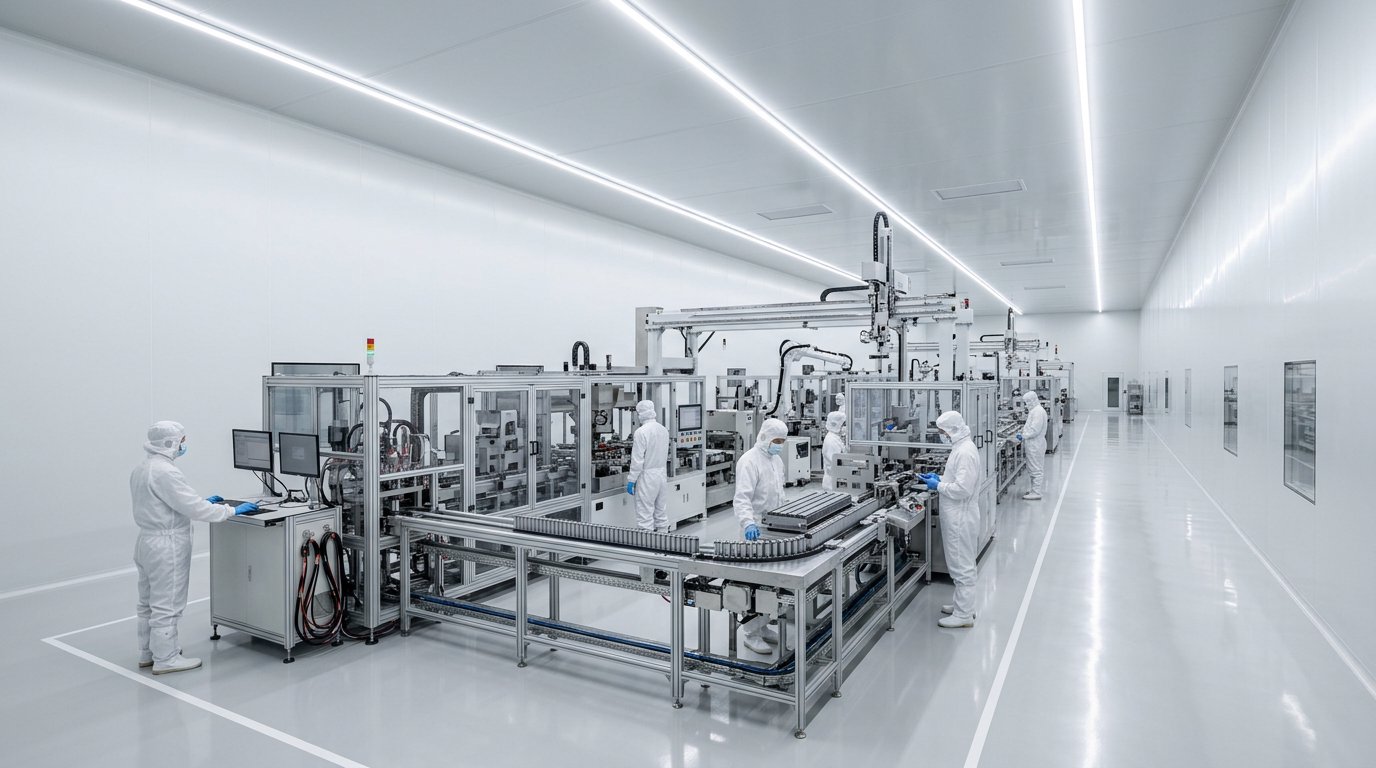
Lithium-ion cell production processes—particularly electrode coating, cell assembly, and electrolyte filling—are highly sensitive to moisture. Water vapor reacting with electrolyte or lithium materials can trigger chemical degradation, hazardous gas generation, and production defects that shorten battery lifespan. This is why the core production area must be built as a dry room: an enclosed space where relative humidity is kept far below normal atmospheric conditions.
Unlike pharmaceutical cleanrooms that focus on particle count, battery dry rooms focus on dew point—a parameter that is far harder to achieve and maintain. Failing to control dew point translates into large-scale production losses, making the building envelope design (walls, roof, joints) a critical engineering element rather than a mere weather barrier.
Dew Point and Humidity Control Specifications for Dry Rooms
Lithium-ion battery industry standards generally require a room dew point around -40°C (equivalent to relative humidity below 1%), although certain processes and next-generation cell chemistries demand -50°C to -65°C. Advanced dry rooms for next-generation battery chemistries even target dew points below -75°C. Supply air from the HVAC/dehumidification system is typically designed even drier than the room target—for example -50°C when the room target is -40°C—to offset internal moisture loads from worker respiration and equipment.
Achieving conditions this strict is virtually impossible with conventional porous walls full of joint gaps. The building envelope must:
- Have the lowest possible vapor permeability on wall and roof panels
- Use hairline joint systems with continuous sealant, not simple overlapping seams
- Avoid thermal bridging in the structural frame that can trigger localized condensation
- Support HVAC ducting and filter integration without compromising room airtightness
Why PIR Sandwich Panels Suit Dry Rooms and Fire Rating Needs in Battery Plants
Sandwich panels with a polyisocyanurate (PIR) core are a popular choice for dry room envelopes because of their low thermal conductivity, around 0.020-0.024 W/(m·K), significantly better than EPS at the same thickness. The metal facing on both panel surfaces also functions as an integrated vapor barrier, reducing the risk of weak points compared to plastered brick walls fitted with a separate membrane.
EV battery facilities also carry real fire risk—from flammable electrolyte filling processes to thermal runaway risk in finished cells. Selecting panels with EI60 to EI120 fire resistance ratings for critical zones (electrolyte rooms, cell filling areas, finished-cell warehouses) is therefore part of risk mitigation, not just regulatory compliance. Read our full guide on EI60-EI120 sandwich panel fire ratings to understand the performance differences between each fire resistance class.
For the dry room area itself, wall material selection largely borrows principles from pharmaceutical cleanrooms—smooth, non-porous surfaces that are easy to clean and minimize gaps where microbes or dust can accumulate. Our team covers this topic in more depth in the cleanroom wall material selection guide, whose vapor-barrier and hairline joint principles are equally relevant to battery dry rooms.
Design and Installation Considerations on Site
Battery plant projects typically run on extremely tight construction schedules due to investment pressure and production targets. Sandwich panels offer faster installation than conventional wet-wall methods, but several points need coordination from the design stage:
- Panel thickness should match the target dew point per zone—core production zones need higher thickness and insulation performance than warehouse or support office areas
- Corner details, ducting penetrations, and wall-floor junctions require special design to maintain vapor barrier continuity
- Core material choice between PIR and rock wool should match the zone: PIR excels in thermal insulation and vapor control, rock wool excels in fire resistance for high-risk zones
- Humidity and air-tightness commissioning tests should be performed before production equipment installation, not after
As EV battery industry investment continues to grow in Karawang and surrounding industrial areas, demand for contractors and panel suppliers who understand dry room technical specifications—not just standard warehouse-grade sandwich panels—is expected to keep rising in the coming years.
FAQ
What is the difference between an EV battery dry room and a pharmaceutical cleanroom?
Pharmaceutical cleanrooms control the count and size of airborne particles according to ISO 14644 classes, while EV battery dry rooms focus on dew point to keep air humidity as low as possible, typically in the -40°C to -65°C range. Both require an airtight, smooth building envelope, but the critical parameters and supporting HVAC systems differ.
What sandwich panel thickness is ideal for a battery plant dry room?
There is no single figure because it depends on target dew point, local climate, and internal moisture load. As a general guide, core production zones with extreme dew point targets (-50°C and below) typically use thicker PIR panels with hairline joint systems and additional sealant, compared to support areas that can use standard warehouse-grade wall panel specifications. Consult your panel supplier's technical team for project-specific requirements.
Are sandwich panels fire-resistant enough for electrolyte filling areas?
Sandwich panels with PIR or rock wool cores are available in fire resistance ratings from EI30 to EI120 depending on thickness and configuration. For high-risk zones such as electrolyte rooms and finished-cell areas, EI60 or higher ratings with rock wool cores are recommended, as rock wool maintains structural integrity longer than PIR under high temperatures.