

Many buyers assume ACP (Aluminium Composite Panel) and sandwich panel are the same product because both get installed as an exterior wall layer. In reality they are fundamentally different: ACP is a decorative cladding material with no structural or thermal insulation capability, while sandwich panel is a structural-plus-insulation element that can fully replace a brick wall or roof. Picking the wrong material can inflate a factory's operating costs or even create a real building safety risk.
This article breaks down the difference between ACP and sandwich panel across structure, insulation, fire safety, and 2026 market pricing, so you can choose the right material for a building facade, warehouse, or factory envelope.
What Is ACP (Aluminium Composite Panel)?
ACP is a composite panel made of two thin aluminium sheets bonded to a polymer core, typically Polyethylene (PE) for the standard variant or Fire Retardant (FR) for the fire-safe variant. ACP thickness usually ranges from 3-4 mm, far thinner than sandwich panel, which can reach 50-150 mm.
ACP's main purpose is aesthetic: covering columns, concrete walls, or steel frames so a building looks modern and clean. It is not engineered to carry structural load or provide meaningful thermal insulation, so it is always installed on top of an existing wall or supporting frame.
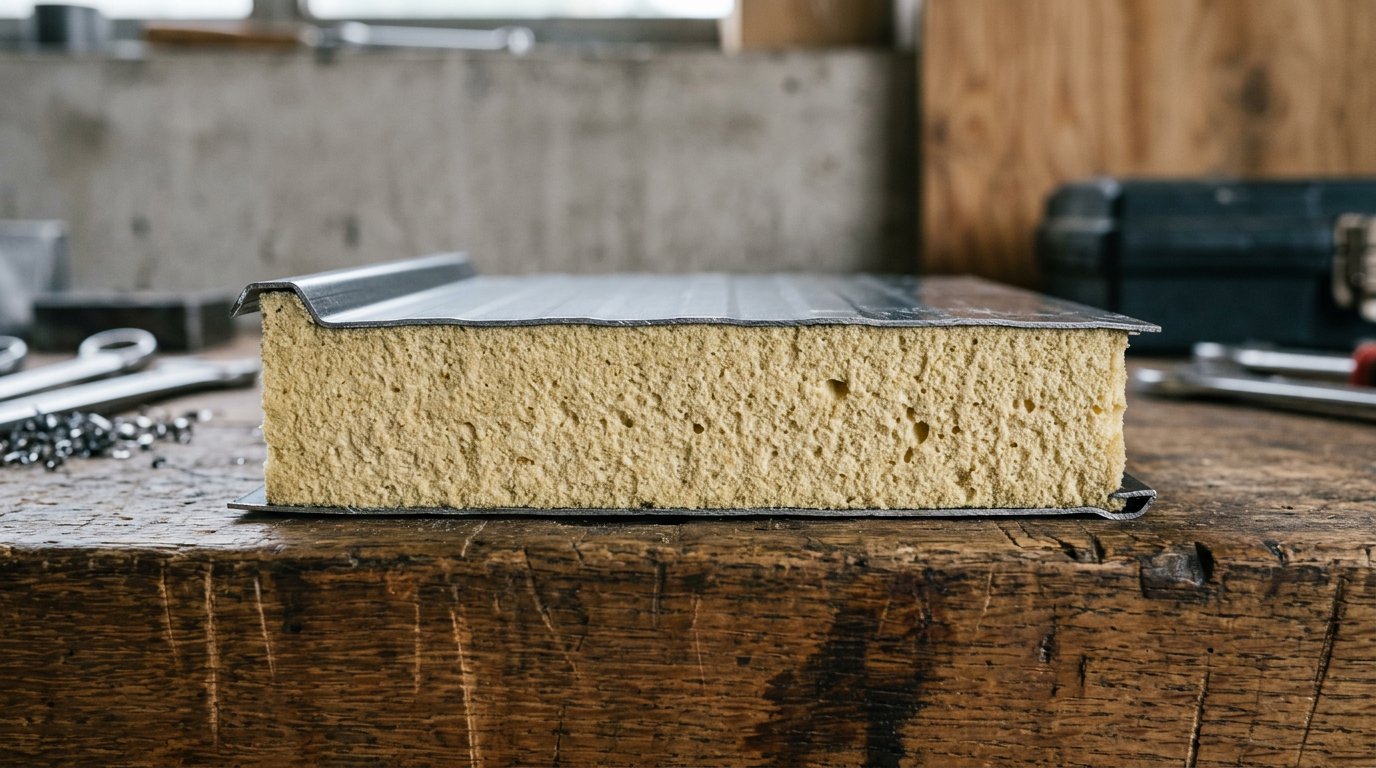
What Is Sandwich Panel?
Sandwich panel is a structural panel made of two metal skins (galvanized/galvalume steel) enclosing an insulation core such as PU (polyurethane), PIR (polyisocyanurate), EPS, or rockwool. Because the core is much thicker and the metal skins are roll-formed into an interlocking profile, sandwich panel can stand alone as a wall or roof without needing brick or a backing frame.
There are several types of sandwich panel, distinguished by core material, each with different insulation and fire performance. The core choice is what determines the building's final performance far more than panel thickness alone.
Key Differences: Structure, Insulation, and Function
The most fundamental differences between the two materials sit in four areas:
- Structural function: ACP is purely decorative and needs a supporting wall or frame; sandwich panel can be a self-supporting wall and roof under EN 14509.
- Thermal insulation: ACP has almost no insulation value because its core is very thin; sandwich panel with a PU/PIR core has low thermal conductivity, effectively blocking solar heat or keeping an interior cold.
- Air and water tightness: sandwich panel's interlocking joint system with sealant produces a tighter envelope than ACP, which needs extra sealant at every panel seam.
- Weight and install speed: ACP is lighter per sheet but needs a separate supporting frame; sandwich panel is heavier per m2 but installs faster since it directly becomes the building envelope.
Fire Safety: Which One Is Safer?
Fire performance is the most critical differentiator, especially for multi-story buildings and industrial facilities. Standard PE-core ACP is combustible and drew global scrutiny after the Grenfell Tower fire in London (2017), which accelerated tighter regulation of combustible cladding in several countries. Manufacturers responded with FR (Fire Retardant) ACP variants using a more heat-resistant core, tested against standards such as ASTM E-84 and German and British fire standards.
Sandwich panel has its own testing pathway through SNI 1741 for fire rating systems, with performance depending heavily on core type. Rockwool core is non-combustible and withstands very high temperatures, PIR offers better fire resistance than standard PU, while EPS is the most vulnerable to fire and is generally avoided in high-risk areas like industrial kitchens or chemical warehouses.
Academic review of ACP materials notes that fire risk in composite cladding is heavily influenced by the polymer core type and how it is installed relative to any air cavity behind it — a factor that does not apply to sandwich panel since its core is fully bonded with no cavity.
ACP vs Sandwich Panel Price Comparison 2026
Based on 2026 market research, price ranges for both materials in Indonesia differ significantly by specification:
- Standard PE ACP: around IDR 300,000 - 450,000 per m2, excluding frame and installation labor.
- FR (fire retardant) ACP: around IDR 450,000 - 600,000 per m2 due to the more expensive fire-safe core.
- Sandwich panel, PU core: around IDR 280,000 - 400,000 per m2, already functioning as a finished wall with no extra frame needed.
- Sandwich panel, PIR core: around IDR 350,000 - 1,200,000 per m2 depending on fire-rating certification.
- Sandwich panel, rockwool core: around IDR 400,000 - 700,000 per m2, chosen when fire resistance is the top priority.
These per-m2 figures are not quite apples-to-apples, since ACP still needs a hollow-steel frame and a base wall, while sandwich panel pricing already includes the complete wall function. Totaled as a full building envelope system, sandwich panel is often more economical for large industrial buildings, as detailed in the roof sandwich panel pricing guide.
When to Use ACP vs When to Use Sandwich Panel
ACP is best suited for purely aesthetic needs: office building facades, canopies, signage, or covering concrete columns in public areas that do not require insulation. Because it is non-structural, ACP cannot serve as a dividing wall for a production floor, cold storage, or cleanroom.
Sandwich panel is the right choice for factories, warehouses, cold storage, pharmaceutical cleanrooms, and modern livestock barns that need temperature and humidity control. Combining structure and insulation in one material speeds up construction compared to the conventional method of brick plus separate ACP cladding.
If your project needs a functional wall that is finished without extra layers, the next step is sourcing quality panels by following the guide to choosing a trusted sandwich panel supplier so core specification and certification match your project's needs.
FAQ
Can ACP be used as a factory's structural wall?
No. ACP only functions as decorative cladding installed over an existing wall or frame. For a factory's structural, load-bearing, insulated wall, sandwich panel is the appropriate choice under the EN 14509 standard.
Which sandwich panel core is the most fire-resistant?
Rockwool core is the most fire-resistant option because it is non-combustible and withstands very high temperatures, followed by PIR, which performs better than standard PU. EPS should be avoided in high fire-risk areas.
Which is cheaper, ACP or sandwich panel?
Standard ACP is slightly cheaper per m2 than PU-core sandwich panel, but ACP still needs a separate frame and base wall. As a complete wall system, sandwich panel is generally more economical for large industrial buildings.