

Installed data center capacity in Indonesia reached roughly 520 MW by June 2026. IDPRO chairman Hendra Suryakusuma expects the national figure to approach 600 MW by year end, driven by projects now entering construction, energization, and commissioning. A medium term projection puts capacity at 1.41 GW by 2029 (Kontan, 5 August 2026).
In early August 2026 CoreWeave announced three AI data centers in Indonesia with a combined 360 MW of contracted IT capacity, targeted to come online in 2028. It is the company's first physical footprint in Asia-Pacific. For contractors and panel manufacturers the message is plain: a lot of technical space has to be built quickly, and the specification will not be forgiving.
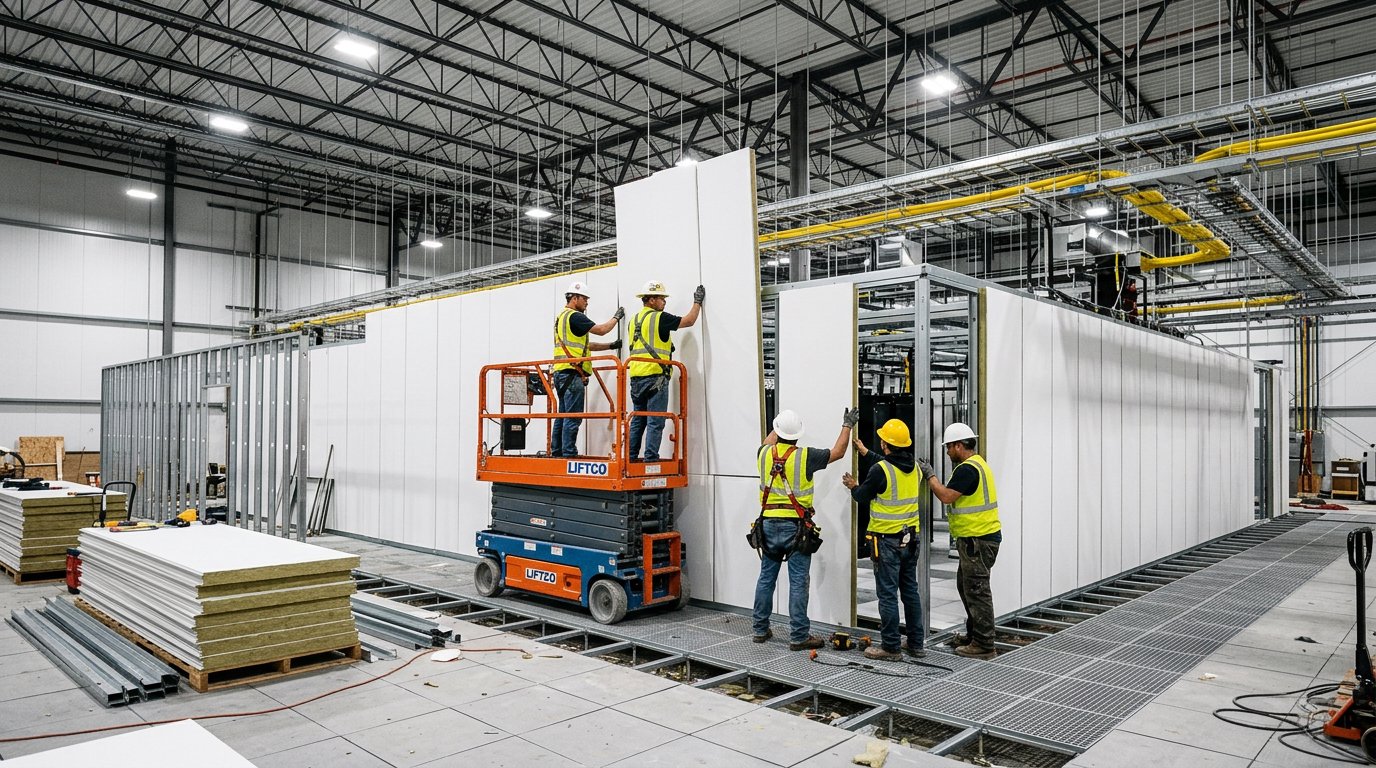
Why a data center wall is not a warehouse wall
The white space carries three demands that rarely appear together in other industrial buildings. It has to hold back fire for a defined period, keep temperature and humidity inside a narrow window, and avoid shedding particles into air that gets recirculated thousands of times per hour.
Plastered masonry can meet the first requirement, but it is slow and wet. Residual moisture from mortar is a real problem in a room held at a low dew point. A metal-skinned sandwich panel solves all three with a dry product installed after the steel frame is up.
- Fire compartment: mineral wool cores deliver EI60 to EI120 resistance classes under EN 13501-2.
- Vapour barrier: pre-coated steel skins are effectively impermeable, so diffusion into the wall cavity is close to zero.
- Clean surface: oven-baked coatings do not shed dust and wipe down easily during commissioning.
- Speed: no curing time, unlike wet trades.
The binding standards: NFPA 75, TIA-942, and ASHRAE
The fire protection reference most data center consultants work from is NFPA 75. Its 2024 edition requires IT equipment rooms to be separated from other occupancies by construction rated at not less than one hour, with opening protectives such as doors rated at three quarters of an hour.
One hour is the floor, not the ceiling. Operators pursuing ANSI/TIA-942 certification at Rated 3 or Rated 4 generally raise the target to two hours where the white space adjoins battery rooms, generator halls, and storage. A panel specified at EI120 on a mineral wool core covers both cases.
Locally, building fire protection in Indonesia follows the technical requirements issued by the Ministry of Public Works, while the panels themselves are usually tested against EN 14509, with SNI 8399 applying only to the light steel support framing. Overseas consultants tend to write specifications around European references, so confirm that a local manufacturer can produce equivalent test reports before the contract is signed.
The thermal side comes from ASHRAE TC 9.9. The recommended envelope at the inlet of Class A1 equipment is 18 to 27 degrees Celsius, with an allowable range of 15 to 32 degrees. Relative humidity is typically held between 40 and 60 percent, and the rate of temperature change is capped at 5 degrees per hour to avoid condensation on cold surfaces.
That last figure gets overlooked. If the wall U-value is too high, cooling load rises and the internal surface can drift toward dew point while the system is in recovery mode. Thicker panels damp that swing.
Choosing a core: rockwool, PIR, or a mix
The core debate on data center projects almost always reduces to one question: how much fire risk is the owner willing to carry. Our full material comparison sits in the guide on EPS vs PU vs rockwool, but for server halls the answer narrows considerably.
- Rockwool (mineral wool): reaction to fire class A2-s1,d0 and capable of EI120. Thermal conductivity sits near 0.040 W/mK, so it needs more thickness for a given U-value. This is the default for white space compartment walls.
- PIR: conductivity around 0.022 W/mK, close to twice as thermally efficient at the same thickness. Well suited to the building envelope and mechanical rooms, less so to critical separating walls.
- Mixed build-up: many projects run PIR on the facade and rockwool internally. It keeps cost down without giving up compartmentation.
How to read the resistance classes and their test certificates is covered separately in our EI60 and EI120 fire rating guide. Worth repeating: an EI class belongs to the complete system, not to the panel alone. Framing, fixings, sealant, and joint details are all part of the tested assembly.
Construction details that get missed
The most expensive mistake on a data center fit-out is rarely the panel selection. It is the penetrations. Every cable tray, chilled water pipe, and duct that crosses a rated wall has to be sealed with a firestop system tested to the same class. One unsealed hole voids the EI rating of the entire wall.
- Use fire-rated sealant, not general purpose silicone, at every panel-to-slab and panel-to-structure joint.
- Set out tray and pipe routes before panels go up; cutting installed panels damages both core and skin.
- Specify server room doors at the correct class, at minimum three quarters of an hour under NFPA 75.
- Survey floor level before installation, because tall panels amplify small deviations.
Why modular methods suit data center schedules
Data center programmes are driven by an energization date already locked into the utility agreement. Wet trades are hard to accelerate because curing time is fixed. Dry panel systems can be installed in parallel with MEP works, and that is usually what recovers the schedule. We set out the principle in our article on the modular sandwich panel system.
One practical gain for owners: panels can be ordered cut to the lengths on the shop drawings, which keeps site waste low and the work area clean. On a project running rack installation and cable pulling at the same time, site cleanliness is not about appearances. It decides whether equipment can move in on schedule.
Hendra himself names lead times on electrical and cooling equipment as a core industry challenge, alongside grid connection timing and a shortage of specialist labour. When equipment arrives late, the only schedule buffer left is usually the civil and architectural package. Dry construction is what creates that room to negotiate.
FAQ
Can sandwich panels be used as server room walls?
Yes, provided the panel system carries fire resistance certification that satisfies local code and NFPA 75, which sets a one hour minimum for separating IT rooms from other occupancies. For facilities targeting TIA-942 Rated 3 and above, a two hour specification on a mineral wool core is the safer call.
What panel thickness suits a white space wall?
Thickness is driven by two things at once, the fire resistance class and the thermal load. A 100 mm rockwool panel is commonly sufficient for EI120 in many certified systems, while server hall insulation demands are lighter than cold storage. Always follow the figures in the manufacturer's test report rather than a rule of thumb.
How do data center panel needs differ from cold storage?
Cold storage chases the lowest possible U-value because the temperature difference against ambient can reach 50 degrees. A data center runs near room temperature, so the priority shifts to fire resistance, humidity control, and surface cleanliness. A panel that is optimal for one application is not automatically right for the other.