

Why Cold Storage Panels Are Crucial for Your Business
In today's competitive business landscape, especially in food, pharmaceutical, and logistics industries, maintaining product quality is key to success. Cold storage panels play a vital role in creating controlled storage environments with stable temperatures. These are not ordinary walls—they are advanced insulation systems that protect your investment from losses due to spoilage, quality degradation, or regulatory non-compliance.
Many business owners face challenges such as:
- Skyrocketing electricity bills from overworked cooling systems
- Rapid product deterioration due to temperature fluctuations
- Difficulty meeting food safety or pharmaceutical standards
- Cold leakage causing energy waste
- Condensation damaging building structures
Understanding Cold Storage Panel Technical Specifications
Before selecting panels, it's essential to understand the technical specifications that determine performance:
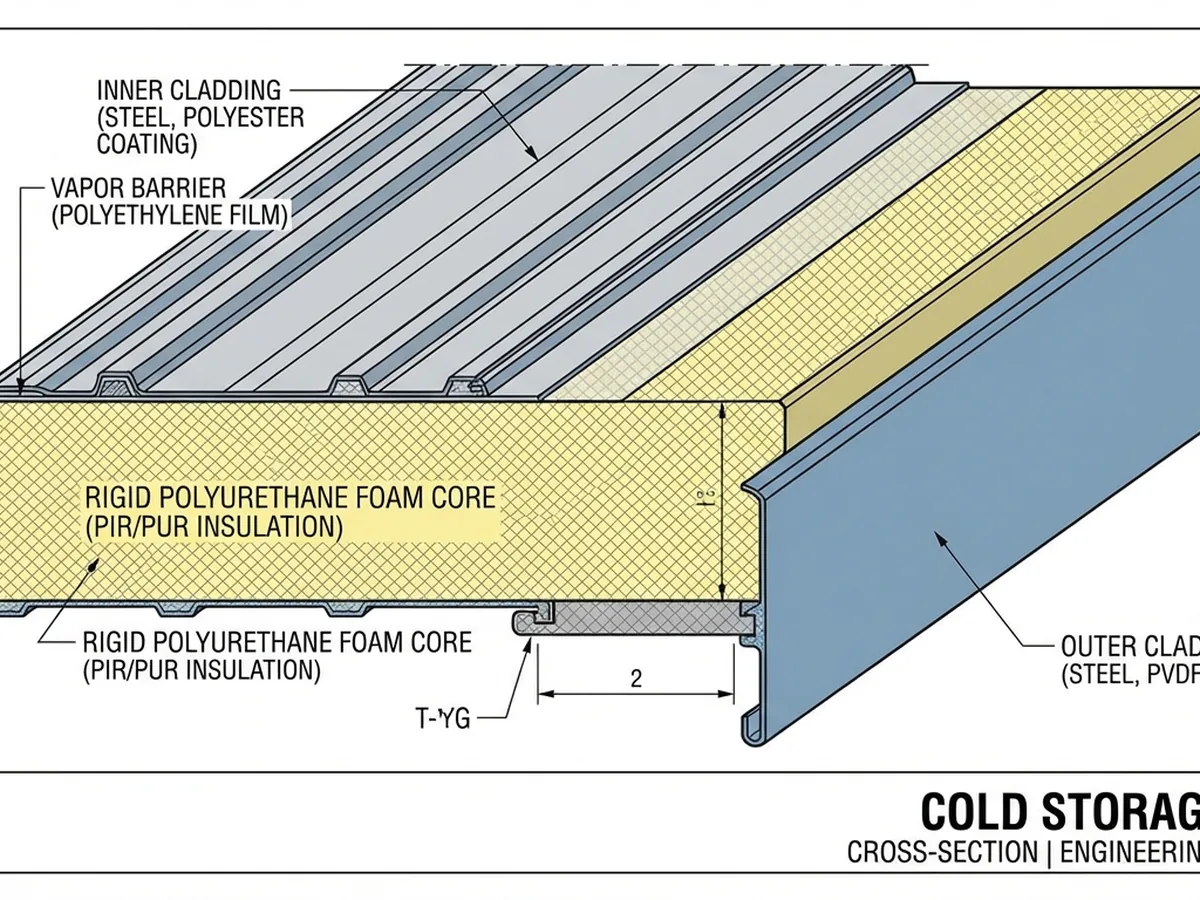
1. R-Value (Thermal Resistance)
R-value measures a panel's ability to resist heat flow. Higher R-values mean better insulation. For cold storage:
- Freezer (-18°C and below): Minimum R-30
- Cold room (0°C to 4°C): Minimum R-25
- Chiller (4°C to 10°C): Minimum R-20
2. Panel Thickness
Thickness determines insulation capacity:
- 50mm: Suitable for chiller rooms
- 75mm: Ideal for standard cold rooms
- 100mm+: Required for freezers and heavy industrial applications
3. Core Material Type
Core material choice affects performance and cost:
PIR (Polyisocyanurate)
Advantages: Highest R-value, Class A fire resistance, environmentally friendly
Disadvantages: Higher cost
Best for: Pharmaceuticals, premium foods, applications with strict standards
PU (Polyurethane)
Advantages: Good performance, competitive pricing, easy installation
Disadvantages: Slightly lower R-value than PIR
Best for: General cold storage, food warehouses, restaurants
EPS (Expanded Polystyrene)
Advantages: Most economical, lightweight
Disadvantages: Lowest R-value, less moisture resistant
Best for: Chiller rooms, budget-constrained applications
Cost Comparison and ROI Analysis
Investment in cold storage panels should be viewed as a long-term decision. Here's a cost vs savings analysis:
| Panel Type | Cost per m² (IDR) | Annual Electricity Savings | ROI (Years) | Lifespan |
|---|---|---|---|---|
| PIR 100mm | 850,000 - 1,200,000 | 35-45% | 2-3 years | 25+ years |
| PU 100mm | 700,000 - 950,000 | 30-40% | 2-4 years | 20+ years |
| EPS 100mm | 450,000 - 650,000 | 20-30% | 3-5 years | 15+ years |
Example calculation: For a 100m² cold storage with PIR panels, an initial investment of approximately IDR 100 million can save IDR 15-20 million annually in electricity costs. ROI is achieved in 2-3 years, and over the 25-year lifespan, total savings could reach IDR 400-500 million!
Applications Across Various Industries
1. Food and Beverage Industry
Cold storage panels must meet food-grade standards with antibacterial surfaces and easy cleaning. Food-grade panels with special coatings are highly recommended.
2. Pharmaceutical and Healthcare
Panels with high chemical resistance and stable temperature maintenance are required. Cleanroom panel systems with airtight seals are ideal choices.
3. Logistics and Distribution
Durability under intensive use and consistent insulation performance are priorities. Panels with thick cladding and strong locking systems are highly recommended.
4. Agriculture and Fisheries
Resistance to high humidity and extreme temperature fluctuations are critical factors. Panels with premium vapor barriers and good drainage systems are essential.
Tips for Choosing a Reliable Supplier
- Check experience and portfolio – Experienced suppliers typically have many similar projects
- Request certificates and technical documents – Ensure panels meet national and international standards
- Conduct site visits – Visit factories or previous projects to see quality firsthand
- Consider after-sales service – Clear technical support and warranty are crucial
- Ask for references – Contact previous clients for real testimonials
Installation and Maintenance Guide for Cold Storage Panels
Proper installation is as important as panel quality itself. Here's a guide to ensure your cold storage functions optimally:
1. Pre-Installation Preparation
Before panels arrive on site, ensure:
- Floor is level and strong – Use leveling compound if needed
- Drainage is available – Drainage system must function well
- Adequate access – Ensure space for transporting panels
- Electricity ready – Cooling system requires stable power
2. Installation Process
Follow these steps for correct installation:
- Start from corner – Install first panel in room corner
- Use special sealant – Apply sealant to all joints
- Tighten properly – Not too tight or too loose
- Check levelness – Use water level every 3-4 panels
- Seal panel ends – Ensure no gaps at top and bottom
3. Routine Maintenance
To maintain cold storage performance:
- Clean surfaces – Use mild detergent monthly
- Check sealant – Inspect sealant condition every 6 months
- Monitor temperature – Record daily temperature fluctuations
- Visual inspection – Look for damage or corrosion signs
- Pressure test – Perform annual pressure test
4. Common Troubleshooting
Common issues and solutions:
| Issue | Cause | Solution |
|---|---|---|
| Unstable temperature | Air leakage | Check and repair sealant |
| Excessive condensation | Damaged vapor barrier | Replace vapor barrier |
| Panel wrinkling | Thermal expansion | Provide expansion joint |
| Cladding corrosion | High humidity | Apply anti-corrosion coating |
Case Study: Cold Storage for Frozen Food SME
A frozen food SME in Bandung successfully optimized operations with proper cold storage panels:
Initial Condition:
- Electricity cost: Rp 8 million/month
- Product loss: 15% due to temperature fluctuations
- Old cold storage: Conventional building with ordinary insulation
Solution:
- PIR 100mm panels with R-32 value
- Tongue-and-groove locking system
- Premium vapor barrier
- Food grade coating
Results After 1 Year:
- Electricity cost reduced 40% to Rp 4.8 million/month
- Product loss decreased to 3%
- ROI achieved in 2.5 years
- Storage capacity increased 25%
Conclusion: Investment in quality cold storage panels not only saves operational costs but also improves product quality and business capacity.
FAQ (Frequently Asked Questions)
Q: How long do cold storage panels last?
A: With proper installation and maintenance, quality cold storage panels can last 20-25 years for PIR/PU, and 15-20 years for EPS.
Q: Is special vapor barrier necessary?
A: Yes, vapor barrier is crucial to prevent condensation inside panels, which can reduce insulation effectiveness and cause structural damage.
Q: How to calculate panel requirements for my project?
A: You can use our panel requirement calculator or consult directly with our technical team.
Q: Can cold storage panels be self-installed?
A: For small projects maybe, but for commercial cold storage, it's highly recommended to use experienced contractors to ensure perfect airtight seals.
Conclusion and Call to Action
Choosing the right cold storage panels is a strategic investment that protects products, saves operational costs, and ensures regulatory compliance. By understanding technical specifications, considering ROI, and selecting reliable suppliers, you can make the right decision for your business.
Ready to optimize your business cold storage? Our expert team is ready to assist you from needs analysis to implementation. Free consultation is available to help you choose the best solution.
Or contact via WhatsApp for faster response and special offers.