

Why This Topic Matters for Industrial Projects
Choosing the right wall and roof system for an industrial building should never be reduced to the cheapest visible material. In warehouses, factories, cold storage rooms, production halls, and hygienic support areas, the envelope affects energy use, installation speed, operating stability, maintenance frequency, and even how professional the facility looks to clients and auditors. That is why the pros and cons of sandwich panels for industrial buildings need to be evaluated through total project value rather than through a narrow material-only comparison.
Many contractors prefer sandwich panels because the metal skins and insulation core are already integrated into one system, making installation faster and thermal performance easier to achieve in a controlled way.
Industrial schedules are usually unforgiving. Owners want to start operations quickly, tenants want earlier turnover, and MEP teams need a stable building shell before internal systems can move efficiently. Sandwich panels often perform well in this environment because they shorten enclosure time and reduce the number of wet trades on site. A building can become weather-protected earlier, interior coordination becomes more predictable, and the final finish often looks cleaner than a conventional wall built from multiple site-assembled layers.
Still, sandwich panels are not a universal answer. They must be specified carefully when fire performance is critical, when the operating environment is highly corrosive, or when future wall modifications are expected to happen frequently.
If you are still comparing envelope options, review the sandwich panel product range to understand different core options and thicknesses. For project-specific recommendations, use the consultation page so the final decision reflects your real thermal, hygiene, and construction requirements.
Key Advantages of Sandwich Panels for Industry
The first major advantage is thermal efficiency. In many industrial buildings, temperature directly influences operating cost. Warehouses storing sensitive materials, food processing rooms, packaging areas, and controlled environments all benefit from a stable indoor condition. Cores such as PIR, PU, EPS, or rockwool reduce heat transfer more effectively than a basic wall system that lacks proper insulation. In practical terms, this helps lower cooling demand, improves indoor consistency, and supports more predictable energy spending.
For owners planning long-term operation, that is not a minor benefit; it becomes part of the building’s financial logic.
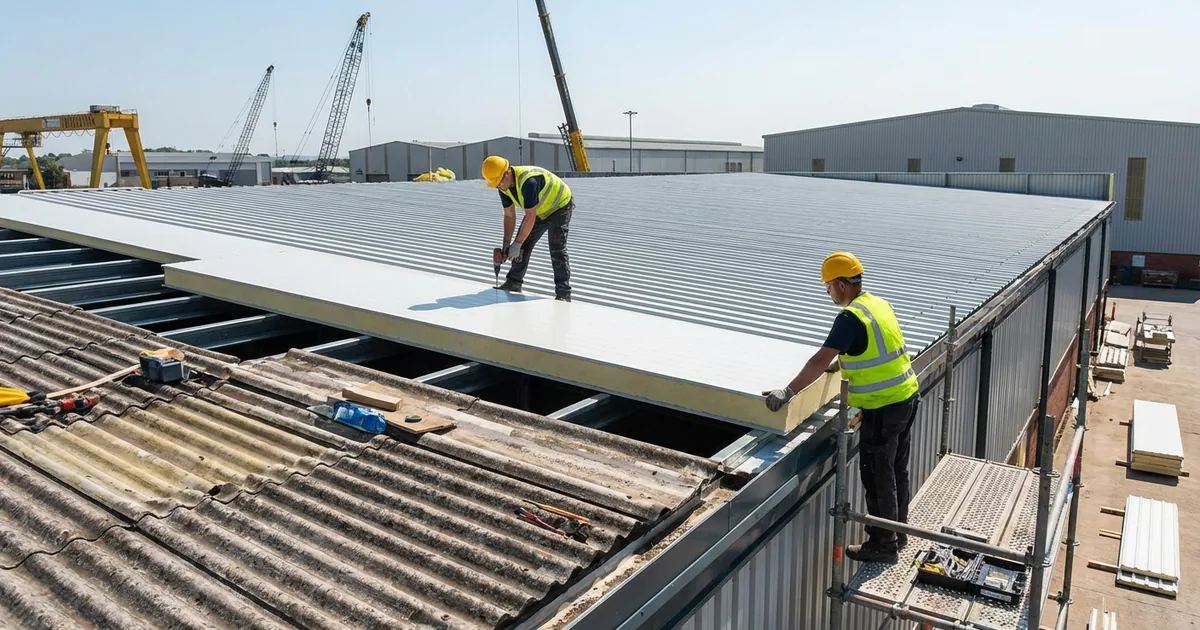
The second advantage is installation speed. Since sandwich panels arrive as prefabricated elements, site teams do not have to assemble multiple layers one by one. For industrial projects working toward commissioning deadlines, saving even a few weeks can change the economics of the whole job. Structural steel can be enclosed faster, interior trades can start sooner, and weather-related disruption becomes easier to manage.
This speed also influences labor cost, equipment cost, and indirect project overhead. A faster dry enclosure is often one of the strongest reasons developers move toward panelized systems.
The third advantage is a cleaner finished appearance. Industrial buildings today are no longer judged only by function. Many warehouses and factories host client visits, regulatory inspections, and operational audits. A flat metal finish, disciplined joint lines, and consistent coating colors help the building look organized and credible. In food, pharmaceutical, and cleaner assembly environments, the smoother internal finish can also support easier housekeeping. That combination of visual order and practical maintenance is a real advantage over basic wall solutions that require extra finishing work to reach a comparable result.
The fourth advantage is application flexibility. Sandwich panels can be used for external walls, roofs, internal partitions, utility enclosures, and spaces requiring stronger thermal separation. That means the same product family can support multiple zones within one facility, simplifying coordination across architecture, structure, and MEP. In some projects, the lighter weight of the wall system compared with heavier masonry alternatives also helps optimize structural design. When speed, thermal control, and visual consistency are all priorities, sandwich panels become highly competitive.
Limitations and Risks That Must Be Counted
The first limitation is the initial capital cost. If a buyer compares only the purchase price of visible wall material, sandwich panels can appear more expensive than simple conventional alternatives. That quick comparison is misleading because it ignores insulation value, installation speed, operational savings, and finishing quality. Even so, the higher upfront figure still matters in cost-sensitive projects, especially where thermal requirements are modest. Owners need to respect that reality rather than pretending the initial budget difference does not exist.
The second limitation is installation sensitivity. Sandwich panels perform well only when joints, flashings, fasteners, sealants, and handling procedures are executed correctly. Poor unloading, careless lifting, weak joint sealing, or imprecise alignment can lead to dents, coating damage, leaks, thermal bridging, and disappointing appearance. In other words, a good product can still underperform if the installer lacks experience. That is why project teams should treat detailing as seriously as material selection.
If technical installation guidance is required, the project services and support page provides a useful starting point for structured coordination.
The third limitation is post-construction modification. With masonry walls, some site teams feel more familiar cutting or altering small openings later. Sandwich panels can still be modified, but the work must be planned more carefully so the integrity of the panel, finish continuity, and weather tightness are not compromised. This is not a reason to reject the system, but it is a reminder that future flexibility should be discussed during design rather than left entirely for later improvisation.
If machinery layout or logistics flow may change often, panelization and opening locations should reflect that possibility from the beginning.
The fourth limitation is incorrect core selection. Not every sandwich panel suits every industrial use case. EPS may be economically attractive in some projects, while PIR or PU may be more appropriate where insulation efficiency is crucial. Rockwool may become more relevant where fire performance receives stronger emphasis. A poor core decision can make a building look economical at tender stage but expensive during operation or difficult during compliance review.
Therefore, the pros and cons of sandwich panels must always be linked to the selected core, thickness, coating, and operating environment rather than discussed as if all panel systems are identical.
When Sandwich Panels Are the Right Choice
Sandwich panels are particularly strong when a project needs a balance of speed, insulation, cleanliness, and professional appearance. Warehouses, cold rooms, food factories, electronics facilities, and expansion buildings with tight handover deadlines are common examples. In these projects, faster enclosure and better temperature stability often justify the system very clearly. Hygienic environments gain an extra advantage from cleaner surfaces that are easier to maintain, while operational teams benefit from a more predictable internal condition.
They are also appropriate when owners want operating costs to remain under control over time. Even if the initial purchase price is higher than a basic wall system, a better envelope can reduce cooling demand and help maintain process stability. In industrial decision-making, that matters because indoor consistency affects product quality, employee comfort, equipment reliability, and utility planning. For many owners, sandwich panels are no longer just a cladding product; they are part of an efficiency strategy.
However, sandwich panels may be less attractive when a building has almost no insulation requirement, when the environment is unusually aggressive without the right protective coating, or when frequent uncontrolled modifications are expected after handover. In such situations, comparison with other systems remains valid. The right conclusion should include temperature needs, project timeline, hygiene targets, fire expectations, maintenance access, and the capability of the installation team.
How to Evaluate the System Objectively
A practical way to evaluate sandwich panels is to ask five questions. First, how critical is temperature control for the products, equipment, or people inside the building? Second, how fast must the facility be enclosed and operational? Third, what level of finish, cleanliness, and visual order is required? Fourth, what are the fire and corrosion expectations? Fifth, how often will the building layout change after operation starts?
If most answers point toward thermal control, speed, and cleanliness, sandwich panels usually become a strong candidate. If not, the project team should compare alternative systems without bias.
An objective review should also include the supplier and installer, not just the panel brochure. A strong specification can still fail through weak execution, while the right product installed correctly can provide long service life and acceptable maintenance cost. That is why the final decision should combine material performance, climate exposure, process needs, future expansion planning, and installation discipline.
FAQ
Are sandwich panels always more expensive than conventional walls?
Not when the full project cost is considered. The upfront material figure may be higher, but faster installation, better insulation, and lower operating cost can make the total outcome more competitive.
Which core is suitable for industrial buildings?
It depends on the project. EPS can be economical, PIR and PU are strong for thermal efficiency, and rockwool is often chosen when fire performance is more important.
Are sandwich panels suitable for logistics warehouses?
Yes, especially when the project values fast installation, a cleaner appearance, and better temperature control than a basic non-insulated wall system can provide.
Conclusion
The pros and cons of sandwich panels for industrial buildings must be judged in relation to the project’s real operating priorities. The system offers strong insulation, fast installation, clean appearance, and flexible industrial use, but it also requires disciplined detailing, correct core selection, and a broader cost analysis than a simple material price check. When speed, efficiency, and long-term building performance matter, sandwich panels are often a very rational choice.
If you need a recommendation based on your warehouse, factory, or cold storage application, contact our team through sandwichpanels.id so the specification matches your actual project condition rather than a generic assumption.