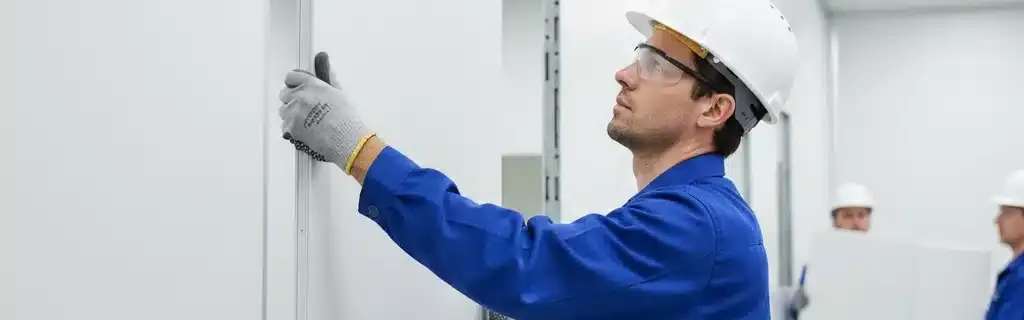

Building a clean room for the food industry is not just about providing a clean production space. You must meet food safety standards, control dust particles, and ensure proper airflow to prevent product contamination. Many entrepreneurs experience certification failures or defective products because they skip critical construction steps.
The success of clean room construction depends not only on quality materials, but also on an experienced construction team that understands food industry hygiene standards. Each stage must be well documented to facilitate future audits and certification processes.
This guide discusses clean room construction steps for the food industry systematically from planning to final validation. Follow this sequence so your facility passes audits and is ready for commercial operation.
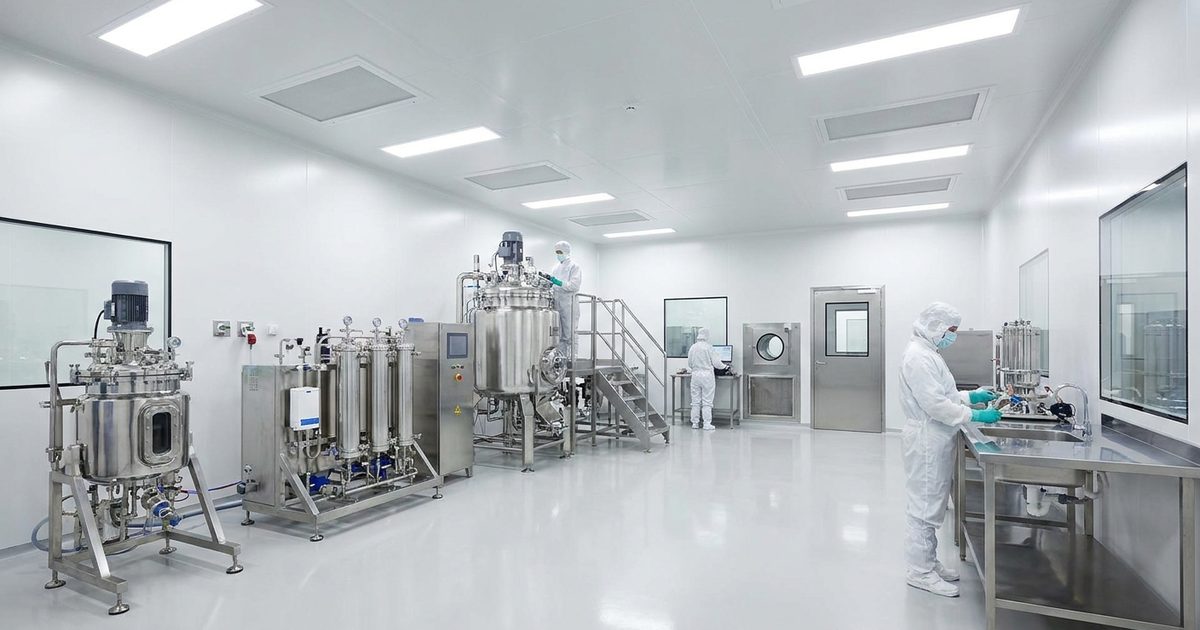
Why Clean Rooms Are Important for the Food Industry
The food industry faces risks of microbial contamination, dust, and allergens that can damage products and endanger consumers. A clean room provides a controlled environment with:
- Controlled air particles according to ISO 14644 classification
- Stable temperature and humidity to prevent bacterial growth
- Positive pressure that prevents pollutants from entering
- Wall and floor materials that are easy to clean and sanitation-resistant
Without adequate clean rooms, your products risk failing laboratory tests, being withdrawn from the market, or even causing mass poisoning.
Stage 1: Needs Analysis and Design Planning
Before starting construction, conduct a thorough analysis:
- Determine clean room classification — ISO 8 for packaging, ISO 7 for primary production, or ISO 6 for sensitive products
- Calculate area and layout — separate clean, semi-clean, and dirty zones with clear airlocks
- Identify heat loads — production equipment, lighting, and personnel affect HVAC requirements
- Plan personnel and material flow — avoid cross-contamination with separate entry routes
This planning document becomes the foundation for the entire project. Errors at this stage will impact all subsequent stages.
Stage 2: Material and Component Selection
The right materials determine long-term clean room success:
Wall and Ceiling Panels
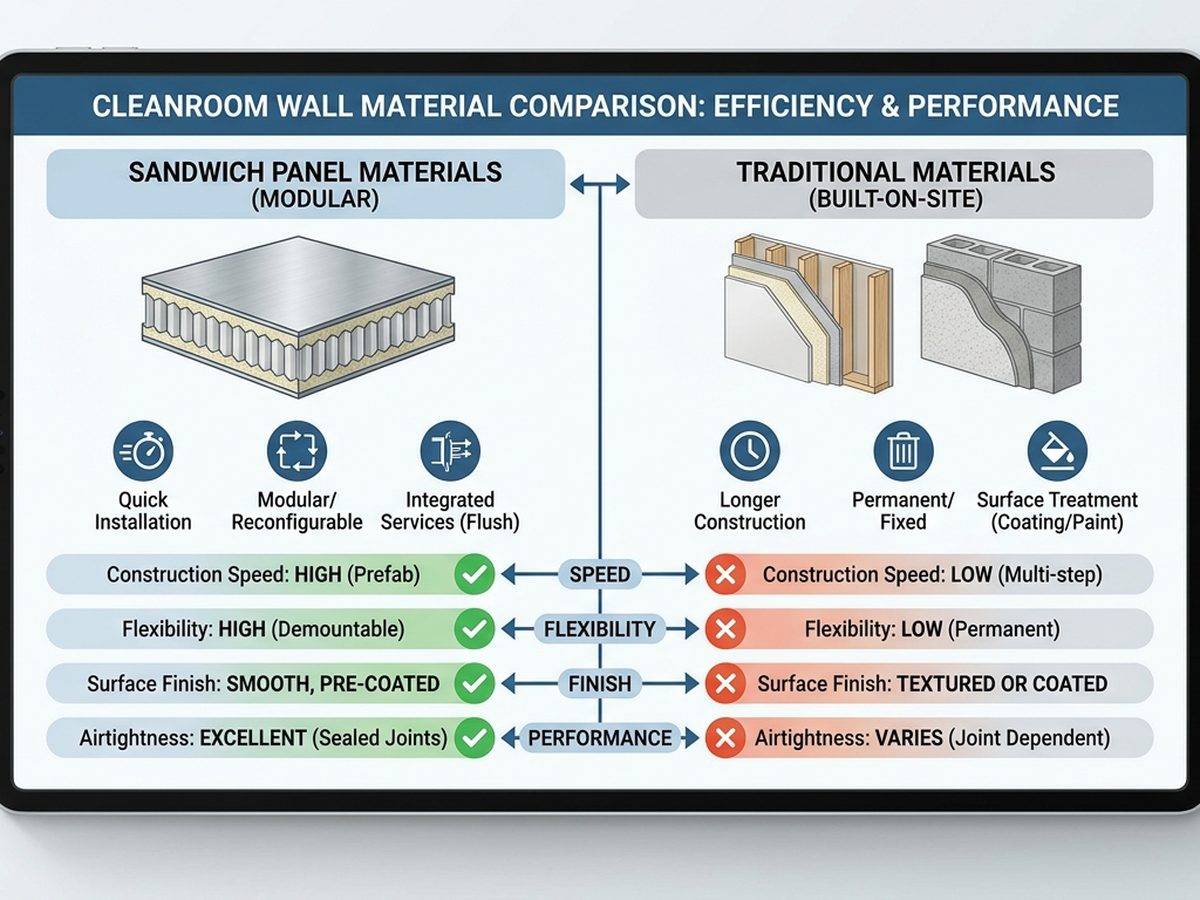
Use modular sandwich panels with specifications:
- Core material: rockwool or PU for insulation and sound absorption
- Surface: prepainted steel or stainless steel 304 for ease of sanitation
- Thickness: 50-100mm depending on insulation needs
- Joint system: camlock or tongue-groove for airtightness
HVAC System
Specialized clean room AHU (Air Handling Unit) must filter particles down to HEPA filter H13 or H14. Calculate CFM based on required air changes per hour.
Doors and Windows
Choose cleanroom doors with tight rubber seals, double glass vision panels, and interlock features.
Stage 3: Construction and Panel Installation
The construction process requires high precision:
- Floor preparation — ensure level surface with epoxy or chemical-resistant vinyl flooring
- Aluminium frame installation — install track and stud according to layout
- Wall panel installation — start from corners, ensure tight joints
- Ceiling installation — install T-bar grid or suspended system
- Utility integration — penetrate panels for outlets with proper sealing
Every connection must be checked with smoke tests to ensure no air leakage.
Stage 4: HVAC and Filtration System Installation
The air system is the heart of the clean room:
- Ducting installation — use pre-insulated ducting or stainless steel ducting
- Filter staging — from pre-filter G4, bag filter F7-F9, to HEPA H13/H14
- Pressure differential — install pressure sensors between zones for real-time monitoring
- Return air system — design return grille to avoid dead zones
Verify HVAC performance with airflow visualization and particle count tests.
Stage 5: Equipment and Furniture Installation
After structure and HVAC are ready, install production equipment:
- Stainless steel work tables — no sharp joints, easy to clean
- Racks and storage — off-wall design for cleaning access behind
- Pass box and air shower — for material transfer and personnel decontamination
- Laminar airflow unit — for areas requiring extra protection
All equipment must have food-grade certification and not generate particles.
Stage 6: Validation and Qualification (IQ/OQ/PQ)
Critical stage before operational:
Installation Qualification (IQ)
Verify all components are installed according to design specifications. Document model, serial number, and location of each equipment.
Operational Qualification (OQ)
Test system operation without product:
- Recovery test — how long clean room returns to classification after disturbance
- Air change rate — verify ACH meets specifications
- Filter integrity test — scan HEPA filters for leaks
Performance Qualification (PQ)
Test with actual operational conditions:
- Particle count with personnel and equipment operating
- Microbial monitoring — settle plate and air sampling
- Surface sampling — swab test on product contact points
Common Mistakes to Avoid
Based on project experience, these mistakes often occur:
- Undersizing HVAC — saving costs initially but failing to maintain classification at full load
- Non-food grade materials — panels with hazardous coatings or that easily peel
- Non-ergonomic layout — workflow forcing personnel to repeatedly cross different zones
- Ignoring maintenance access — no space for filter and equipment service
- Incomplete documentation — difficult during audits or future troubleshooting
FAQ: Common Questions About Food Industry Clean Room Construction
How long does food industry clean room construction take?
For 100-200 m2 space, typical projects take 4-8 weeks depending on complexity. Panel construction 1-2 weeks, HVAC 2-3 weeks, and validation 1-2 weeks.
What is the construction cost per m2 for food clean rooms?
Cost range IDR 3-8 million per m2 for panel structure, basic HVAC, and validation. Costs increase significantly for high classifications (ISO 5-6).
Does food clean room need special certification?
In Indonesia, food clean rooms must meet BPOM Standards and can be audited based on ISO 14644. Some exports require additional certification like BRC or FSSC 22000.
Can clean rooms be built in stages?
Yes, with modular panel systems you can start from priority zones and expand to other areas. The modular advantage is relocation flexibility.
How to maintain food industry clean rooms?
Regular schedule: filter replacement (pre-filter 3-6 months, HEPA 1-3 years), daily cleaning, monthly sensor calibration, and annual revalidation.
Conclusion and Next Steps
Food industry clean room construction requires careful planning, quality materials, and thorough validation. From needs analysis, selecting the right sandwich panels, professional HVAC installation, to IQ/OQ/PQ qualification.
Do not let construction errors disrupt your operations and business reputation. Consult your clean room project with our expert team for optimal design and transparent cost estimates. Contact SandwichPanels.id for site surveys and detailed quotations.