

Why Sandwich Panel Thickness Matters
Choosing the right sandwich panel thickness is one of the most critical decisions in any industrial construction project. The wrong thickness can result in excessive heat buildup, wasted energy, or failure to meet safety standards. On the other hand, panels that are too thick inflate your budget without delivering proportional benefits.
Sandwich panel thickness directly affects three key properties: thermal insulation performance, structural strength, and fire resistance. A 50mm panel may suffice for interior office partitions, but it will fall short for cold storage walls that must maintain -20°C.
This guide will help you choose the right thickness — from 50mm to 150mm — based on your application type, insulation requirements, and project budget.
Common Sandwich Panel Thickness Options in the Market
In Indonesia, sandwich panels are available in several standard thicknesses. Here is a breakdown of each option and its ideal applications:
50mm — Light Partitions and Interior Use
50mm panels are the most economical option. They are suitable for office partitions within factories, light production area dividers, or interior walls not exposed to extreme weather. These panels provide basic thermal insulation and are adequate for non-critical applications.
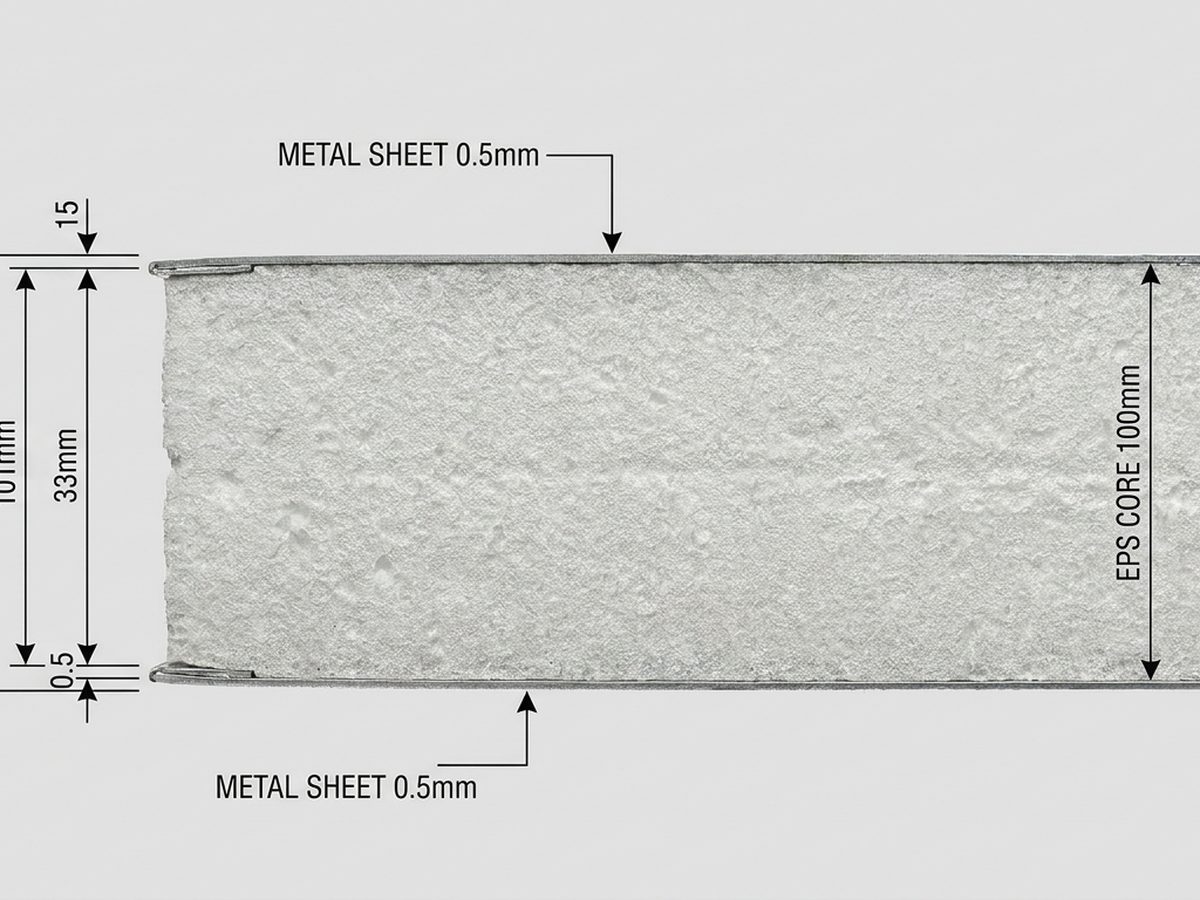
For exterior applications or areas with significant temperature fluctuations, 50mm panels are generally insufficient. The U-value of a 50mm EPS panel is approximately 0.70 W/m²K — adequate for lightly air-conditioned rooms, but not for cold storage or cleanroom environments.
75mm — Exterior Walls and Standard Warehouses
75mm panels are the most popular choice for warehouse walls and roofs and general industrial buildings. This thickness offers an optimal balance between cost and insulation performance. The U-value is approximately 0.45 W/m²K for EPS-core panels — sufficient to keep interior temperatures comfortable in Indonesia's tropical climate.
75mm panels also provide good structural rigidity, capable of withstanding standard wind loads for one- to two-story industrial buildings. Most warehouse projects, light factories, and commercial buildings use this thickness as a standard.
100mm — Cold Storage, Cleanrooms, and High Insulation
100mm panels are the minimum standard for applications requiring high insulation performance. With a U-value around 0.22 W/m²K (PIR core), these panels are ideal for cold storage walls and roofs, refrigeration rooms, and cleanroom walls that demand precise temperature and humidity control.
Core material makes a significant difference at this thickness. PIR (Polyisocyanurate) provides superior insulation compared to EPS and offers better fire rating. For low-temperature cold storage (below -20°C), 100mm PIR panels are the minimum recommended option.
150mm — Extreme Temperature Applications and High Fire Rating
150mm panels are used for heavy-duty applications: ultra-low temperature cold storage (-40°C), industrial-scale freezer rooms, or buildings requiring EI120 or EI240 fire ratings. The U-value of a 150mm PIR panel can reach 0.15 W/m²K — delivering maximum energy efficiency for long-term operations.
Although more expensive upfront, the electricity savings from superior insulation often pay back the investment within 2-3 years for large cold storage facilities or 24-hour operations.
Key Factors in Choosing Panel Thickness
Beyond application type, several technical factors should be considered before deciding on panel thickness:
- Wind and seismic loads: Thicker panels offer higher rigidity. For buildings in high-wind zones or earthquake-prone areas, consider a minimum of 75mm for exterior walls.
- Core material type: PIR provides 30-40% better insulation than EPS at the same thickness. A 75mm PIR panel may match the performance of a 100mm EPS panel for certain applications.
- Purlin spacing: For roofs with wide purlin spacing (>1.5m), 75mm or 100mm panels are recommended to prevent deflection.
- Building regulations: Some local governments require minimum fire ratings for industrial buildings. 100mm or 150mm rockwool panels may be mandatory for specific sectors.
- Long-term budget: Calculate 5-10 year operational costs, not just upfront material costs. Thicker panels with better insulation often prove more cost-effective over time.
Common Mistakes When Choosing Sandwich Panel Thickness
Here are frequent errors and how to avoid them:
- Choosing the cheapest panel without considering thermal load. Using 50mm panels for cold storage walls is a critical mistake — electricity bills will soar and temperatures will be difficult to maintain. Always calculate cooling loads before selecting.
- Ignoring core material differences. EPS 100mm ≠ PIR 100mm. Never look at thickness alone without considering the core type used.
- Failing to plan for future expansion. If there is a possibility of upgrading to cold storage or cleanroom within 5 years, consider 100mm panels from the start.
- Using the same thickness for walls and roofs. Roofs receive higher thermal loads from direct sunlight. In Indonesia, roofs often require one thickness level above walls.
How to Calculate Panel Requirements by Thickness
Once you have selected the thickness, the next step is to calculate the number of panels needed. The basic formula is straightforward: total area (m²) ÷ area per panel sheet. However, add 5-10% for waste factor (cuts, fittings, and damage).
For large projects, consult with a contractor or supplier for more accurate calculations. Panels of different thicknesses may have different effective widths due to their joint systems.
Frequently Asked Questions (FAQ)
What is the main difference between 75mm and 100mm panels for a standard warehouse?
75mm panels are sufficient for general storage warehouses without strict temperature control. 100mm panels are recommended if the warehouse stores temperature-sensitive goods, has high worker activity (internal heat load), or is located in an area with extreme ambient temperatures. The cost difference is approximately 20-25%, but energy savings can be significant for cooled warehouses.
Can 50mm panels be used for roofing?
Not recommended for industrial building roofs in Indonesia. Roofs receive significant direct solar radiation — 50mm panels will transfer too much heat into the building. Use a minimum of 75mm panels for roofs, and consider 100mm if the area beneath the roof is used as an active workspace.
How do I choose the right thickness for cold storage?
For cold storage, use thermal load calculations as your primary guide. As a general reference: chiller rooms (0°C to 5°C) require at least 75mm PIR panels, freezer rooms (-18°C) at least 100mm PIR, and blast freezers (-40°C) at least 150mm PIR. Consult a cold storage specialist for accurate calculations based on room dimensions and stored products.
Conclusion
Choosing the right sandwich panel thickness is an investment that affects your building's comfort, safety, and operational costs for decades. Do not fall into the trap of choosing based solely on the lowest price — consider your specific application, environmental conditions, and total long-term cost of ownership.
For standard projects like warehouses and light factories, 75mm panels are a safe choice. For cold storage, cleanrooms, or buildings with high insulation requirements, use at least 100mm. And for extreme temperature applications or high fire ratings, 150mm panels are the right investment.
Need help determining the right specifications for your project? Contact our team via WhatsApp for a free consultation and the best pricing. Our technical team is ready to help calculate your panel requirements — at no cost and with no obligation.