

A laundry is one of the harshest rooms in any building. Hot vapour from washers and dryers, splash water, alkaline detergent and chlorine bleach all work on the same surfaces through every shift. Painted plaster walls typically show mould along the joints within months, then the paint starts to peel.
That is why many hospitals and commercial laundry operators move to sandwich panel walls. The surface is flat, the joints are few, and it takes disinfectant wiping without absorbing water. This article covers the construction side: core selection, steel coating, and the installation details that decide whether the wall lasts five years or fifteen.
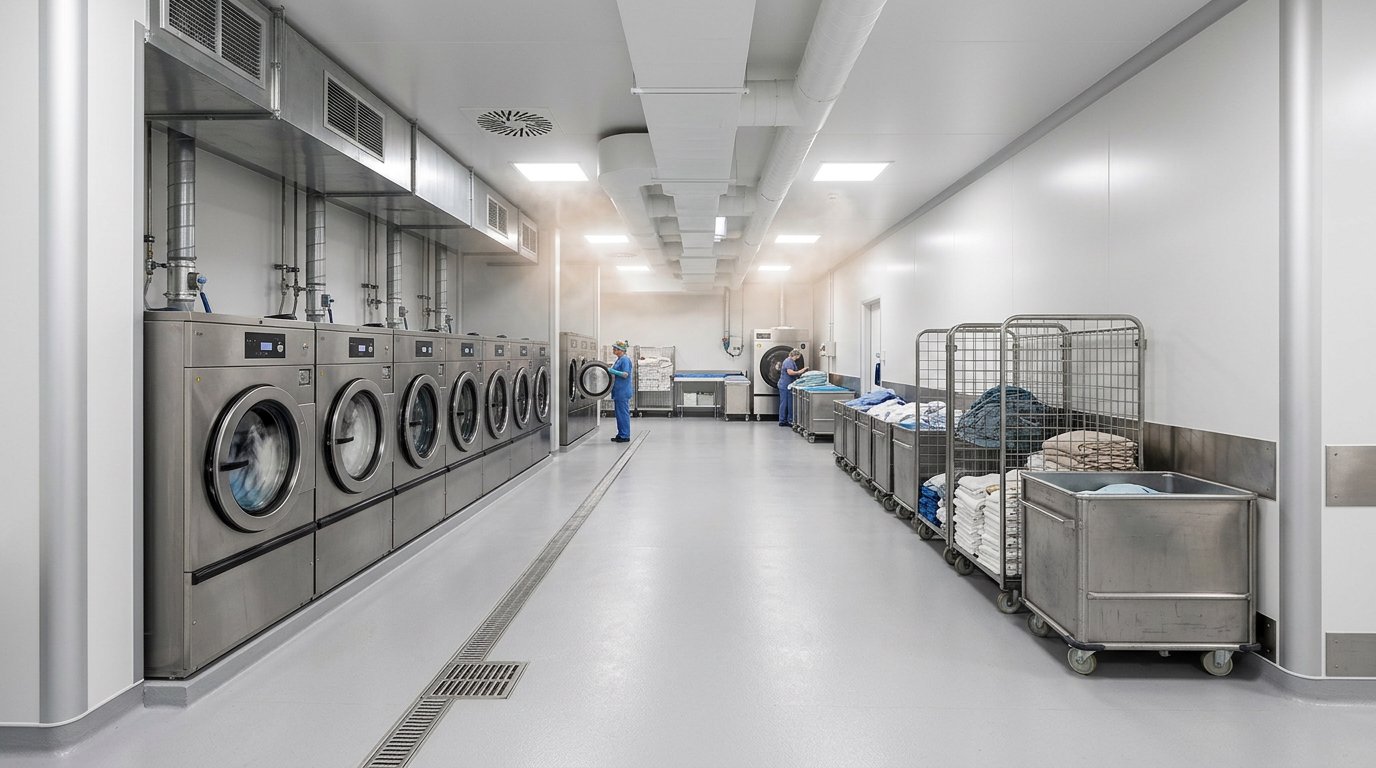
Why a Laundry Punishes an Ordinary Wall
The real problem is not the water you can see but the vapour you cannot. Air in washing and drying areas routinely sits between 30 and 35 degrees Celsius at high humidity. Using the Magnus formula, air at 30 degrees and 80 percent relative humidity has a dew point near 26 degrees; at 35 degrees and 85 percent, the dew point rises to roughly 32 degrees.
Any surface colder than that will get wet from condensation, not from a leak. In an air-conditioned room next to a wet area, that cold surface is often the inner face of the dividing wall itself. An insulated panel breaks the thermal bridge so the surface stays above dew point.
The second load is chemical. Sodium hypochlorite, strong alkalis and hot vapour accelerate steel corrosion. ISO 12944-2 places high-humidity production halls such as laundries, food plants and dairies in corrosivity category C3, with carbon steel thickness loss of 25 to 50 micrometres per year. Swimming pools and chemical plants sit in C4, at 50 to 80 micrometres per year.
Indonesian Regulation: Useful Numbers, Changed Legal Status
Hospital laundry requirements in Indonesia have long been read from the annex of Health Ministry Regulation 40 of 2022. It separates dirty and clean zones, asks for two doors on different sides, one-way flow, negative pressure in receiving and washing rooms, and at least 10 total air changes per hour. Room temperature is set at 24 plus or minus 2 degrees, with a minimum 2.8 metre ceiling in the drying room.
Worth noting: that regulation has been revoked. Health Ministry Regulation 6 of 2026 on Hospitals, promulgated on 12 June 2026, repeals 21 regulations at once through Article 84, including Regulation 40 of 2022. The official text can be checked at the Ministry of Health legal documentation portal.
For designers the consequence is practical. Those technical figures are now sound engineering reference rather than a legal obligation you can quote directly. Keep using them as a design basis, but do not write them into tender documents as though they were still binding clauses.
Regulation 7 of 2019 on hospital environmental health, by contrast, was not repealed. That is the rule setting linen washing at 70 degrees for 25 minutes or 95 degrees for 10 minutes. Water that hot is the direct reason the vapour load in a washing room is so large.
For comparison, the Appendix B table in the environmental infection control guidance from the CDC lists general laundry at 10 total air changes per hour with all air exhausted directly outdoors, and soiled linen sorting under negative pressure. The figures line up with Indonesian practice.
Choosing the Core and the Steel Coating
For laundry walls, the steel coating decides service life more than the core does. Pre-coated steel follows EN 10169, which classes the corrosion resistance of organic coatings into RC categories. A standard polyester coat is only around 25 micrometres, while PVC plastisol is built far thicker at roughly 200 micrometres and resists permanent humidity and chemical vapour much better.
- PIR: closed cell, low water absorption, suited to washing and drying rooms that are humid and hot at once.
- Rockwool: non-combustible, the choice for compartment walls and clean linen stores, which Indonesian technical guidance expects to have one-hour fire resistance.
- EPS: economical for administration rooms and dry stores around the laundry, but not for wet, vapour-loaded areas.
Panel specifications should reference EN 14509, the product standard for self-supporting double skin metal faced insulating panels. It governs mechanical and thermal testing so manufacturer claims can be compared on equal terms. Common laundry wall thickness is 50 to 75 mm; the full discussion sits in our guide to wall panel sizes and thickness.
Installation Details That Decide Service Life
A correctly chosen panel can still fail on detailing. Water in a laundry always finds the weakest joint, usually at the wall base and around pipes.
- Use hidden screw panels so no fastener head sits exposed holding water and rusting.
- Close the wall-to-floor junction with a curved coving profile so corners can be scrubbed.
- Fit a stainless kickplate 60 to 100 cm high along linen trolley routes.
- Seal joints with a neutral cure, mould-resistant sealant rather than acetic silicone, which attacks the steel coating.
- Handle steam, hot water and drain penetrations with sealed sleeves, not field-cut holes patched afterwards. We cover the rules separately in our guide to electrical and plumbing installation.
- Slope the floor toward the drain and stop panels on a concrete upstand rather than in standing water.
Industrial, Hotel and Commercial Linen Plants
Hotel and industrial laundries share the same physics as hospitals without the infectious zoning duty. The load is often heavier: flatwork ironers release heat continuously, operating hours are longer, and chemical volumes are larger. Zoning here is operational, keeping soiled linen away from finished linen.
In a converted rental warehouse, panels also solve a schedule problem, since they install dry with no plaster curing time. The same hygienic surface logic appears in our articles on commercial kitchens and bottled water production rooms, two wet rooms with comparable cleaning demands.
One recurring error in tender documents is calling a laundry a cleanroom. A laundry is not a particle-classified space; what it needs is hygienic surfaces, one-way flow and correct pressure. Writing an ISO 14644 class into a laundry specification raises cost without benefit.
FAQ
Are sandwich panels safe in a washing room that is always wet?
Yes, provided the steel coating is chosen for humid service and the base detail is right. Panels that fail in wet rooms almost always fail at unsealed joints or where the panel was set directly onto a wet floor, not because of the material itself.
What panel thickness suits a hospital laundry wall?
For internal partitions, 50 mm is usually enough. A 75 mm panel is chosen where the wall separates a wet area from an air-conditioned space, because the temperature difference is larger and condensation risk on the cold face rises. Tall spans and fire resistance requirements also push the number up.
Does the laundry standard in Regulation 40 of 2022 still apply in 2026?
No. It was revoked by Health Ministry Regulation 6 of 2026, promulgated on 12 June 2026. The technical figures remain worth using as design reference, but they no longer carry legal force that can be cited as a basis for compliance.