
Indonesia's national wheat flour consumption is projected to reach 7.82 million tonnes in 2026 according to a January 2026 Katadata report, up roughly 5% from the 7.41 million tonnes recorded in 2025, which had itself grown 5.48% over 2024. The main driver is the government's free nutritious meals programme.
The same report notes something buyers often skip over: millers believe they do not yet need to add new milling capacity. That matters for anyone budgeting a building, because construction spending in this sector lands mostly on reworking existing production rooms, warehouses and packing areas rather than on greenfield plants.
USDA data for 2026 puts small and medium enterprises at about 71% of Indonesian wheat flour consumption, while KF Indonesia cites 68-70%. APTINDO members represent 99.5% of market share and, according to UNICEF, Indonesia's entire flour supply is milled from imported wheat grain.
On the rice side, milling runs from small village units to modern rice milling units. The two sectors handle different raw materials but arrive at the same technical question: what kind of wall suits a dusty process room and a warehouse that has to hold product moisture steady.
What the wall actually protects is product moisture
The money in a flour mill or rice mill is not in a glossy wall; it is in the grade of what leaves in the sack.
For rice, SNI 6128:2020 is the quality standard in use. A July 2025 Republika report summarises the premium-class limits as a maximum 14% moisture content, at most 14.5% broken grains and at least 85% whole kernels. Of those three, only moisture still moves after the product reaches the warehouse.
It is worth stating plainly that SNI 6128 is voluntary rather than mandatory. Permentan 31/2017 also sets rice quality classes, and BSN has noted that at least three overlapping rice regulations exist, recommending that government requirements refer directly to the SNI instead of restating it.
So the figure you adopt as a warehouse target is better taken from your buyer's specification and your own quality team than from any single regulation.
Rice and flour are both hygroscopic: they take up and give off water vapour in step with the surrounding air. This is where the building envelope earns its keep.
Panel walls, tight joints, a closed ceiling and doors that are not left standing open slow the ingress of humid outside air, which lowers the dehumidification load and keeps product moisture from tracking the weather.
The room's RH set point is still decided by the HVAC design, not by the wall. The wall only makes that set point affordable to hold.
A leaky envelope costs more than off-spec moisture. Walls that sweat where a cold surface meets humid air invite mould and storage insects. We cover already-mouldy warehouse walls in a separate article.
Product SNIs govern the sack, not the wall
For wheat flour the standard is SNI 3751:2018, Wheat Flour as Food Ingredient, made mandatory through Ministry of Industry Regulation No. 1 of 2021, which replaced the earlier reference to SNI 3751:2009.
It sets product quality requirements including a maximum ash content of 0.70% and mandatory fortification with iron, zinc, vitamin B1, vitamin B2 and folic acid. Companies producing or importing wheat flour must hold an SPPT-SNI certificate and mark packaging accordingly, or supply the document for bulk product.
This has to be said directly: none of those provisions mentions walls, panels or buildings. So reject any supplier claim that a panel complies with SNI 3751.
What is true is that processed food requires clean, zoned production rooms, and the reference normally used for that is the good manufacturing practice regime in Ministry of Industry Regulation 75/2010: surfaces that are flat, impervious, easy to clean and non-shedding. We go through the detail in our food production wall guide.
Plant zones and the panel thickness used
Our line stops at 150 mm for every core. The U-values below are design estimates to ISO 6946, not test data; manufacturer declared values use EN 14509.
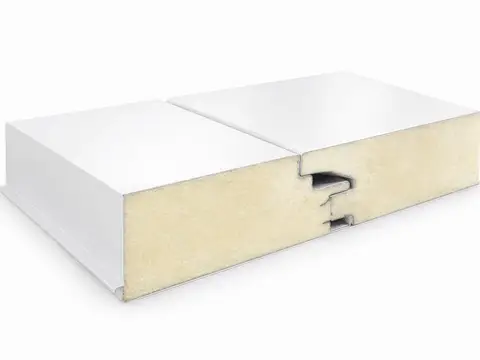
- Wheat, paddy and raw material warehouses: EPS partitions 50-75 mm, estimated U 0.63-0.43 W/m2K. Their job is separating dirty from clean zones and holding back outside air, not refrigeration.
- Milling and sifting rooms: EPS or PIR 75-100 mm, with tight joints and as few recesses as possible, because this is the dustiest room in the plant.
- Packing areas and humidity-controlled finished goods stores: PIR 100 mm, about 0.23 W/m2K given core conductivity of 0.022-0.026 W/mK.
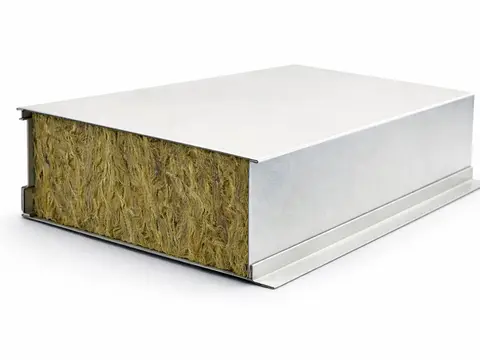
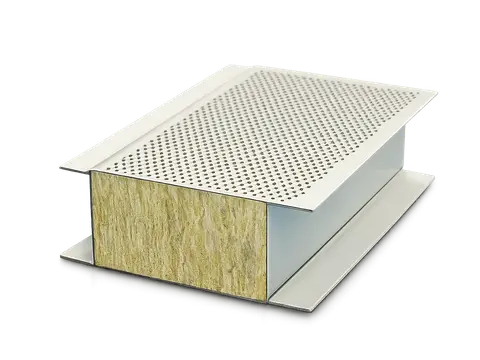
- Fire-separation partitions, electrical rooms and bulkheads to the dust collector area: rockwool 100-150 mm. Indicative figures are EI 60 from 80 mm and EI 120 from 120 mm; the actual rating comes only from an assembly test report.
Flour and paddy dust: where the wall's job ends
Flour, wheat and bran dusts are combustible organic dusts, and this is the part marketers most often embellish.
NFPA 61, 2020 edition, Prevention of Fires and Dust Explosions in Agricultural and Food Processing Facilities, covers facilities that receive, handle, process, dry, mill, package, store and ship dry agricultural bulk materials, their by-products and dusts; flour mills fall inside that scope. NFPA 652 carries the fundamentals of combustible dust.
Two caveats suppliers rarely mention. First, both are foreign engineering references, not legal obligations in Indonesia. Second, their content is explosion protection, meaning venting, isolation and housekeeping, not wall specification.
NFPA 61 is explicit about venting on bucket elevators and dust collectors, yet it does not address belt, drag or screw conveyors. In the United States, the deadline for completing a dust hazard analysis at existing facilities was 1 January 2022.
On numbers, we are deliberately silent. A dust explosion class and a Kst value are only valid when they come from a test report on a dust sample from your own plant, because fineness and moisture differ from mill to mill. Do not take them from a brochure, and do not take them from this article.
The boundary should be clear from the start: a panel wall is not an explosion protection system. It does not replace venting, it does not replace dust extraction, and it does not reduce any housekeeping duty.
A panel brings exactly two things you can evidence on paper: reaction to fire of the material under EN 13501-1 and fire resistance of the assembly under EN 13501-2, both from test reports.
Flat walls leave dust fewer places to settle
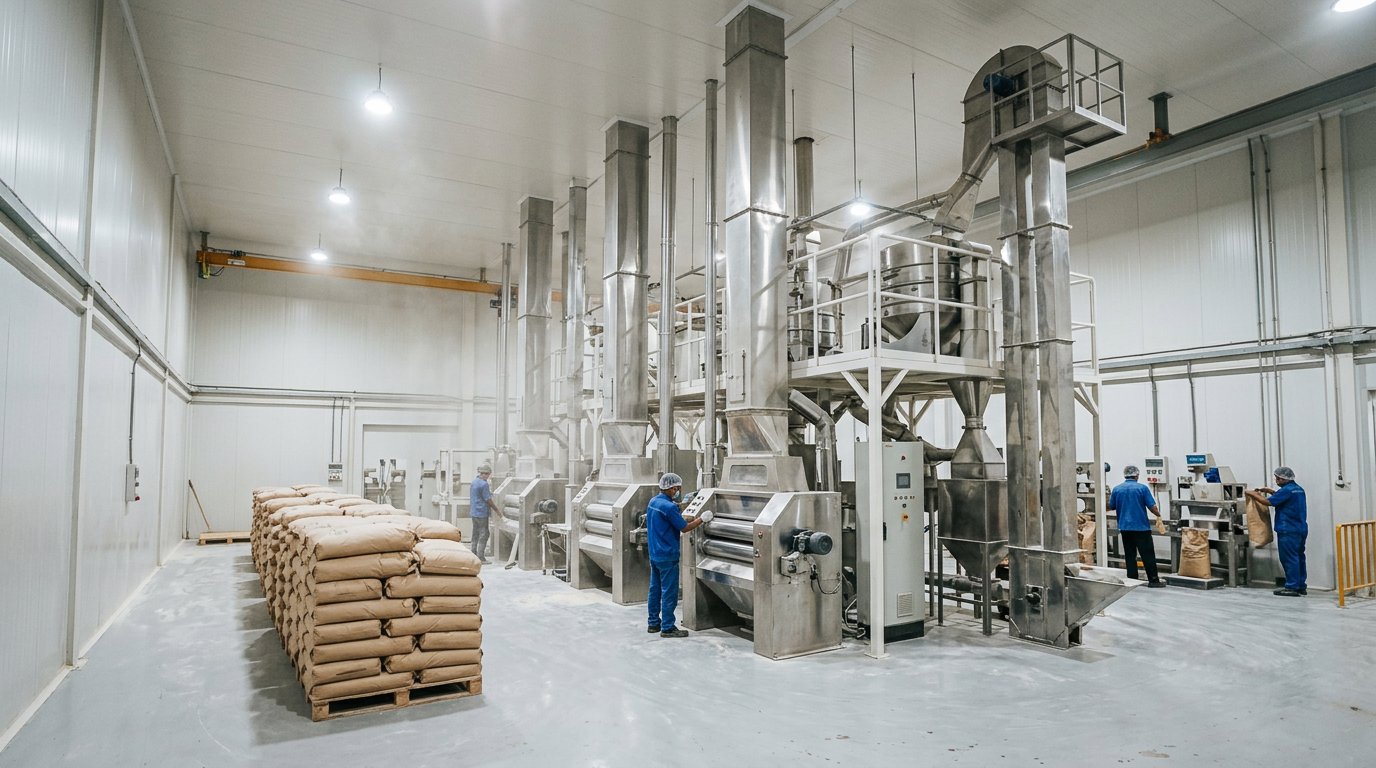
Housekeeping is precisely where the wall choice does count. Ribbed brickwork, exposed steel framing and notched columns offer plenty of horizontal surfaces for flour dust to settle on, and it is that accumulated dust layer that housekeeping programmes in milling plants worry about most.
Panels give a flat plane with few joints, can be wiped or washed down, and do not absorb dust the way unsealed brick does.
Details worth putting on the drawings early: radiused corner flashing so there are no dead corners, no open shelves or brackets on upper surfaces, partition tops either capped or slightly sloped so dust does not sit, and every cable and pipe penetration sealed.
On EPS-cored panels, run cables in conduit or tray rather than buried against the core.
Separating raw material from finished goods
Imported wheat and paddy arrive carrying soil, husk, foreign seeds and sometimes storage insects, while milled flour and rice have to stay clean until they are packed.
Physical separation between intake, milling and finished goods storage is the first thing a buyer's auditor looks at, and panel partitions are the quickest way to form those zones inside a building whose roof already stands.
Where the process involves washing or parboiling, the wet zone is handled differently: separate it from the dry side, choose a surface coating that tolerates moisture, and do not let wet-zone air drift into the flour store.
For large bulk raw material warehouses, the thickness and zoning logic resembles what we covered for animal feed mills; the difference is that flour and rice plants have a ready-to-eat finished goods zone with stricter demands. For flour dust further downstream, see our bakery and biscuit plant article.
Market price ranges, November 2026 survey
There is no official public price list for sandwich panels and the spread between sources is wide. The figures below come from a survey of public price lists on 14 November 2026, per m2. Do not mix material-only and installed prices in one table; the basis differs.
- EPS material only: 50 mm IDR 210,000-430,000; 75 mm IDR 250,000-320,000 from one source; 100 mm IDR 290,000-575,000.
- PU or PIR material: IDR 350,000-600,000. Rockwool material: IDR 400,000-700,000.
- Standard wall installation: IDR 65,000-95,000 per our pricing page, IDR 60,000-120,000 per the survey.
- One source estimated a 5-15% increase over the previous year, dated May 2026.
Outside the scope of our panel line
Our line is wall, partition and ceiling panels. We do not sell roof panels.
Milling rooms, packing areas and warehouses in flour and rice plants are almost always built inside a building whose roof already exists, so what is actually bought is the walls, partitions and room ceilings.
Not our scope: HVAC and dehumidifiers that set the RH; dust collectors, ducting and explosion venting; silos, bins and bucket elevators; mills, sifters and polishers; concrete floors for forklift loading; fumigation and pest control; and stock that arrived damp or already infested.
A good wall does not fix the wrong raw material.
FAQ: Frequently asked questions
What moisture level should a rice or flour warehouse hold?
No standard fixes warehouse RH. What exists is a product moisture limit: for premium-class rice, summaries of SNI 6128:2020 give a maximum of 14%. Your quality team sets the room RH target from that limit and from the intended storage period, and the walls, joints and HVAC are then chosen to hold it.
Which panel core suits milling rooms and flour stores?
For zone separation and unrefrigerated raw material warehouses, EPS 50-75 mm is usually enough. Milling rooms and packing areas are better served by EPS or PIR 75-100 mm, and humidity-controlled finished goods stores by PIR 100 mm. For fire-separation partitions and electrical room bulkheads, rockwool 100-150 mm.
Are sandwich panels safe in rooms with flour dust?
Panels help on the housekeeping side because the surface is flat and the joints are few, so less dust accumulates and what does is easier to remove. But a panel is not explosion protection: venting, dust extraction and cleaning remain mandatory. For higher-risk areas, choose a rockwool core and ask for EN 13501-1 and EN 13501-2 test reports rather than a brochure.
Request a quotation for your plant
Every flour mill and rice mill has different zones, moisture targets and schedules, so panel thickness and core are best fixed after the layout has been read. Send us your zone drawings and requirements, talk it through with our team, then request a quotation via our contact page.