
Indonesia's plastics processors are in an awkward spot. Ministry of Industry figures drawn from BPS and reported by Wartaekonomi in November 2026 show the rubber, rubber goods and plastics subsector contracting 7.96 percent in the third quarter of 2026, while manufacturing as a whole grew 5.87 percent.
The ministry also flagged that utilisation at Inaplas member plants sits at only about 60 to 70 percent, while Inaplas presses for curbs on cheap imports (CNBC Indonesia and investor.id, 5-6 November 2026). The practical consequence: this year the defensible capital spend is usually not a new hall, but partitioning and upgrading the space you already own so it passes customer audits and costs less to run.
Why a plastics plant is not just another warehouse
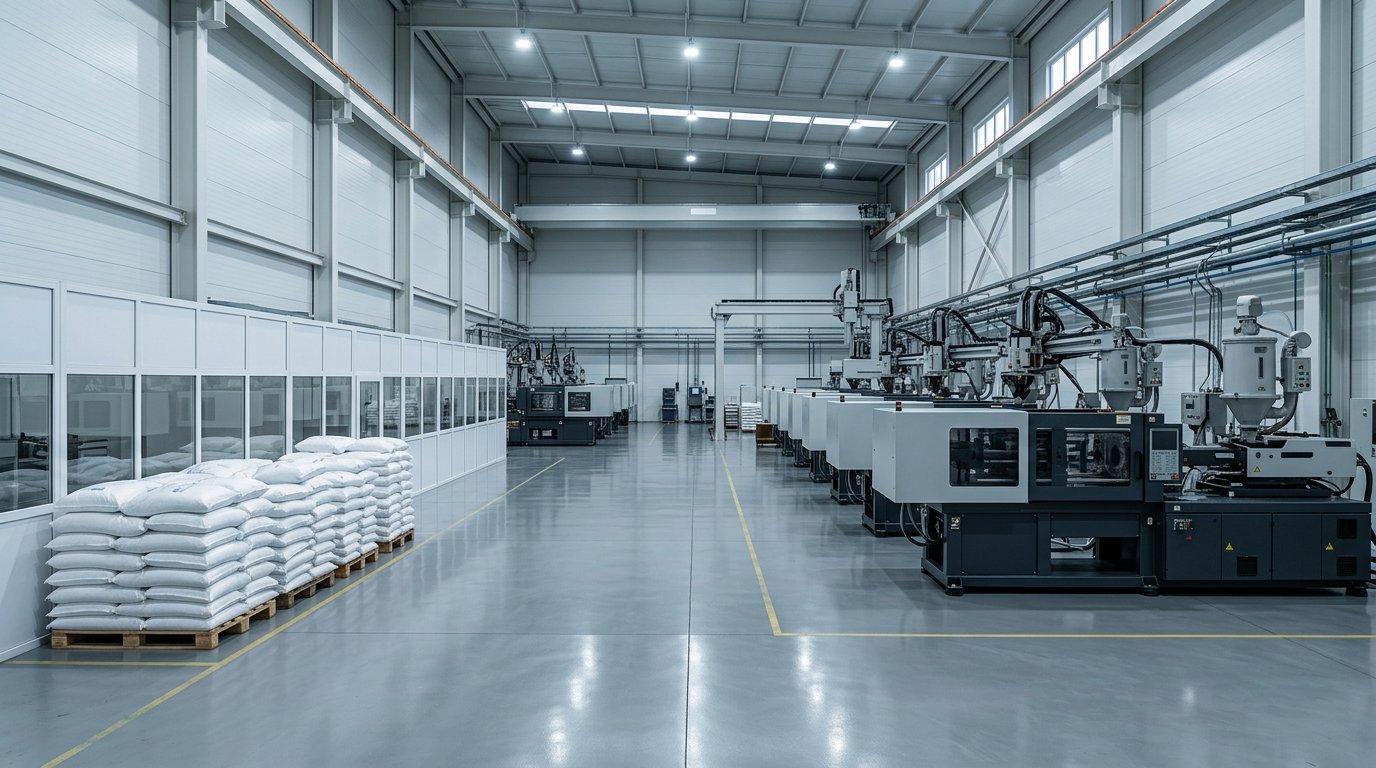
Three things set plastics processing apart: the raw material carries a very high fire load, the machines release heat alongside pressurised oil, and part of the output touches food or medical products, so packing rooms get audited. Panel walls answer each differently, which is why one specification for the whole plant nearly always misses: too expensive for a partition, too light for the wall separating resin storage from the machine floor.
Five zones, five panel specifications
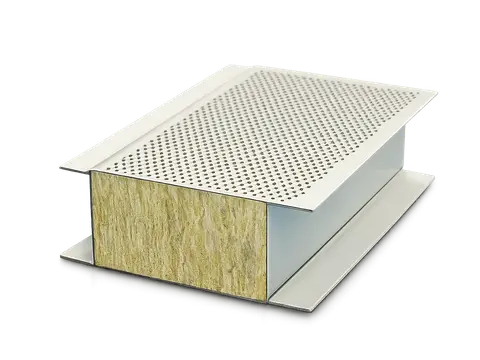
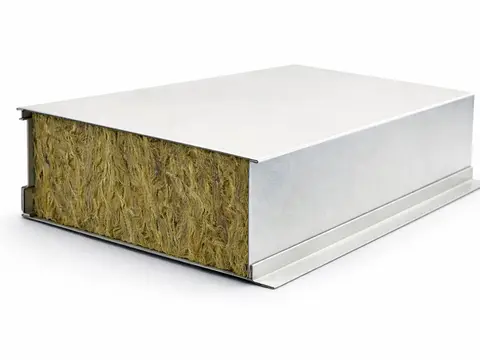
- Resin and finished goods storage - fire compartmentation first: rockwool core with reaction-to-fire class A2-s1,d0 to EN 13501-1, 100 to 150 mm where the wall also has to hold back warehouse heat.
- Injection, extrusion and blow moulding halls - cleanable surfaces and ventilation first; 50 to 75 mm partitions are usually enough.
- Crusher and granulator rooms - acoustics and dust first; a rockwool core helps, and the doors and openings must be designed too, not only the wall.
- Clean packing rooms - for food-contact or medical packaging: non-porous faces, tight joints, easily cleaned corners, 50 to 75 mm.
- Utilities, compressor and oil stores - fire separation and noise first, on the same basis as our compressor room specification.
If you mould food-contact packaging, BPOM Regulation 11 of 2026 replaces PerBPOM 20/2019 and tightens the BPA migration limit for polycarbonate from 0.6 to 0.05 mg/kg, with a 12-month adjustment period from promulgation (detikHealth; Catalyst Consulting). An honest caveat: media give 30 June 2026 as the effective date while the socialisation event was 30 July 2026, so confirm it against BPOM's own document.
Resin fire load: a plastics store is not a paper store
Under the NFPA 13 commodity classification, plastic goods and raw material fall in the highest bracket, Group A plastics, while cartons and paper sit in Class I through IV. That difference drives sprinkler demand, stack height and clearances - far heavier than a carton packaging warehouse. We took the detail from secondary sources and the table numbering shifts between editions, so confirm it against the NFPA 13 edition your fire protection consultant works to.
AXA's risk guidance for injection moulding plants advises keeping finished stock away from production, ideally in a separate building, or at minimum behind a two-hour fire separation. Two hours is what becomes EI 120 under EN 13501-2, and it is only realistic with a rockwool-core panel system and tested joint details.
A fire-rated panel wall limits spread; it does not replace sprinklers or detection. How to read the classes is covered in our fire-rated panel guide and the hazardous goods warehouse article.
Machine heat, hydraulic oil and panel service temperature
One machinery supplier puts extrusion hall temperatures at 35 to 45 degrees Celsius and recommends holding hydraulic oil between 40 and 55 degrees. A Plastics Technology column warns that hot oil reaching barrel heaters can ignite, and that spilled oil can set pellets alight.
Compare that with the working temperature limits in panel suppliers' application guidance: EPS around 75 to 80 degrees, PUR and PIR around 80, and rockwool-core systems around 100. Room temperature is clearly not the problem. The problem is a panel fitted hard against a hot machine surface or an exhaust duct.
A correction worth making: the 1,000 degree figure quoted for rockwool is fire resistance, not a daily service temperature. The two are measured differently and must never be swapped in a specification.
Hygroscopic resin, humidity and the power bill
Nylon, PET and PBT absorb water into the polymer itself, so even sealed pellets can arrive carrying moisture (Plastics Technology). Most pickup happens after bags are opened and left open between runs, which makes storage practice as decisive as dryer performance (Plastics Today).
The result is more than cosmetic splay: water drives hydrolysis that lowers part strength. Insulated walls and ceilings damp temperature swings and condensation, but do not replace a dryer.
The cost side is real. Plastics Engineering, March 2026, calls resin drying a large and often invisible energy load. Our own calculated U-value estimates for 75 mm panels are 0.43 for EPS, 0.30 for PIR and 0.49 W/m2K for rockwool, against roughly 2.5 for plastered brick. At 2026 industrial tariffs of Rp1,122 per kWh for I-3 and Rp997 for I-4 per the energy ministry, that gap shows up on the bill.
SNI 6389:2020 also caps building envelope OTTV at 35 W/m2. A panel improves only one of the three OTTV terms, so compliance does not arrive just because the wall is a panel. The detail is in our U-value and R-value explainer.
Two traps that get missed
- PVC against an EPS core. Phthalate ester plasticiser migrates into polystyrene: cable sheathing hardens and the foam face looks eaten away. The basis is AS/NZS 3000:2018 clause 3.3.2.5 and a 2025 NT WorkSafe technical update. Separate them with conduit - which matters most in a plant that processes PVC.
- Granulator noise. We found no publishable dBA figure for granulators, so measure your own and compare it with the 85 dBA threshold for an eight-hour shift in Permenaker 5/2018.
One product-line limit, stated early: we supply wall, partition and ceiling panels in 50 to 150 mm for every core. We do not sell roof panels, and anything beyond 150 mm is solved through room design instead.
Cost ranges and how to build the budget
A survey of public panel price lists from June to August 2026 is a starting benchmark, not a quotation - useful for sanity-checking a budget before tender.
- PU panel installed, 50 to 75 mm: roughly Rp350,000 to Rp550,000 per m2.
- Installation labour without material: roughly Rp150,000 to Rp230,000 per m2.
- Check the unit: a common cover width is 1,050 mm, so one linear metre equals 1.05 m2 and cannot be compared directly with a price per m2.
FAQ
Which panel core suits a plastic resin warehouse?
For raw material and finished goods storage, a rockwool core is the easiest choice to defend in front of an insurer: class A2-s1,d0 under EN 13501-1, and EI 120 under EN 13501-2 where the wall is genuinely designed as a two-hour compartment.
Can sandwich panels sit close to hot injection moulding machines?
Safe as a room wall or ceiling, unsafe as direct shielding for a hot surface. Panel working limits run from about 75 to 100 degrees Celsius depending on the core, far below barrel temperatures. Provide clearance and non-combustible shielding as the machine builder specifies.
How thick should panels be in a plastics plant?
Typically 50 to 75 mm for partitions and packing rooms, and 100 to 150 mm for warehouse walls and fire compartments. The final call follows frame spans, wind load to SNI 1727:2020, and the fire class your consultant asks for.
If you are planning a warehouse conversion, a partitioned packing room or a fire compartment, we can turn that into a zone-by-zone panel specification with indicative quantities. Send your room dimensions, the zones you want separated and your target schedule through the sandwichpanels.id contact page, and our team will prepare a quotation you can compare line by line.