
Instant noodle and snack plants rarely fail because of the machines. The building envelope is where the costly mistakes happen: frying room walls placed too close to hot oil, cooling rooms that condense, and seasoning rooms that cannot be cleaned properly.
The timing is good for new capacity. Indonesia's Ministry of Industry recorded 6.77 percent growth in the food industry in the first half of 2026. Of the 152 companies that began production in that period with Rp157.56 trillion of investment, food was the subsector with the most new entrants, at 24 companies.
This guide covers panel specifications zone by zone, the technical limits suppliers rarely mention, and 2026 market cost ranges.
Five zones, five different panel specifications
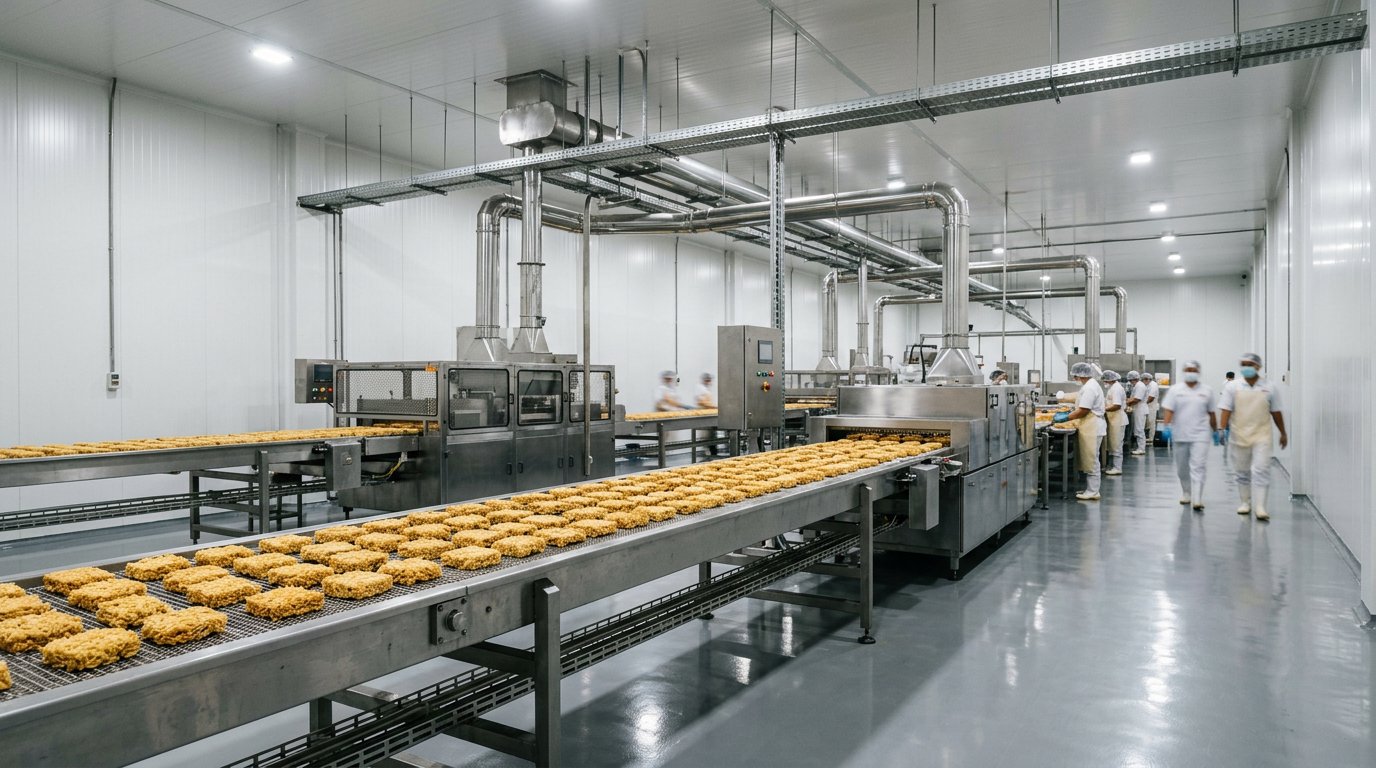
The most expensive budgeting error here is applying one panel thickness to the whole plant. An instant noodle line has zones whose requirements contradict each other: high heat at the fryer, wet conditions at washdown, dry conditions in storage.
- Dough mixing and sheeting: moderate humidity, forklift traffic, so walls need cleanable surfaces and impact resistance at the lower zone.
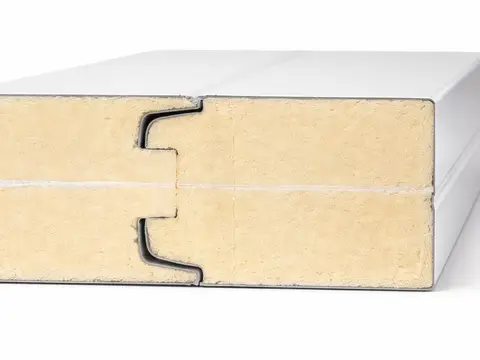
- Steam box: continuous saturated steam, tight panel joints, and a ceiling that must not drip condensate onto product.
- Frying room: the critical zone, where oil operates far above the panel service temperature.
- Cooling and packing: product must drop in temperature before sealing, with condensation and mould as the main risks.
- Seasoning, flour and warehouse areas: combustible powder dust plus a low moisture requirement.
Process figures circulating in industry literature: frying at 140 to 150 degrees Celsius for 60 to 120 seconds, bringing noodle moisture down to roughly 3 to 5 percent, and cooling to about 30 to 40 degrees Celsius before packing. Ranges differ between sources, so confirm against your own equipment data.
The frying room: service temperature limits suppliers rarely mention
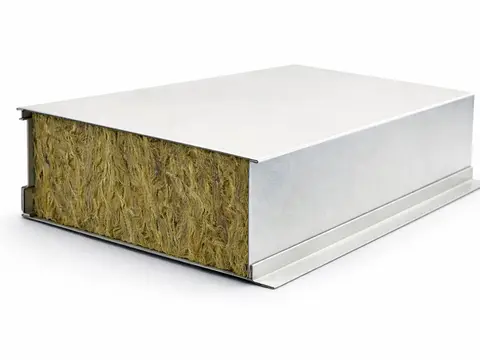
This is the most misunderstood point in the whole specification. Supplier application guidance puts the working limit at roughly 75 to 80 degrees Celsius for EPS cores, around 80 degrees Celsius for PUR and PIR, and around 100 degrees Celsius for rock wool core panel systems. Frying oil runs at 140 to 150 degrees Celsius, so the panel cannot act as a direct shield against hot surfaces.
Three consequences follow. First, provide clearance and non-combustible shielding between fryer and panel wall, per the equipment manufacturer. Second, choose a rock wool core for the frying room envelope, classified A2-s1,d0 under EN 13501-1. Third, where that room must be a separate fire compartment, ask for an EI 60 or EI 120 figure under EN 13501-2 from the manufacturer's test report.
One correction buyers should carry into negotiations: the 1,000 degrees Celsius figure often quoted for rock wool refers to fire resistance, not day-to-day service temperature. The two are measured differently and are not interchangeable.
For the fryer itself, AXA XL risk guidance notes that fryers are designed under the standard suited to their heating system, for example NFPA 86, while NFPA 96 covers ventilation and fire protection for commercial cooking. The panel wall is still specified through reaction to fire and fire resistance classes, not by those standards. Worker heat exposure here also falls under Permenaker 5/2018.
Cooling and packing: fight condensation, not temperature
Noodles leave the fryer hot and must cool before sealing. Incomplete cooling lets vapour condense inside the pack and triggers mould. A sound envelope reduces the cold spots where that vapour condenses first.
For this zone, PU or PIR wall and ceiling panels of 50 to 100 millimetres are usually sufficient. As a design estimate using the ISO 6946 method, a 50 millimetre PIR panel gives a U value of about 0.44 W/m2K and a 100 millimetre panel about 0.23 W/m2K. Declared values are measured under EN 14509, so use product datasheets for formal documents. Dry storage moisture is covered in our flour mill article.
Seasoning and flour rooms: combustible powder dust
Seasoning powders, flour and extruded snack ingredients generate combustible organic dust. NFPA 61, on fire and dust explosion prevention in food processing facilities, is widely used as practice guidance for zones like these. The implications are concrete: flat cleanable panel surfaces, coved wall to floor junctions, and no recesses where dust settles beyond the reach of cleaning.
Baseline hygiene follows Indonesia's good manufacturing practice rules for processed food, Permenperin 75/2010. Flour dust and oven zones are covered in our bakery and biscuit plant article.
Thickness, cores and 2026 market cost ranges
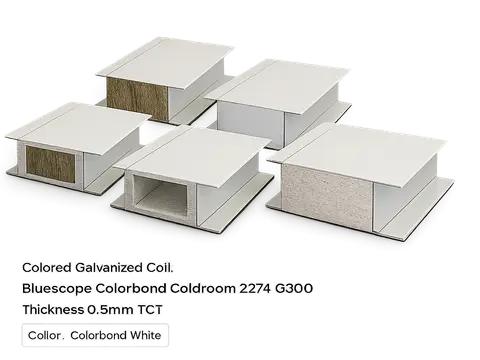
Our panel line covers walls, partitions and room ceilings, 50 to 150 millimetres across every core type, whether PU, PIR, EPS or rock wool. Roof panels are not part of the line. Steel facings common in Indonesia run 0.3 to 0.5 millimetres, with cover widths of 1,000 or 1,050 millimetres.
A survey of public price lists from June to August 2026 put installed PU panels of 50 to 75 millimetres at Rp350,000 to Rp550,000 per square metre, and installation only, excluding material, at Rp150,000 to Rp230,000 per square metre. Watch the unit trap: at a 1,050 millimetre cover width, one linear metre equals 1.05 square metres, so a per linear metre price always looks cheaper. We update ranges on our price per metre page.
What auditors ask for, and how to write it into a tender
Ask a panel supplier for three things before signing: an EN 13501-1 test report for reaction to fire, an EN 13501-2 report where compartmentation is required, and a datasheet stating thickness, core type and facing thickness. A verbal "class A" claim with no test report number is not enough for a tender.
On the product standard, Indonesia's standards body lists SNI 3551:2012 for instant noodles as in force. An honest caveat: one certification body listing shows SNI 3551:2018 and we have not verified that revision with BSN, so confirm the edition before citing it. Writing panel clauses a vendor cannot negotiate away is covered in our tender specification guide.
FAQ
Can sandwich panels be installed directly against a frying room wall?
Yes as a room envelope, but not as a direct shield against hot surfaces. Panel service temperature sits well below frying oil temperature, so the fryer still needs clearance and non-combustible shielding per the manufacturer. For this room, choose a rock wool core.
What panel thickness suits a noodle cooling room?
For cooling and packing rooms that are not held at cold storage temperatures, PU or PIR panels of 50 to 100 millimetres are usually adequate. The maximum thickness we supply is 150 millimetres across all cores. The final figure depends on the cooling load and the room dew point.
Can one panel type serve the whole plant?
It can physically be installed, but it will almost always be wrong in one zone. Rock wool excels at the fryer yet costs more than needed for storage, while PIR performs well in cool zones but is unsuited to fryer heat. Splitting the specification by zone is usually cheaper in total.
Every plant divides its zones differently, so panel specifications are best calculated from your own layout and equipment data rather than a generic price list. If you are planning a new plant or reworking an existing line, send your zone requirements, wall and ceiling areas, and target schedule through the sandwichpanels.id contact page. Our team will build a zone by zone specification and prepare a quotation you can compare directly.