

Hazardous material (B3) warehouses carry a much higher fire risk than ordinary industrial storage. A single ignition point near stored solvents, oils, or oxidizing chemicals can spread within minutes if the wall and roof structure itself becomes part of the fuel load. This is why choosing a fire-rated sandwich panel is a non-negotiable construction decision, not a nice-to-have upgrade.
This article covers the fire rating specifications relevant to B3 (hazardous and toxic material) warehouses in Indonesia, how environmental and occupational safety regulations shape the building envelope, and the technical trade-offs in choosing panel core and thickness.
What a B3 Warehouse Is and Why Fire Rating Comes First
Bahan Berbahaya dan Beracun (B3) covers chemicals that are flammable, explosive, toxic, corrosive, or reactive with other substances. Facilities storing them can be raw-material warehouses (governed by PP 74/2001 on Hazardous and Toxic Materials Management) or temporary hazardous-waste storage sites (TPS Limbah B3), regulated in more technical detail by PP 22/2021 and Permen LHK No. 6/2021.
Both regulatory tracks share the same underlying intent: a B3 storage building must minimize the risk of fire spreading and prevent environmental contamination if an incident occurs. The wall and roof structure isn't just weather protection — it is the first compartment that has to hold back fire long enough for emergency responders to react.
EI60 vs EI120 Fire Rating: Which One Does a B3 Warehouse Actually Need
EI fire ratings are expressed in minutes of resistance against two parameters: integrity (E, no flame or smoke passage) and insulation (I, the unexposed face doesn't get hot enough to ignite adjacent material). EI60 means the panel holds both parameters for 60 minutes; EI120 means 120 minutes before structural failure on either parameter.
Indonesian regulation (Permen LHK 6/2021) doesn't yet spell out a specific EI minute rating for B3 warehouses — its requirement is qualitative, essentially "roofing must be made of non-combustible material." International safety practice, however (EN 13501-1 in Europe, and the NFPA 400 approach in the US), generally places hazardous-material storage in a high-risk class, which commonly calls for at least EI120 for compartment walls separating storage zones.
For B2B projects in Indonesia, treating EI120 as the design baseline is a safer approach than waiting for domestic regulation to catch up with that standard.
Rockwool vs PU/PIR Core: Why Core Choice Decides B3 Warehouse Safety
Not every fire-rated sandwich panel is suitable for a B3 warehouse. Polyurethane (PU) and polyisocyanurate (PIR) cores offer excellent thermal insulation and are common for cold storage or general warehousing, but both are classified as combustible materials, typically rated B-s1/s2 or lower on reaction-to-fire classification — meaning they can still contribute to a fire even with flame-retardant additives.
Rockwool (mineral wool) core carries a non-combustible A1/A2 classification under EN 13501-1, so the material itself does not add fuel load during a fire event. For a B3 warehouse storing flammable substances, that distinction is critical: the walls and roof themselves must not become a secondary fuel source.
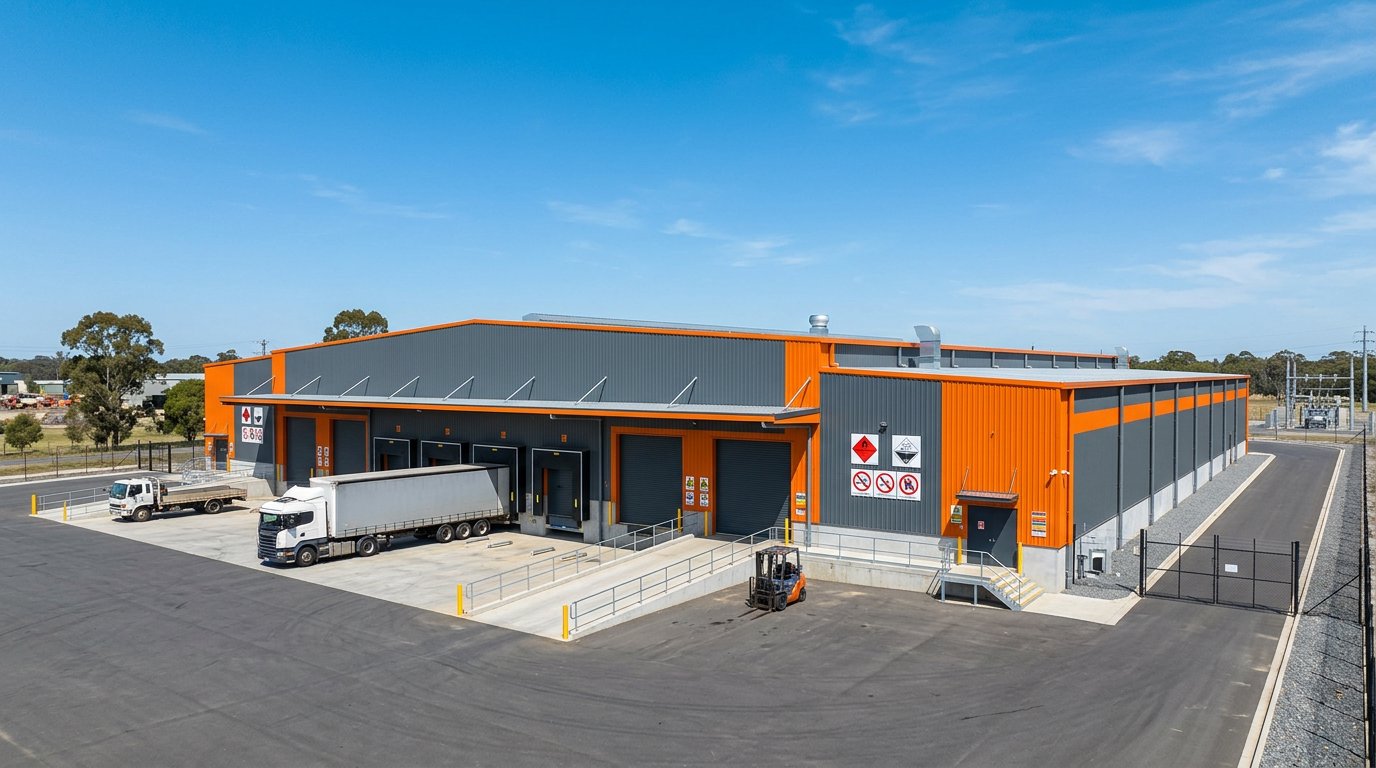
As a rough benchmark, 80 mm rockwool panels typically resist fire for around 60 minutes, while 100 mm can reach roughly 120 minutes depending on rib configuration and jointing system — so thickness selection should always be matched against the target rating and the panel manufacturer's actual test certification.
Building Requirements for B3 Warehouses Under Permen LHK No. 6/2021
Beyond wall and roof fire rating, Indonesian regulation sets several technical building requirements for B3 or hazardous-waste storage facilities:
- Enclosed design that protects B3/hazardous waste from direct rain exposure.
- Roofing made from non-combustible material.
- Watertight, level flooring with a maximum 1% slope toward a spill containment sump (secondary containment).
- Adequate ventilation referencing SNI 03-6572-2001, with openings of at least 10% of the building's floor area.
- Lighting suited to the building layout and storage activity.
- Storage area sized proportionally to the volume and hazard class of B3 stored.
Fire-rated sandwich panels are directly relevant to the roof and wall requirements — not the floor, which must remain watertight concrete construction under the regulation. Combining a lightweight steel frame with rockwool panels lets a B3 warehouse be built considerably faster than conventional brick-and-plaster methods, while still meeting the non-combustible requirement.
Segregation and Compartmentation Under Chemical Safety Rules
Kepmenaker No. 187/1999 on Hazardous Chemical Control requires any workplace storing hazardous chemicals to maintain Material Safety Data Sheets (MSDS), clear labeling, and trained chemical safety officers. One core principle in storage management is segregation: incompatible substances — oxidizers next to flammables, or acids next to bases, for example — must not be stored adjacent to each other without a fire-rated barrier.
This is where fire-rated sandwich panel partitions serve a dual role: not just as the building's outer envelope, but as internal compartment walls separating storage zones by hazard class. Because the panels are lightweight and install in a modular fashion, rockwool partitions are relatively easy to reconfigure when storage layout changes following a safety audit.
Chemical and Corrosion Resistance of the Panel Coating
Corrosive vapor and spills — acids, bases, or salts — can accelerate degradation of the galvanized or galvalume coating on a panel's metal skin if it isn't specified correctly. Beyond fire rating, the surface coating specification matters just as much for a B3 warehouse: PVDF or SMP coatings with adequate primer thickness offer better resistance to chemical corrosion than standard polyester paint. For a deeper look at coating selection for corrosive chemical-plant environments, see the guide to corrosion-resistant panel walls for chemical plants.
Panel jointing also matters: a hidden-fastener system with chemical-resistant sealant helps prevent corrosive vapor from seeping into the joint gap, which over time can trigger corrosion from the inside that isn't visible from the outside.
Sandwich Panel Specification Checklist for B3 Warehouses
Before finalizing specifications with a manufacturer, confirm the following:
- Non-combustible rockwool/mineral wool core (A1/A2), not PU/PIR, for the actual B3 storage zone.
- Target fire rating of at least EI60, ideally EI120 for higher-risk compartments.
- Core thickness matched to the manufacturer's test data — as a general indication, 80 mm for ~60 minutes and 100 mm for ~120 minutes.
- Chemical-resistant metal skin coating (PVDF/SMP) matched to the B3 substances stored.
- Jointing system with chemical-resistant sealant to prevent corrosive vapor seepage.
- Flooring remains watertight concrete sloped to a spill containment sump — panels do not replace this requirement.
For a full breakdown of EI classifications and how to read a manufacturer's fire test certificate, see the fire rating specification guide and the EI60, EI120, and EI240 standards guide. For choosing the right core for a project more broadly, the EPS vs PU vs rockwool comparison is also a useful reference.
Frequently Asked Questions
Does Indonesian regulation require EI120-rated panels for B3 warehouses?
Domestic regulation (Permen LHK 6/2021) doesn't yet specify an exact EI minute rating — the requirement remains qualitative, essentially non-combustible roofing material. EI120 is recommended as a design baseline following international practice for high-risk hazardous storage facilities, particularly for compartment walls separating different B3 hazard classes.
Is PU/PIR sandwich panel completely off-limits for a B3 warehouse?
Not entirely banned, but it's a poor fit for the actual flammable B3 storage zone because it's combustible. PU/PIR still has a place in non-storage support areas (offices, control rooms) within the same complex, as long as they're structurally separated from the B3 storage zone by non-combustible fire-rated walls.
What rockwool panel thickness should a B3 warehouse use?
As a general indication, 80 mm rockwool panels typically resist fire for around 60 minutes, and 100 mm can reach around 120 minutes, but the exact figure always depends on the manufacturer's actual test certification rather than nominal thickness alone.
Can sandwich panels be used for B3 warehouse flooring?
No. Regulation requires watertight, level flooring sloped toward a spill containment sump, which must remain watertight concrete or screed construction. Fire-rated sandwich panels apply to walls and roofing, not as a substitute for the floor structure.
Building a B3 warehouse that satisfies environmental regulation while staying fire-safe takes the right combination of specifications, not just picking the cheapest panel off a catalog. The sandwichpanels.id team can help calculate the right core, thickness, and coating combination matched to your stored B3 hazard class and project fire rating target.