

The number most often missed when designing an archive room is not the fire rating of the panel but the strength of the floor. SNI 1727:2020 sets a minimum uniform live load of 7,18 kN/m2 for library storage, roughly 732 kg/m2. Indonesian archival standards require the floor to carry 1.200 kg/m2 for static shelving and 2.400 kg/m2 for compact shelving. That is a two to threefold gap.
This article puts the decisions back in order: what the rules actually require, which load really governs, and what panel specification belongs in an archive room in 2026.
What the Rules Actually Require of an Archive Room
Indonesia's Permen PU 26/PRT/M/2008 on technical requirements for fire protection systems defines TKA, the fire resistance level, in minutes. It is judged on three criteria in sequence: load bearing capacity, integrity against flame spread, and insulation against heat transfer. The notation looks like "50/-/-", where a dash means that criterion is not required.
One point deserves plain speaking: the word "archive" does not appear anywhere in that regulation. Permen PU 26/2008 sets no specific fire resistance level for archive rooms. The figure follows the building class and the compartmentation strategy, so choosing EI60 or EI120 for an archive is a design decision driven by fire load, not a clause you can cite.
The requirement for fire resistant walls comes from the archival side instead. Decree of the Head of ANRI No. 03 of 2000 on minimum standards for inactive archive buildings and storage rooms, still listed as in force on the ANRI legal database, states that storage rooms for vital and permanent records are to be purpose designed as fire resistant. ANRI Regulation 31/2015 on archive depot formation adds the infrastructure side: construction, foundation, walls, floors, ventilation and insulation.
Internationally, ISO 11799:2024, the third edition replacing the 2015 one, covers the physical requirements of buildings used to store archive and library materials: siting, construction and renovation, and the equipment installed in them. It also allows separate compartments inside one repository so the climate can suit each type of medium.
NFPA 232, Standard for the Protection of Records, recognises five categories of storage environment, in descending order of protection: vaults, archives, file rooms, compartmented and noncompartmented records centers, with assemblies tested to ASTM E119 or UL 263. A fire resistant archive room is not one specification but a graded set.
Floor First, Panel Second
This is where the sequence usually goes wrong. Sandwich panels carry none of the shelving load; the slab and foundation do, so the load figures must be settled before the wall specification is discussed.
SNI 1727:2020 Table 4.3-1 gives a minimum uniform live load of 150 psf, or 7,18 kN/m2, for library stack rooms and 60 psf, or 2,87 kN/m2, for reading rooms. The table notes add that 150 psf also covers filing cabinet installations provided aisles are at least 0,92 m wide, while mobile shelving on rails must be designed for actual demand and readily exceeds 300 psf, or 14,4 kN/m2.
Compare that with the archival figures, which are derived from what sits on the shelf rather than from the room's label:
- One linear metre of records averages 50 kg; one cubic metre averages 600 kg; one cubic metre equals 12 linear metres.
- Conventional shelving, fully loaded: 1.200 kg/m2. A 10 m2 room therefore means 12.000 kg resting on the slab.
- Compact or roll-out shelving: 2.400 kg/m2, about 23,5 kN/m2.
- Reference capacity: 200 m2 at 260 cm clear height holds 1.000 running metres of static shelving, or 1.800 running metres with compact shelving.
Taking the library figure at face value can therefore fall short for a dense archive, and the SNI note on mobile shelving above 14,4 kN/m2 actually agrees with the archival numbers. Ask the structural engineer to verify the slab against the layout that will really be installed, including compact shelving planned for later.
Panel Specification for Archive Compartment Walls
Fire load in an archive room is very high because the contents are paper. Permen PU 26/2008 defines fire load as the net calorific value of combustible material expected to burn within a compartment, and rows of cardboard boxes are the extreme case. The core is not the place to economise.
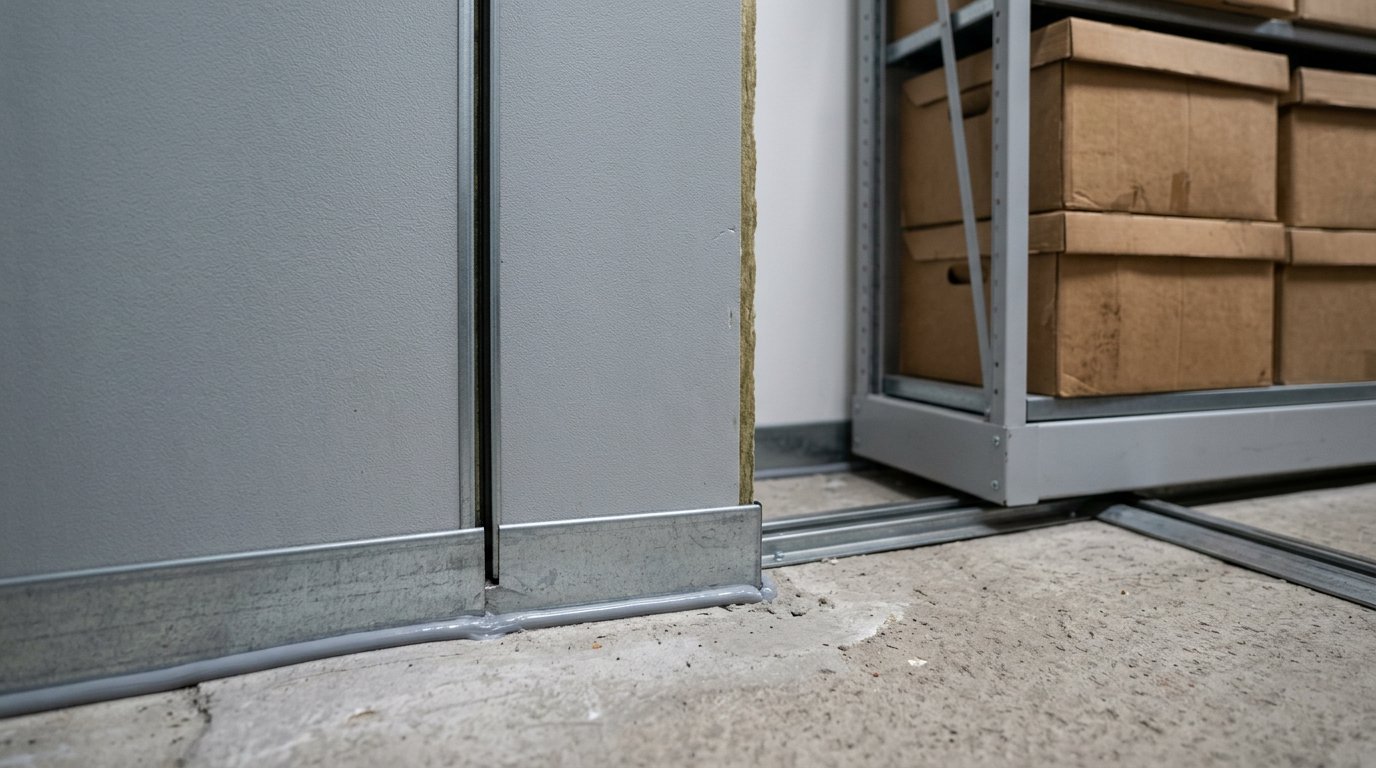
A rockwool core is the sensible choice for archive compartment walls: a non-combustible mineral core with thermal conductivity of 0,038-0,042 W/mK. EPS sits at 0,033-0,038 W/mK and PU or PIR at 0,022-0,026 W/mK, better insulators but not the answer for a high fire load room. We compare all three cores in EPS vs PU vs rockwool.
The bridge from European EI ratings to local regulatory language sits in that TKA definition. The insulation criterion requires the unexposed face to stay below 140 degrees Celsius, the same threshold used by EN 1363-1 and EN 13501-2. Full EI60 and EI120 tables, and how to read a test report, are covered in our pillar page on sandwich panel fire rating standards, so we will not repeat them here.
Climate, Dimensions and Storage Layout
ANRI 03/2000 sets temperature at no more than 27 degrees Celsius and relative humidity at no more than 60 percent, checked periodically with a hygrometer. Media, microfilm, electronic and vital records need their own cooling, and shelving must not be packed so tightly that air cannot circulate.
The reference dimensions are detailed enough to be useful while drawing the layout:
- Storage floor to floor height 260-280 cm, static shelving 200-220 cm.
- Shelving to wall clearance 70-80 cm, aisle between shelving rows 100-110 cm.
- Archive boxes 37x9x27 cm and 37x19x27 cm, made of perforated cardboard for air movement.
- Avoid plastic boxes, which trap moisture, and wooden shelving, which invites termites; use corrosion resistant metal shelving.
The building itself must be weather resistant and non-combustible, with a floor that is strong and will not flake. Rockwool cored panel walls, an adequately rated slab and metal shelving satisfy all three. Where the archive sits inside a factory office, the partitioning pattern resembles what we describe in factory office sandwich panel partitions.
Active Protection and Fire Service Access
ANRI lists the minimum equipment: fire alarm and fire fighting system, extinguishers, smoke detection, and hydrants inside and outside the building. ISO 11799:2024 treats prevention, detection and extinguishing as separate subjects, an order worth following when the budget is drawn up.
Permen PU 26/2008 adds fire service access at one opening per 620 m2 of floor for the first 6.200 m2, spaced at least 30 m apart, and exit enclosures rated one hour up to three storeys and two hours from four storeys up. For another high fire load comparison, see our review of hazardous material warehouses.
FAQ
Do the regulations require a two hour fire rating for archive rooms?
No clause states that figure for archive rooms specifically. Permen PU 26/2008 sets fire resistance by building class and compartmentation, while ANRI 03/2000 requires purpose designed fire resistant rooms for vital and permanent records without naming a duration. Choosing 60 or 120 minutes follows from fire load, asset value and the NFPA 232 storage category.
How strong does the floor need to be?
Use the archival figures rather than the library ones: 1.200 kg/m2 for fully loaded static shelving and 2.400 kg/m2 for compact shelving. SNI 1727:2020 gives 7,18 kN/m2, about 732 kg/m2, for library stack rooms, so the slab needs rechecking against the shelving configuration you will actually install.
Rockwool or EPS panels for an archive room?
Rockwool. A room filled entirely with paper carries a high fire load, and a non-combustible mineral core suits it better than a polymer core. EPS still works for non-compartment partitions outside the storage area, as long as it is not a separating wall relied on to stop flame spread.