

This question almost always follows the price question: if I move one day, can the unit still be sold? Buying a modular house means putting money into a building a truck can carry away. Buyers of brick houses rarely think about it, because their house is not going anywhere.
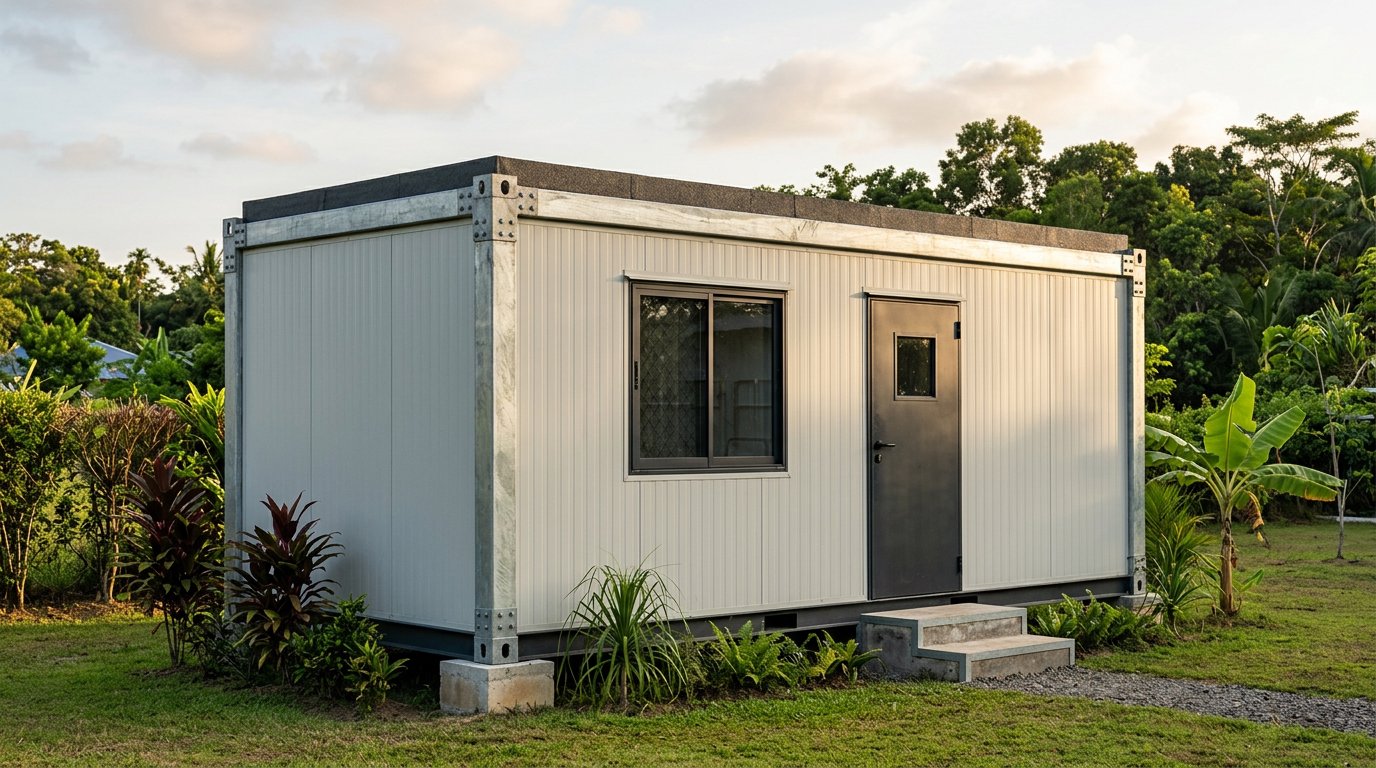
Land and building move in opposite directions
In property valuation, land and buildings are measured separately. Land is not depreciated; its value follows the local market. Buildings are depreciated, because of physical wear and functional obsolescence. An Indonesian valuation case in Karanganyar shows the gap: land at about IDR 866.4 million against an indicated building value of roughly IDR 266.4 million.
So the building part of a brick house depreciates too. What only ever seems to rise is the land, not the walls. A modular house owner who also owns the land enjoys exactly the same appreciation.
The official figure: 10 years for non-permanent buildings
The clearest benchmark comes from tax rules. Indonesia's PMK 72/2023 sets a useful life of 20 years for permanent buildings and 10 years for non-permanent buildings, with straight-line rates of 5% and 10% a year. For permanent buildings, the tax office also allows the actual useful life taken from the taxpayer's books.
That 10-year figure is a fiscal convention, not a forecast of how long the unit lasts. EN 14509, the European standard for sandwich panels, requires insulation material to have a service life of at least 25 years and panels to keep their insulating capacity for at least 5 years. A maintained unit normally outlives its tax depreciation schedule.
What actually destroys the value
A modular unit rarely loses value from age alone. The cause is almost always one of the four below, and each is visible when the unit is inspected.
- Rust on the frame and panel skin. ISO 9223:2012 grades atmospheric corrosivity from C1 to CX. First-year zinc corrosion runs 0.7 to 2.1 micrometres in class C3 and 4.2 to 8.4 micrometres in C5, such as a harsh coastline. The same unit can age far faster purely because of where it stands.
- Neglected sealant. The Construction Specifier notes that sealant joints should last 20 years but rarely do, while ASTM C920 only requires 250 hours of accelerated weathering. A leaking joint ruins the panel behind it.
- Careless welded modifications. The strength of a bolted knock-down system is that it comes apart without damage. Improvised field cuts and welds erase that advantage.
- Missing paperwork. Without panel specifications, the PBG building approval and a handover record, a buyer is left guessing, and guesses favour the buyer.
Routine care is not a formality. Pre-painted steel makers require washing at least every six months, and every three months in coastal, dusty or industrial areas. Skipping it can void the coating warranty. The detail sits in our article on modular house maintenance and service life.
If you are weighing a purchase and want to know which specification best protects resale value in your location, talk to the Smart Modular House team. We can send the current pricelist, help adjust the layout and schedule a site survey before you commit to a size and panel type.
An advantage brick houses do not have
This is the part most buyers miss. Leave a brick house behind and its value stays locked to that plot. A knock-down modular unit can be dismantled, trucked and reassembled on another plot, so the asset travels with the owner. Selling is not the only exit. The process, cost and new-site PBG requirements are in our guide to relocating a sandwich panel building.
There is also a floor that never reaches zero, because a galvanised steel frame still carries scrap value. As a global reference, SMM recorded Turkish HMS 1 and 2 (80:20) scrap at about USD 388.3 per tonne in mid-March 2026 and Alang shipbreaking scrap in India near USD 342 per tonne ex-yard in early August 2026. Local collector prices differ, but the direction sets a floor.
What is it worth on the second-hand market
Honestly, Indonesia has no price index for used modular houses. The market is thin and many circulating figures come from sellers. Two things remain usable. First, the primary market is strengthening: Mordor Intelligence estimates Indonesia's prefabricated building market at USD 8.99 billion in 2026, heading to USD 12.73 billion by 2031, at a CAGR of roughly 7.22%.
Second, buyers price condition rather than year of manufacture. In the used container market, units graded above 90% serviceable, with no structural damage and minimal rust, fetch clearly more than the 70 to 80% class. The same logic carries over to sandwich panel modular units. Legality and funding routes are covered in modular house financing.
How to protect the value from day one
- Keep one complete file: panel specification, layout drawings, the PBG approval and the handover record.
- Choose removable footings, such as concrete pads that let the module be lifted intact.
- Schedule washing and sealant checks, then log the dates. That record is evidence of condition.
- Avoid welded modifications. Use factory options: partitions, canopies, railings, PVC ceilings, vinyl flooring.
- Keep the bolts and corner fittings clean and protected. That is the first thing a buyer checks.
Frequently asked questions
Can a modular house be resold?
Yes, by two routes. Sold with the land like ordinary property, or dismantled and moved to another buyer. The second route is not open to a brick house, and it is precisely the strength of a bolted knock-down system.
How long does a modular house last before its value is gone?
The fiscal useful life of a non-permanent building is 10 years under PMK 72/2023, but that is a tax number. EN 14509 requires insulation service life of at least 25 years, and a galvanised steel exposure study at Pelabuhan Ratu predicted a zinc coating life of about 18 years at that site. Maintenance decides the rest.
What lowers the resale price fastest?
Neglected rust and leaking sealant joints. Both damage the panels and the frame, and both are visible the moment the unit is inspected. Incomplete documents come next.
Request a Pricelist, Layout Consultation and Site Survey
Smart Modular House is built by PT Sunrise Purification Technology at its Cikarang plant: a bolted galvanised steel frame with corner fittings, walls in EPS or fire-resistant rockwool sandwich panel, fibre cement board flooring, and electrical installation included. Sizes run 3x3 m, 3x6 m, 3x6 m two-storey, 3x6 m with tempered glass walls, plus custom builds.
A firm price can only come through a quotation, because it depends on options, installation and freight to your site. Request the pricelist, discuss your layout and book a site survey here.