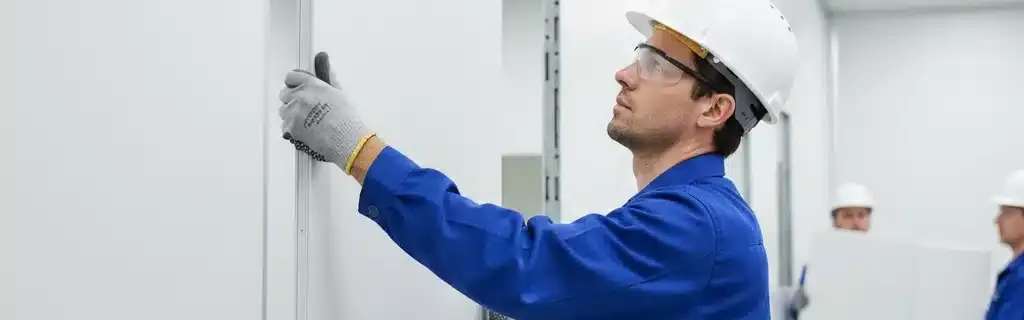

Corrosion Problems in Chemical Plant Walls — What Causes Them?
Chemical plants, food processing facilities, and pharmaceutical installations face a unique challenge not found in ordinary industrial buildings: corrosive environments. Walls in these sectors are exposed to aggressive chemicals, acid vapors, high humidity, and extreme temperature swings daily. Without the right wall material, damage can occur in months, not years.
Corrosion in chemical plant walls originates from three main sources. First, direct exposure to chemicals like sulfuric acid, hydrochloric acid, or alkaline solutions used in production. Second, chemical vapor condensation that settles on wall surfaces and gradually eats away the material. Third, high humidity accelerates oxidation of metal components, especially in tropical regions like Indonesia.
The consequences of wall corrosion are severe. Structural damage can cause roof leaks, panel collapse, and product contamination. In food and pharmaceutical industries, rust particles flaking from walls can contaminate production areas and cause failed quality tests. Repair costs for corroded conventional steel walls can reach 3-5 times the initial investment in proper materials.
International standards like ISO 12944 (corrosion protection of steel structures) classify corrosive environments from C1 to C5. Chemical plants typically fall into C4 (high corrosivity) or C5-I/C5-M (very high industrial/marine). Wall materials MUST pass durability testing for these categories — not just marketing claims.
Why Sandwich Panels Excel in Corrosive Environments
Conventional walls like lightweight bricks or precast concrete have serious weaknesses in corrosive settings. Lightweight bricks are porous — acid vapors can seep into the material and destroy the structure from within. Standard galvanized steel walls, while initially rust-resistant, begin corroding once their zinc layer erodes from continuous chemical exposure.
Sandwich panels with corrosion-resistant specifications offer multi-layer protection unmatched by conventional materials. Their structure consists of two metal skin layers (aluminium, stainless steel, or specially coated steel) with an insulating core in between. This combination delivers walls that are:
- Impermeable to chemical vapors — no pores for acid or alkaline fumes to penetrate
- Non-porous surfaces — easy to clean, zero liquid chemical absorption
- Lightweight — reduces structural load, enables taller construction with smaller foundations
- Thermally insulated — maintains stable internal temperatures, cutting HVAC energy costs
- Fast installation — interlocking joint system, no plaster or render that cracks in corrosive conditions
At a palm oil processing plant in Riau, for example, aluminium sandwich panel walls have lasted over 5 years without significant corrosion, while conventional steel walls in the same area needed panel replacement within 2 years. This difference isn't just about materials — it's about total cost of ownership (TCO) over the building's lifespan.
Choosing the Right Core Material for Corrosion Resistance
Not all sandwich panels are suitable for corrosive environments. Core material and metal skin selection must match the dominant chemicals in your facility. Here's a practical selection guide based on field conditions:
PIR (Polyisocyanurate) Core + Aluminium Skin — the most popular combination for moderate corrosive environments. Aluminium naturally forms a protective oxide layer that prevents further corrosion. PIR core offers superior fire resistance (Class B/B1) and excellent dimensional stability. Ideal for food plants, pharmaceutical facilities, and light chemical processing. Expected service life: 15-20 years with minimal maintenance.
Stainless Steel 304/316 Skin + PIR Core — the choice for heavy corrosive environments with exposure to strong acids like H₂SO₄ or HCl. Grade 316 contains molybdenum for pitting corrosion resistance. Cost is higher (2-3x aluminium) but essential for aggressive chemical processing areas. Service life can exceed 25 years.
Full Aluminium Sandwich Panels (Aluminium-Aluminium) — both sides aluminium, ideal for cold storage in corrosive environments because aluminium doesn't embrittle at low temperatures. Lightweight and 100% recyclable. Limitation: lower structural strength than steel, requires additional support framing for large spans.
Galvanized Steel + PVDF Coating — economical alternative for light to moderate corrosive environments. PVDF (Polyvinylidene Fluoride) is a fluoropolymer coating with excellent UV and chemical resistance. Suitable for exterior factory walls exposed to acid rain or industrial pollution. Requires coating inspection every 3-5 years.
Essential Protective Coatings You Must Spec
The metal skin of sandwich panels for corrosive environments cannot rely on base material alone — protective coatings are mandatory. Without proper coating, even stainless steel can develop crevice corrosion at joints and hidden areas.
Here are the 4 main coating types used in the industry:
- PVDF (Polyvinylidene Fluoride) — premium fluoropolymer coating. Resistant to extreme UV, acids, alkalis, and organic solvents. No peeling or color fading for up to 20 years. Standard for high-end chemical plant projects.
- SMP (Silicone Modified Polyester) — mid-range coating with good chemical and UV resistance. More economical than PVDF, suitable for moderate corrosive environments. Needs recoating after 10-12 years.
- Polyester Coating (Regular) — economical coating for non-corrosive environments. NOT recommended for chemical plants, but sufficient for standard warehouses or commercial buildings.
- Plastisol (PVC Coating) — thick coating (100-200 microns) with high abrasion resistance. Suitable for areas subject to physical impact. However, chemical resistance is below PVDF level — not suitable for strong acid exposure.
Coating thickness is also critical. For C4/C5 environments, the minimum recommendation is 25 microns for PVDF and 35 microns for SMP — measured with a coating thickness gauge, not visual estimation. Ensure your supplier provides factory coating thickness test certificates, not just brochure claims.
-e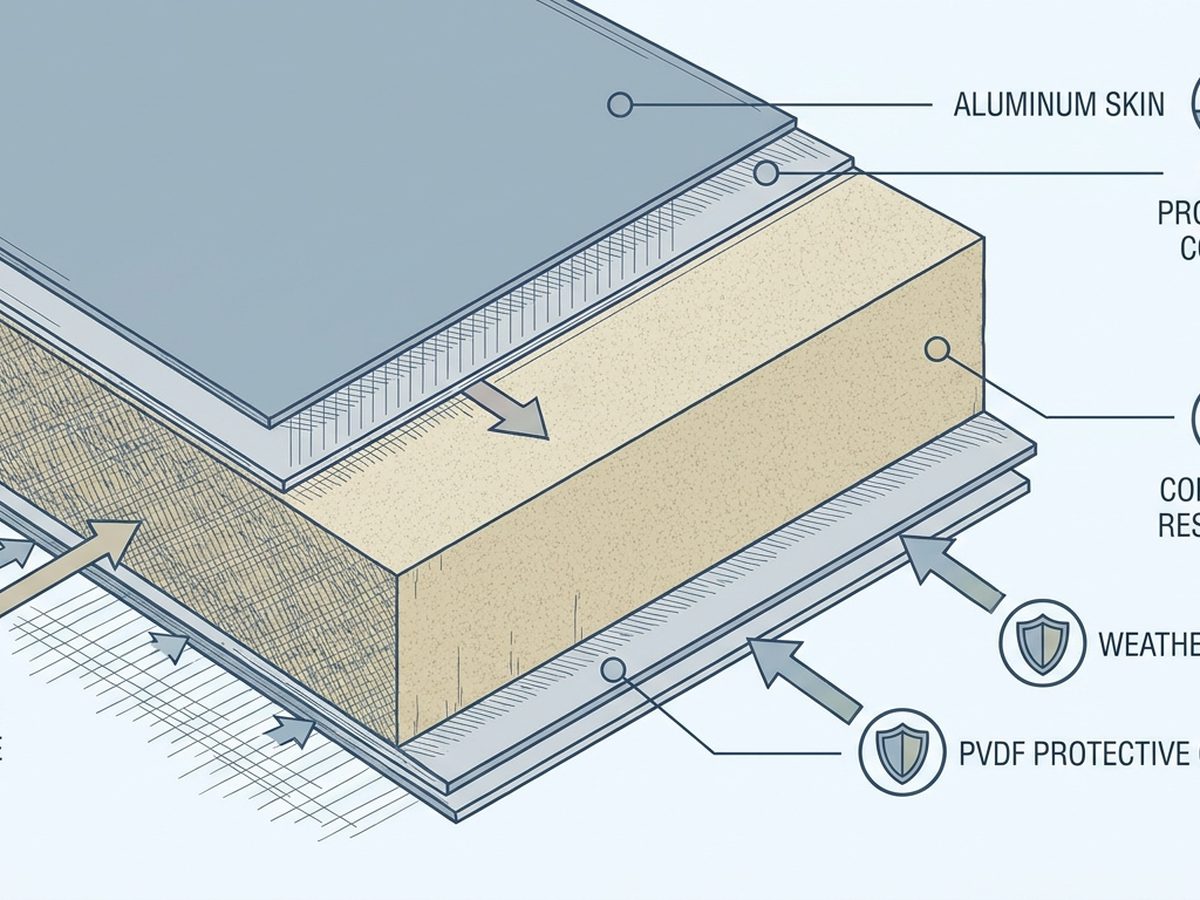
Technical Specifications for Heavy Corrosive Environments
Getting the specifications right is the most critical step in any corrosion-resistant wall project. Spec errors cannot be fixed after panels are installed — the only solution is complete replacement, meaning 2x cost and production downtime.
Here is the minimum specification checklist for C4/C5 (high to very high corrosivity) environments:
- Metal skin: Aluminium AA3003/AA3004 minimum 0.5mm thickness, or stainless steel 304/316 at 0.4-0.5mm
- Coating: PVDF 25+ microns (exterior), food-grade epoxy (interior for food production areas)
- Core density: PIR 38-42 kg/m³ — never below 38, insulation and strength drop sharply
- Joint system: Cam-lock or tongue-and-groove with EPDM gasket to prevent chemical vapor infiltration
- Fasteners & accessories: Stainless steel 316 for screws, rivets, and brackets — never use standard galvanized
- Sealant: Neutral-cure silicone (not acetoxy-cure) — acid-resistant and non-corrosive to metal
- Fire rating: Minimum Class B/B1 (ASTM E84 or EN 13501-1) — critical as many chemical plants store flammable materials
For validation, request that suppliers show salt spray test results (ASTM B117) for minimum 1,000 hours with no corrosion signs on the metal skin, plus chemical resistance tests against the specific chemicals used in your plant. Serious suppliers will have these documents ready — if they only rely on generic brochures, find another supplier.
3 Fatal Mistakes When Choosing Walls for Chemical Plants
Field experience from numerous projects shows that wall failures in corrosive environments almost always trace back to these 3 major mistakes. Learn and avoid them before your project starts:
Mistake 1: Choosing materials based on lowest price, not TCO. This is the most common error. Galvanized steel walls with polyester coating may be 40% cheaper upfront, but panel replacement costs within 2-3 years plus production downtime will far exceed the initial price difference. Calculate TCO (Total Cost of Ownership) for a 15-20 year period, not just the per-square-meter price.
Mistake 2: Ignoring fastener and accessory compatibility. Your panels may be premium aluminium with PVDF coating, but if screws and brackets use standard galvanized steel, that's where corrosion will start. Galvanic corrosion occurs when two dissimilar metals contact each other in humid environments — the less noble metal corrodes faster. Golden rule: all accessories MUST use material equal to or more corrosion-resistant than the main panel.
Mistake 3: Skipping site-specific chemical resistance testing. Every plant has a unique "chemical signature" — a specific mix of chemical vapors and liquids that cannot be simulated by standard lab tests alone. Professional suppliers offer coupon testing: install small panel samples in the target area for 30-90 days, then evaluate conditions before mass production. The additional cost of roughly $200-300 for this test is negligible compared to the risk of total failure costing tens of thousands.
FAQ — Common Questions About Corrosion-Resistant Wall Panels
Can aluminium sandwich panels rust?
Aluminium doesn't rust like steel, but it can experience galvanic corrosion when in contact with dissimilar metals in humid environments. Aluminium may also oxidize forming a white layer — this is normal and actually protects the underlying material. With proper PVDF coating, aluminium can last 20+ years in C4 environments.
How much do corrosion-resistant sandwich panel walls cost per m²?
Prices vary by specification. For aluminium + PIR core with PVDF coating: approximately $28-45 per m² (material only, 2026). Stainless steel 316 panels: roughly 2-3x the aluminium cost. Contact our team with your project specifications for an accurate estimate — every project has unique variables affecting the final price.
Are corrosion-resistant sandwich panels suitable for cold storage in chemical plants?
Highly suitable. Aluminium sandwich panels with PIR core are ideal for cold storage in corrosive environments because aluminium doesn't embrittle at low temperatures (unlike carbon steel). Panels should include vapor barriers and joint systems with EPDM gaskets to prevent internal condensation that can cause ice buildup.
What is the service life of sandwich panel walls in corrosive environments?
With proper specifications (aluminium + PVDF coating + stainless steel accessories), service life reaches 15-20 years with routine maintenance. Stainless steel 316 panels can exceed 25 years. Biannual coating and sealant inspections are key to achieving maximum lifespan.
Conclusion & Recommendations
Corrosion-resistant sandwich panel walls are not just an option — they are a mandatory requirement for chemical plants, food processing facilities, and pharmaceutical installations operating in corrosive environments. The higher upfront investment pays back many times over through reduced maintenance costs, prevented downtime, and protected product quality.
Practical recommendations based on field project experience: for C4 (high corrosivity) environments, choose aluminium sandwich panels with PVDF coating, stainless steel 316 fasteners, and neutral-cure silicone sealant. For C5 (very high corrosivity), consider stainless steel 316 skin with PIR core. Always conduct coupon testing before mass production — 30-90 days of on-site testing is far cheaper than total failure.
Our team at SandwichPanels.id has handled numerous corrosion-resistant wall projects for chemical plants, food processing facilities, and pharmaceutical laboratories across Indonesia. We provide free specification consultation, site surveys, and coupon testing to ensure the selected materials truly match your plant's environment.
Contact us now for a free corrosion-resistant wall specification consultation. Visit our aluminium sandwich panel specifications page or our sandwich panel factory construction benefits guide for more details. Our engineering team is ready for a site visit to your location — free, with no obligation.