

Green building certification is often treated as a concern for glass office towers in Jakarta. In fact warehouses and factories sit in the mandatory bracket with the lowest floor-area threshold of all, and panel owners usually discover this when planning documents are reviewed.
This article sets out where sandwich panels genuinely earn points in Indonesia's BGH performance assessment, and where they do nothing at all. The reference is the text of Minister of Public Works Regulation 21 of 2021 itself, not a brochure summary.
The legal basis of BGH and who falls in the mandatory category
BGH performance assessment is governed by Minister of Public Works and Housing Regulation 21 of 2021, signed on 31 March 2021 and promulgated on 1 April 2021. It revoked Regulation 02/PRT/M/2015. The ministry legal database still lists it as in force, and as of October 2026 no replacement regulation has been issued.
Article 2 paragraph (1) splits compliance into seven orders: new and existing buildings, each in either the mandatory or the recommended category, plus community green housing (H2M) and green districts.
Article 2 paragraph (2) states the mandatory category in plain numbers:
- class 4 and 5 buildings above 4 storeys with a floor area of at least 50,000 m²;
- class 6, 7 and 8 buildings — retail, warehousing, factories and laboratories — above 4 storeys with a floor area of at least 5,000 m²;
- class 9a buildings larger than 20,000 m²;
- class 9b buildings larger than 10,000 m².
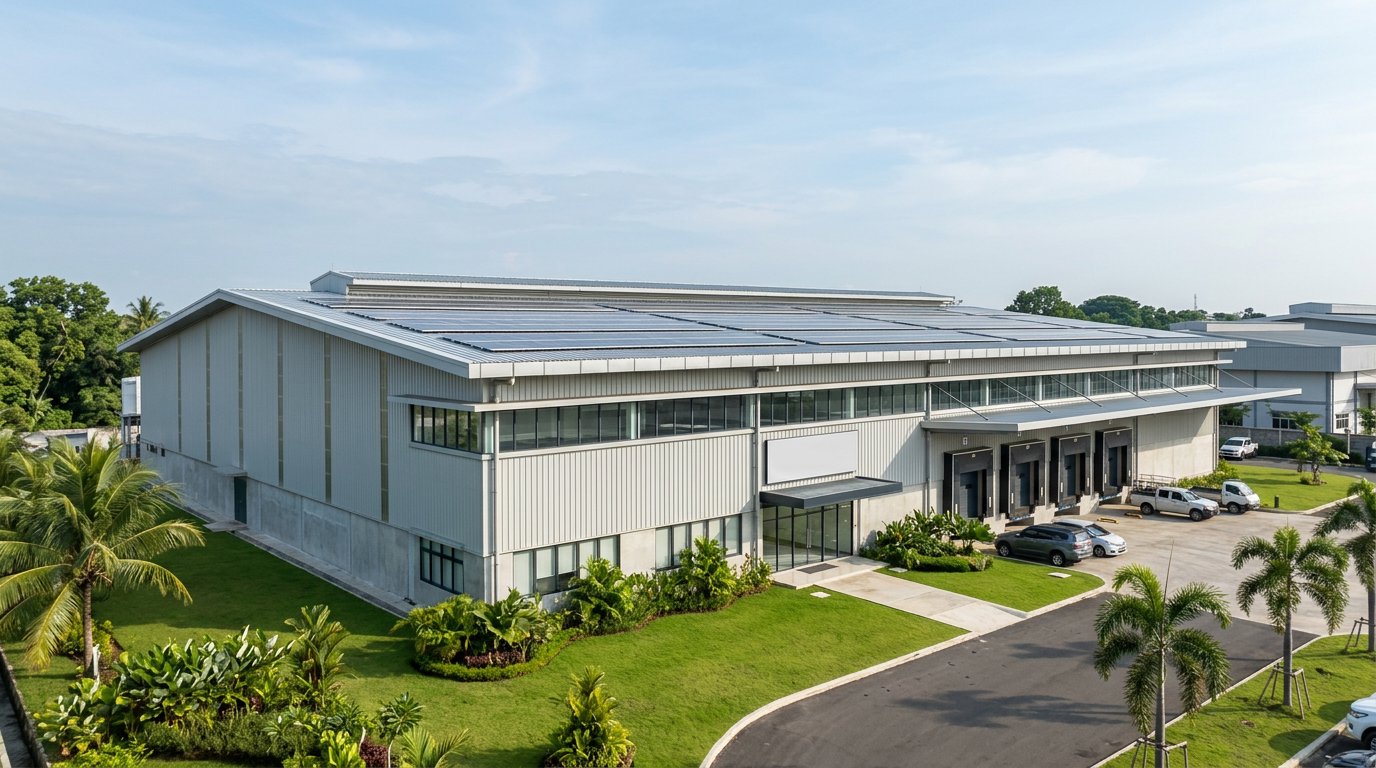
Note the phrase “above 4 storeys” in point b. A single-storey panel warehouse of 8,000 m² is not in the mandatory bracket; under Article 2 paragraph (3) it falls in the recommended category. Article 35 still opens the door to regional government incentives for BGH owners.
Seven assessment parameters and where panels sit
At the technical planning stage the assessment uses seven parameters: site management, energy use efficiency, water use efficiency, indoor air quality, use of environmentally friendly materials, waste management and waste water management.
The energy parameter is split into seven criteria, with the building envelope first, followed by ventilation, air conditioning, lighting, in-building transport, efficiency calculation and the electrical system. Panel walls and roofs are scored under that first criterion.
So the panel choice touches one criterion out of seven, inside one parameter out of seven. A supplier promising that its panel will make your building pass BGH is selling a conclusion the regulation does not contain.
The envelope numbers that get scored
The thermal benchmark for envelopes in Indonesia is SNI 6389:2020 on building envelope energy conservation, which caps OTTV at 35 W/m². OTTV is built from three terms: conduction through opaque walls, conduction through glazing, and solar radiation entering through glazing.
A sandwich panel improves the first term only. Design-estimate U-values, using the ISO 6946 method with an EPS core at 0.035 W/mK, show why that term moves so far:
- 50 mm EPS panel, roughly 0.63 W/m²K;
- 75 mm EPS panel, roughly 0.43 W/m²K;
- 100 mm EPS panel, roughly 0.33 W/m²K;
- 150 mm clay brick wall plastered both sides, roughly 2.5 W/m²K.
Thickness-by-thickness and core-by-core figures are set out in our discussion of sandwich panel U-values and R-values. The numbers above are design estimates; manufacturer declared values follow the EN 14509 reference method.
Glazing still decides the outcome. A warehouse facade with a narrow window strip and a deep roof overhang clears the OTTV limit far more easily than a glass-walled office that uses panels only on the remaining solid areas.
Environmentally friendly materials and the green supply chain
This parameter has two criteria: control over hazardous materials, and the use of eco-labelled materials. The second needs to be prepared before tender, not after panels arrive on site.
For the construction stage the regulation adds four parameters: conformity of construction performance, green construction process, green behaviour practice and green supply chain. The green supply chain criterion scores the construction materials used and the choice of suppliers and subcontractors.
Ask the panel manufacturer for data sheets, test reports and environmental documents at the quotation stage. On a BGH project that paperwork is part of the score, not an administrative annex.
Construction waste and materials reused
The construction waste management criterion sits under the green construction process parameter. Panels are produced to ordered lengths, so offcuts on site are easier to hold down than with wet wall trades, provided the cutting list is correct before production starts.
At the demolition stage the regulation requires documentation of the building's construction materials, of the parts to be dismantled, and of the materials or waste that will be reused. Bolted panel buildings have a real advantage here; the procedure and cost are covered in our guide to relocating a sandwich panel building.
Ratings, certificates and the link to PBG and SLF
BGH ratings run Pratama, Madya and Utama, set by the score achieved. Thresholds quoted by civil engineering journals and a ministerial circular are 45 to 65 per cent for Pratama, above 65 to 80 for Madya and above 80 for Utama. These are secondary sources, so verify them against the official checklist before using them in a contract.
A planning stage BGH certificate goes to owners who already hold a PBG building approval. Construction and occupancy stage certificates require an SLF certificate of functional suitability, and the BGH certificate runs for the same five years as the SLF, a route covered in our SLF guide.
What panels cannot promise
BGH scores seven planning parameters plus construction and occupancy parameters. Water efficiency, solid waste, waste water, site management and occupant governance are untouched by a wall material decision. A good envelope only eases the energy criteria.
The market context deserves an honest mention. A guide published by Gadjah Mada University in February 2025 records that green buildings in Indonesia still amount to around 2 per cent of the total building stock. On the voluntary track, Konstruksi Media reports roughly 110 Greenship certified and 153 EDGE certified buildings.
Need envelope figures for your own planning documents? Our team can prepare panel specifications, estimated U-values by thickness and manufacturer data sheets through the contact page.
Frequently asked questions
Does a single-storey sandwich panel warehouse need BGH certification?
No. Article 2 paragraph (2) point b requires class 6, 7 and 8 buildings to be above 4 storeys before the 5,000 m² threshold applies. A single-storey warehouse falls in the recommended category under paragraph (3), so certification is voluntary.
Do sandwich panels automatically raise a BGH rating?
Not automatically. Panels act on the envelope criterion inside the energy efficiency parameter, and points only appear once the OTTV calculation and supporting documents are submitted. The rating reflects every parameter, water and waste included.
What is the maximum OTTV value to achieve?
SNI 6389:2020 caps OTTV at 35 W/m². The calculation covers conduction through opaque walls and glazing plus solar radiation through glazing, so glazed area and shading shape the result alongside the panel U-value.