

Almost every sandwich panel datasheet carries two numbers that sound similar but run in opposite directions: the U-value and the R-value. Together they decide how many watts of heat cross your warehouse wall every hour, and that ends up on the electricity bill. This guide covers how to work them out yourself, a U-value table by thickness for EPS, PIR and rockwool cores, and two worked examples that turn W/m2K into rupiah.
U-Value and R-Value Get Mixed Up Constantly
R-value is thermal resistance, measured in m2K/W. The higher the R-value, the harder it is for heat to pass through that layer. U-value is the inverse, thermal transmittance in W/m2K, so a lower U-value means better insulation. The relationship is simply U equals 1 divided by total R.
The mistake that shows up most often when comparing quotes is putting one supplier's R-value next to another supplier's U-value and concluding that the bigger number wins. The two units cannot be compared until one is converted. Some datasheets also publish the core R-value without surface resistances, which makes the figure look better than the installed wall.
How to Calculate a Sandwich Panel U-Value
The method is the layered resistance calculation standardised in ISO 6946: total wall resistance is the inner surface resistance plus the resistance of each material layer plus the outer surface resistance.
For a vertical wall with horizontal heat flow, the inner surface resistance is normally taken as 0.13 m2K/W and the outer as 0.04 m2K/W, giving 0.17 m2K/W in total. The insulation layer's resistance is its thickness in metres divided by the material's thermal conductivity. The steel skins can be ignored, at roughly 50 W/mK over 0.3 to 0.5 mm.
Take a 75 mm EPS panel at 0.035 W/mK. Core resistance is 0.075 divided by 0.035, which is 2.14 m2K/W. Add 0.17 and you get 2.31 m2K/W. The U-value is 1 divided by 2.31, or 0.43 W/m2K.
U-Value Table by Thickness and Core Type
The table below is calculated the same way, using mid-range conductivities from manufacturer datasheets: EPS 0.035, PU/PIR 0.024 and rockwool 0.040 W/mK. All figures are in W/m2K.
| Thickness | EPS | PU/PIR | Rockwool |
|---|---|---|---|
| 50 mm | 0.63 | 0.44 | 0.70 |
| 75 mm | 0.43 | 0.30 | 0.49 |
| 100 mm | 0.33 | 0.23 | 0.37 |
| 150 mm | 0.22 | 0.16 | 0.26 |
| 200 mm | 0.17 | 0.12 | 0.19 |
For comparison, a 150 mm clay brick wall plastered on both sides works out at roughly 2.5 W/m2K by our own calculation using the same method. A 50 mm EPS panel therefore resists heat about four times better than brick, and a 100 mm PIR panel about eleven times better. These are design estimates, not a substitute for test data; declared U-values are measured against the EN 14509 reference method. For the structural and span side, see our guide to standard wall panel sizes and thicknesses.
From W/m2K to Rupiah: Two Worked Examples
Conduction heat load is area multiplied by U-value multiplied by the temperature difference in kelvin, which gives watts. Divide that by the chiller's coefficient of performance to get electrical watts, then multiply by running hours and tariff.
First, an air conditioned warehouse 40 by 25 m with 6 m walls, so 780 m2 of wall. Outside 33 degrees, inside 25 degrees, a difference of 8 K. A brick wall gives 780 x 2.5 x 8, which is 15,600 W. A 50 mm EPS panel gives 780 x 0.63 x 8, or 3,931 W. The gap is about 11.7 kW of cooling load.
At a coefficient of performance of 3 that is 3.9 kW of electricity. Run it 10 hours a day for 26 days and it comes to roughly 1,014 kWh a month, or about Rp1.14 million at the B-3 and I-3 tariff of Rp1,122 per kWh.
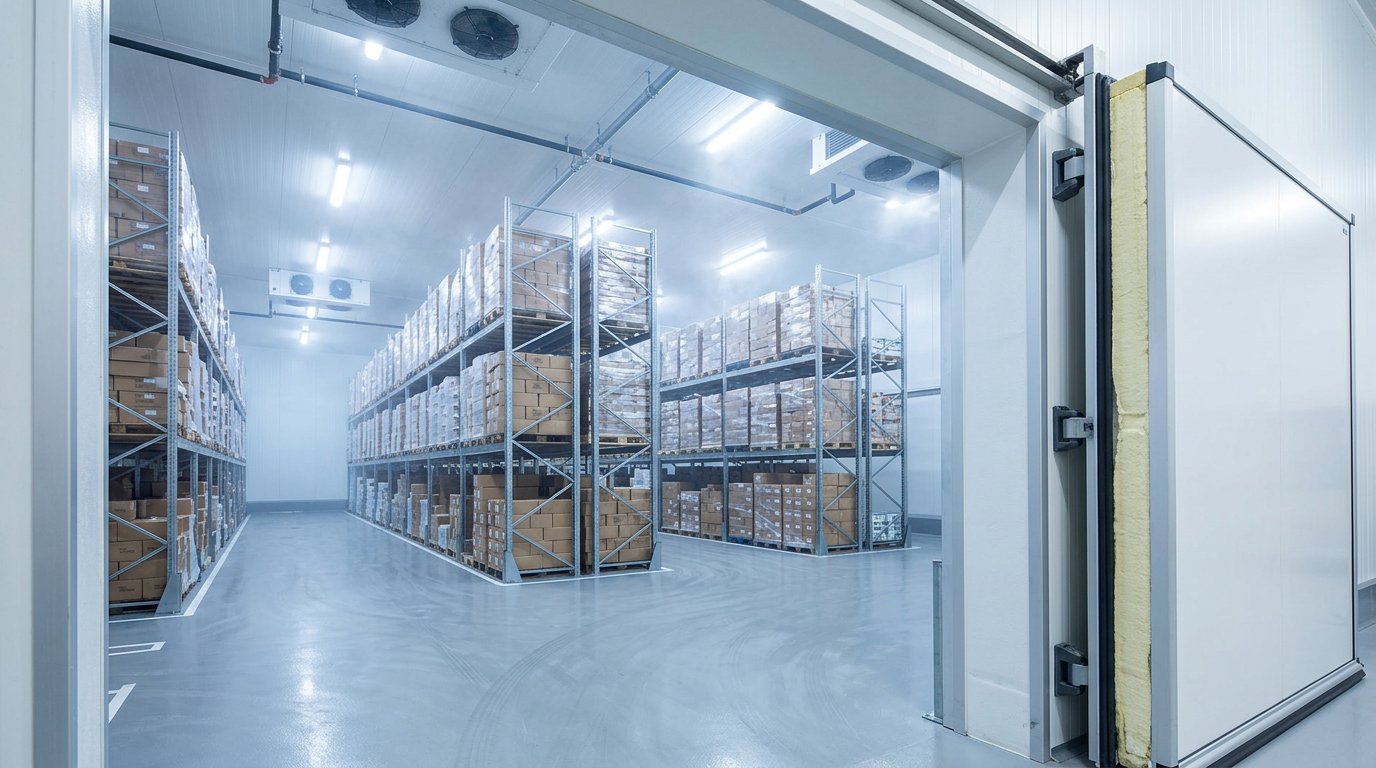
Second, a freezer room 10 by 10 m and 4 m high, minus 18 degrees inside against 32 outside, a difference of 50 K. Wall, floor and ceiling area is about 360 m2. A 100 mm EPS panel carries 5,940 W while 100 mm PIR carries 4,140 W, a gap of 1,800 W.
At freezing temperatures the coefficient of performance is far lower, around 1.5. That load gap becomes 1,200 W of electricity running 24 hours a day, roughly 864 kWh a month. At Rp1,122 per kWh that is about Rp970,000 a month, close to Rp11.6 million a year. The material price gap between EPS and PIR usually pays back within a few years in a freezer, but not necessarily in a dry warehouse. Our review of PIR panels for cold storage covers the material side.
The tariffs above are the non-subsidised rates announced by Indonesia's Ministry of Energy and Mineral Resources for 2026: B-2 at Rp1,445 per kWh, B-3 and I-3 at Rp1,122, and I-4 at Rp997. Adjustments are set quarterly under Ministerial Regulation 7 of 2024, and the rates were held flat through the first three quarters of 2026.
The SNI 6389:2020 OTTV Limit and Where Panels Fit
In a building, wall U-value does not stand alone. SNI 6389:2020 on building envelope energy conservation governs the overall thermal transfer value, or OTTV, and sets a maximum of 35 W/m2. The same limit appears in the Ministry of Energy's own energy conservation briefing material.
OTTV adds up three heat paths: conduction through opaque walls, conduction through glazing, and solar radiation transmitted by glazing. The opaque wall term comes from surface absorptance, wall U-value and the equivalent temperature difference. That is where the panel U-value does its work.
So an insulated panel improves one term out of three. A panel clad building with wide unshaded glazing can still miss the limit, and a dark coating absorbs far more than a light one.
Choosing Thickness: Practical Rules of Thumb
The following are drawn from cold room panel supplier guidance and common practice, not from a mandatory standard:
- Chillers near 0 degrees: typically 80 mm for walls and roof.
- Freezers at minus 18 to minus 20 degrees: 100 mm as a starting point, up to 140 mm where higher insulation is demanded.
- Blast freezing near minus 40 degrees: 150 to 200 mm.
- Hot climates: some suppliers advise adding 20 to 50 per cent to the reference thickness.
- A cold store envelope heat gain benchmark circulating in industry guidance: around 10 W/m2.
That 10 W/m2 figure is useful as a cross-check. In the freezer example above, 100 mm EPS gives 16.5 W/m2 and fails it, 100 mm PIR gives 11.5 W/m2 and is still over, and 150 mm PIR gives 8 W/m2 and passes. For whole building costs, see our sandwich panel warehouse construction cost guide.
FAQ
Can a panel R-value be added directly to a brick wall R-value?
Yes, as long as the surface resistances are counted once for the whole assembly. Add the resistance of each material layer first, add 0.17 m2K/W, then invert to get the U-value. Adding the U-values of two layers together is a common arithmetic error.
Why is the installed U-value often worse than the datasheet figure?
Mainly thermal bridging at joints, penetrating fasteners and the supporting steel frame. Loose joints also admit humid air, which degrades core performance. A few per cent to low double digits is normal, and most of it can be controlled by installation quality.
Is a thicker panel always the cheaper option?
Not always. The U-value improvement slows as thickness grows because the relationship is inverse, while material price rises close to linearly. From 50 to 100 mm the EPS U-value drops 0.30 points, from 150 to 200 mm only 0.05. In a dry warehouse, thickness beyond 75 mm often does not pay back.
Need a declared U-value for a specific thickness, or an envelope load calculation for your project? Talk to our technical team through the sandwichpanels.id contact page. For the residential case, see our article on heat in modular houses.