

The question almost always lands right after a buyer finishes comparing prices: is a sandwich panel modular house safe from termites and rats? The honest answer has two halves. The wall material itself is not termite food. But every house has gaps, and the gaps decide the outcome.
Termites do not eat EPS, but they nest inside it
A University of Florida study by Tucker, Pereira and Koehler, published in Sociobiology in April 2008, exposed three materials to the subterranean termite Reticulitermes flavipes for eight weeks: 2x4 lumber, plywood, and rigid foam board insulation.
The result surprised the researchers. Foam board took the worst damage: 12 percent of the material was removed in eight weeks, and its insulation value fell 27 percent. In plywood the termites ate only 3.1 percent of the material, yet insulation value dropped 74 percent. In 2x4 lumber, 6.7 percent was consumed and insulation value fell 35 percent.
Cynthia Tucker's explanation matters. The plastic in insulation is not a food source for termites, but its soft texture lets them build extensive tunnels, and they eat the paper facing on its surface. It is also a near-ideal habitat, shielding the colony from cold.
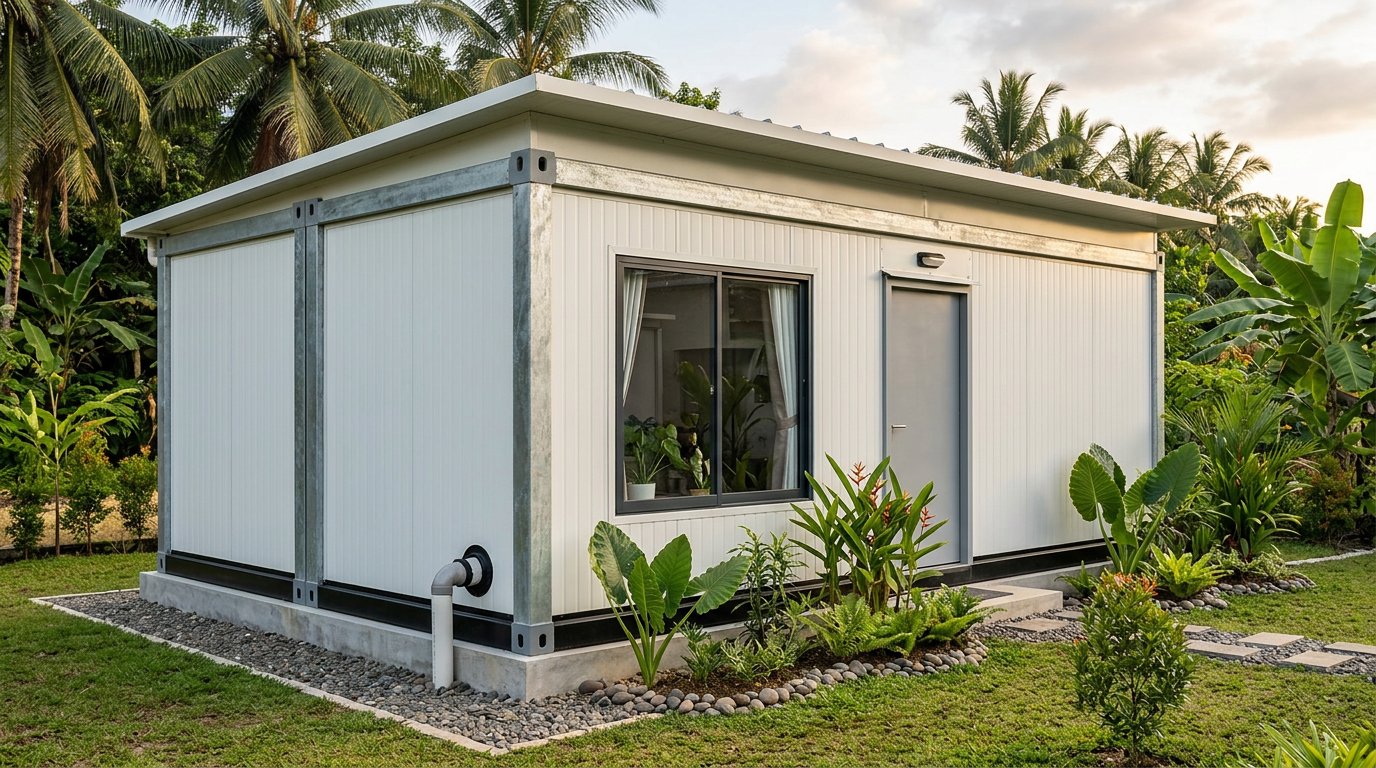
That is exactly where a factory sandwich panel differs. Its EPS core is sealed between two pre-painted steel skins, not kraft paper. Termites have no organic surface to chew and no way in while those skins stay intact. The risk simply moves elsewhere: cut edges, pipe penetrations, and the base of the wall.
Five weak points for rats, none of them mid-wall
Rats do not chew through steel. They enter through an opening that already exists, then enlarge it with their teeth. University of Nebraska extension guidance uses long-standing thresholds: rats get through any opening larger than half an inch, roughly 12.7 mm, mice through anything larger than a quarter inch, roughly 6.35 mm.
So a site inspection is a measuring job, not a guessing one. Bring a ruler and check these five places.
- Base of the wall. The joint between the lowest panel and the ring beam or slab, including corners often left open after installation.
- Pipe and cable penetrations. Holes for supply water, waste water and electrical cable drilled wider than the pipe itself.
- Roof-to-wall junction. The voids under corrugated spandek sheeting when no profile filler is fitted.
- Cut panel edges. Window and door openings cut on site and then left without flashing or a closure profile.
- Underfloor void. The space beneath a module standing on raised footings or concrete pedestals.
The first four are installation work you can specify from the start. The underfloor void is a foundation decision, better settled before production, especially on raised units of the kind covered in our flood-resistant guide.
These weak points belong in the conversation before the floor plan is frozen, not after the unit arrives. Our team can send the current pricelist, review your plan, and schedule a site survey through the sandwichpanels.id contact page.
Sealing materials that last, and ones that do not
This is where owners most often pick the wrong material. The same extension guidance names hardware cloth as the standard closure: 19 gauge with half-inch mesh to exclude rats, and 24 gauge with quarter-inch mesh where mice are also a problem.
What cannot be trusted on its own is expanding foam. Structural pest control guidance notes that rodents chew straight through it in minutes unless it is reinforced with metallic wool or capped with mortar. Ordinary steel wool rusts, so stainless steel is safer in damp spots.
The routine maintenance that protects sealant and steel coating also closes pest gaps. We set out the intervals in our modular house maintenance guide.
Soil treatment: the current SNI and market cost
For the soil, Indonesia has its own standard. SNI 2404:2015 covers control of subterranean termite attack on houses and buildings before construction, revising SNI 03-2404-1991. Its companion, SNI 2405:2015, covers the same work on buildings already standing.
Do not cite the 1991 edition, which has been superseded. The scope runs from requirements through design to execution, including clearing tree roots and timber formwork from the site before building starts.
Market rates from service providers, using Fumida figures carried by Warta Ekonomi, Katadata and RM.id: post-construction around Rp35,000 to Rp45,000 per square metre, pre-construction Rp50,000 to Rp60,000, piped systems Rp75,000 to Rp80,000. Warranties run three years for post-construction and piped work, five for pre-construction. Rentokil puts soil treatment protection at three to five years depending on soil conditions.
The Smart Modular House specs that matter here
Smart Modular House, built by PT Sunrise Purification Technology at its Cikarang plant, uses a bolted galvanised steel frame with a corner fitting at every corner, EPS density 10 sandwich panel walls, aluminium windows, steel doors and fibre cement board flooring. Ceiling height is 2.85 m and electrical installation is included.
Where fire resistance is required, EPS density 15 or rockwool is available. There is no structural timber in the base package. That is not an anti-termite claim; it removes the main food source, and the difference shows against timber-lined used container homes, which we compare in used container home versus sandwich panel modular.
Sizes available are 3x3 m, 3x6 m, 3x6 m two-storey, 3x6 m with tempered glass walls, plus custom knock-down or welded builds. Options that change the gap count: an internal toilet and biotech septic tank set how many pipe penetrations you get, and a PVC ceiling closes the roof void from inside.
FAQ
Can termites eat an EPS sandwich panel wall?
No. EPS is a plastic and not a termite food source, a point the University of Florida researchers made explicitly. With bare foam board, termites tunnel through it and eat the paper facing. In a factory sandwich panel the EPS core is sealed between two steel skins, so there is no organic surface left to chew.
What gap size has to be sealed to keep rats out?
The University of Nebraska extension benchmark: seal every opening wider than about 12.7 mm to exclude rats, and wider than about 6.35 mm where mice are also a concern. Use hardware cloth or sheet metal, not unreinforced expanding foam, because gnawing enlarges a small opening quickly.
Does a modular house still need soil termite treatment?
For a unit on concrete footings with no structural timber, soil treatment is optional and depends on site history and what you put inside. Furniture, added frames and timber shelving can still be attacked. If your land has a termite history, pre-construction treatment to SNI 2404:2015 is done before the footings are poured.
Request a Pricelist, Floor Plan Consultation and Site Survey
A firm Smart Modular House price only comes through a quotation, because it depends on size, options and delivery location. We can send the current pricelist, review your floor plan including pipe penetrations and wall base detail, then schedule a site survey. Reach us through the contact page and tell us the size and intended use.