

In 2026 modular buildings became a line item in Indonesian public spending. The Ministry of Public Works used them for post-disaster temporary housing in Aceh and North Sumatra, at a unit count that qualifies as a large project.
This article is for the institutional buyer: housing agencies, ministry work units, state-owned enterprises, and mining or plantation companies that buy through formal procurement. It covers three things — what the government has already built, the specifications that appear in tender documents, and the paperwork to prepare during budgeting.
Modular Huntara Is Already the Ministry's Choice
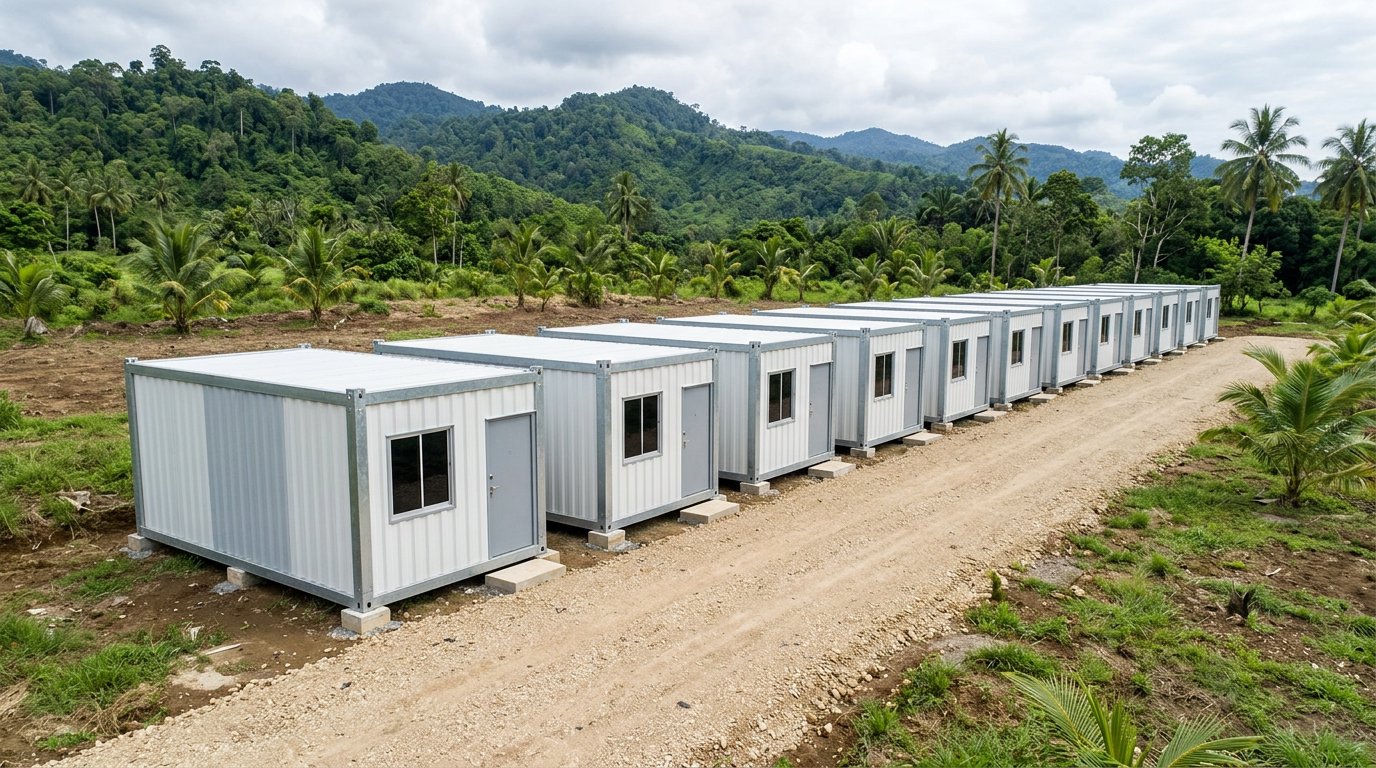
In February 2026 the Ministry of Public Works was building 1,301 modular housing units for Sumatra disaster victims: 1,056 units in Aceh and 245 in North Sumatra. As of 9 February 2026 average progress stood at 47 percent, with completion targeted for the end of February so families could move in before Eid.
The distribution shows a package-per-regency pattern. The Directorate General of Strategic Infrastructure recorded 252 units in Tapanuli Selatan, 202 families in Bener Meriah, and 114 modules for 84 families in Aceh Tamiang, with sanitation units and communal space. In Tegal Regency, modular huntara housed victims of a land-shift disaster.
The method is called Modular Lite, or MOLI, delivered in part by PT Wijaya Karya Bangunan Gedung. What won it the job was not price but installation without heavy equipment, short site time, and far less construction waste.
The lesson for whoever drafts the specification: the recurring terms are bolted system, knock-down, and no heavy equipment — not brand names. Earthquake-resistant temporary housing is covered in our article on earthquake-resistant temporary housing.
House Renovation Grants and Huntara Are Different Routes
These two programmes get mixed into one question, yet their mechanics differ sharply. The renovation programme runs through Bantuan Stimulan Perumahan Swadaya (BSPS) at the Ministry of Housing and Settlement Areas, under Ministerial Regulation Number 10 of 2025.
According to the ministry, the grant is Rp20 million per house in regular regions — Rp17.5 million for building material and Rp2.5 million for labour. Papua and North Maluku use higher figures. The 2026 target is 400,000 units on a budget reported between Rp8.3 trillion and Rp8.57 trillion, with 46.72 percent realised as of 30 September 2026.
So BSPS is cash assistance managed by the recipient, not a channel for buying finished modular units, and Rp20 million does not cover a complete dwelling. Modular buildings enter through other routes: contractual packages held by work units, agency goods procurement, or the electronic catalogue.
Choosing the wrong budget line stalls a package in verification rather than on site. Official programme references sit on the Ministry of Housing website.
Drafting terms of reference or a budget plan for housing, guard posts, or site offices? Send the unit count, location, and installation deadline through our contact page. The Cikarang factory team prepares a pricelist, a layout proposal, and a site survey schedule so your specification is realistic before announcement.
Specifications Tender Documents Usually Ask For
Smart Modular House, built by PT Sunrise Purification Technology in Cikarang, is configured along the lines procurement documents tend to request. These are the items committees write most often:
- Galvanised steel frame with a bolted knock-down system and corner fittings at every corner, so a unit can be dismantled and relocated once its service period ends.
- Walls in EPS sandwich panel at density 10, density 15 where fire resistance is required, or rockwool when the specification demands higher fire performance.
- Fibre cement board flooring, 2.85 metre ceiling height, aluminium windows, and a steel door.
- Electrical installation already included in the unit.
- Sizes of 3x3 m, 3x6 m, 3x6 m two storey, 3x6 m with tempered glass walls, plus custom knock-down or welded builds.
- Options: internal toilet, air conditioning, partitions, stairs, canopy, railing and roof terrace, mini pantry, PVC ceiling, gable or sloped spandek roof, vinyl or ceramic flooring, and a biotech septic tank.
Write the specification around function and dimension, not a brand. A committee that states panel core density, thickness, and joint method receives bids that compare like for like. For worker housing and site barracks, the combination is set out in our worker mess article.
Electronic Catalogue, Local Content, and Building Permits
Catalogue rules changed this year. LKPP Regulation Number 2 of 2026 on the Electronic Catalogue in Government Procurement was promulgated on 1 September 2026 and revoked LKPP Regulation Number 9 of 2021. Its legal basis is Presidential Regulation Number 46 of 2025, the second amendment to Presidential Regulation Number 16 of 2018.
The most visible change is the role of the Managing Agency Partner; where none exists, authority returns to LKPP. Running catalogue systems have up to one year to adjust. For construction e-purchasing, mini competition is governed by LKPP Head Decree Number 93 of 2025, published by JDIH LKPP.
An honest note on product categories: we found no confirmation that a dedicated modular building category exists in the catalogue. Check inaproc.id directly before assembling a package, and do not rely on catalogue numbers from secondary sources.
On local content, procurement rules oblige agencies to use domestic products where one exists with local content of at least 25 percent, and the obligation binds fully once local content plus company benefit value reaches 40 percent. Certificates come from the Ministry of Industry through SIINas; confirm these thresholds per package, since sources cite different references.
On permits, Government Regulation Number 16 of 2021 recognises a permanence classification: permanent and non-permanent buildings. Post-disaster huntara is generally handled through the emergency response route, so its mechanism differs and must be confirmed with the local agency. Permit steps for permanent units are covered in our modular house permit article.
FAQ
How long does one modular unit take to install on site?
Because the frame is bolted and panels arrive as ready-to-fit sheets, site work is assembly rather than casting. The ministry's huntara projects chose a no-heavy-equipment method so the schedule would not depend on crane mobilisation. Actual duration depends on unit count, foundation readiness, and road access.
Can units be relocated after the emergency period ends?
Yes, and that is why corner fittings and bolted joints belong in the specification. A knock-down unit can be opened, transported, and reassembled at a new location, so asset value is not consumed in one cycle. Welded versions are stiffer and suit long-term placement.
Request a Pricelist, Layout Consultation, and Site Survey
Procurement packages fail more often because suppliers cannot meet the written specification than because the budget was short, and fixing that before announcement is far cheaper.
Reach us through the sandwichpanels.id contact page for a Smart Modular House pricelist, a layout consultation matched to your institution, and a site survey schedule. Catalogue prices change and exclude VAT, installation, and freight, so firm figures come by quotation. State the unit count, destination regency, and deadline; we reply with a quotation, specification details, and delivery options from the Cikarang factory.