

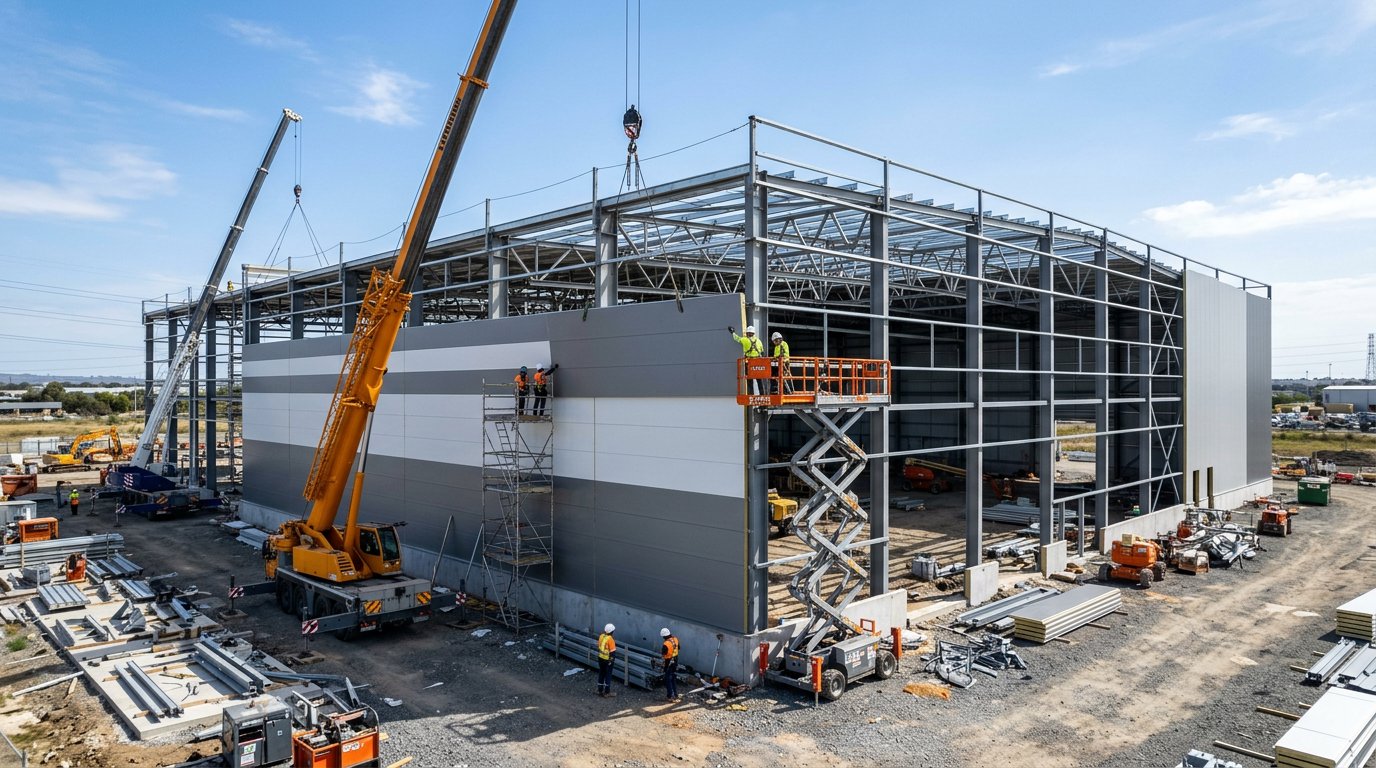
Sandwich panels have become the go-to material for factory construction, cold storage, cleanrooms, and portable offices because they install fast and weigh far less than brick or concrete.
But "sandwich panel" is actually an umbrella term covering many core materials, each with very different thermal insulation, fire resistance, and pricing. Picking the wrong core can waste your budget or, worse, cause a cooling system to underperform down the line.
This guide breaks down the sandwich panel types available in the Indonesian market in 2026, with technical data and current price ranges, so your material decision is based on real specifications rather than the lowest number on a catalogue.
Why the Core Material Determines a Sandwich Panel's Performance
A sandwich panel consists of two metal facesheets, typically galvanized steel or aluminium, wrapped around an insulating core. That core, not the facesheet, is what defines the panel's real-world performance.
Three factors separate one core type from another: thermal conductivity or k-value (lower means better insulation), fire resistance classification under standards such as EN 13501-1 or SNI 1741, and weight per square meter, which affects the structural load on the building frame.
A credible core test certificate must list a report number, the reference standard such as BS 476, EN 1366, or SNI 1741, plus the thickness and density of the tested specimen — not just an unverified claim printed in a manufacturer's brochure.
Facesheet choice matters too. Panels typically use galvanized or galvalume steel with PVDF or polyester coating, while aluminium is chosen when extra-light weight or extreme corrosion resistance is required. This choice largely determines how long a panel lasts in coastal or chemical-industry environments.
Sandwich Panel Types by Core Material
Polyurethane (PU)
PU is the most common core for cold storage and air-conditioned spaces thanks to its excellent thermal insulation, with conductivity around 0.022-0.028 W/mK. Market prices range from Rp200,000-Rp500,000 per square meter depending on thickness and facesheet spec.
Polyisocyanurate (PIR)
PIR is a chemical refinement of PU with a modified isocyanurate structure that improves fire resistance, typically reaching EN 13501-1 class B-s1,d0 up to C-s2,d0 depending on the facesheet and joint detailing used by the contractor.
PIR's thermal conductivity is slightly better than PU's, around 0.020-0.022 W/mK, so a 75 mm PIR panel can match the insulation performance of a 100 mm EPS panel. Standard-grade PIR runs Rp350,000-Rp600,000 per square meter, rising to Rp800,000-Rp1,200,000 for higher-certified specifications.
Expanded Polystyrene (EPS)
EPS is the most economical option, starting from Rp150,000-Rp250,000 per square meter, with thermal conductivity around 0.033-0.038 W/mK. It suits general warehouses, portable offices, and buildings that don't need extreme thermal insulation.
Rockwool (Mineral Wool)
Rockwool is made from melted and spun stone fiber, achieving fire class A1 or non-combustible under EN 13501-1, the top tier that foam-based cores like PU, PIR, or EPS cannot reach.
Its conductivity is higher, around 0.035-0.042 W/mK, and it weighs more than foam cores, but it's the required choice for high fire-risk areas such as industrial kitchens. Prices range Rp400,000-Rp700,000 per square meter.
Magnesium Oxide (MgO)
MgO board is a newer-generation core that is fire-resistant, water-resistant, and environmentally friendly since it contains no foam compound at all. Read the full MgO panel specification and pricing guide here for projects that prioritize maximum fire rating and green building certification.
Here is a quick summary of the best use case for each core type:
- PU: cold storage, air-conditioned rooms, and freezer warehouses
- PIR: applications needing high insulation plus better fire rating than PU
- EPS: general warehouses, office partitions, and non-critical buildings
- Rockwool: industrial kitchens, fire-risk production areas, and sound-insulated rooms
- MgO: buildings prioritizing fire resistance, water resistance, and green certification
How to Choose the Right Sandwich Panel Type for Your Project
Before settling on a core type, rank your project's priorities using these steps:
- Determine your thermal insulation needs first. A very low-temperature cold storage project should use PU or PIR since they have the lowest k-value.
- Check the fire rating regulations that apply to your location and building type. High-risk industrial buildings usually require a non-combustible core such as rockwool.
- Consider the surrounding environmental exposure. For outdoor panels exposed to extreme weather, facesheet and coating quality matter just as much as core type.
- Calculate total lifecycle cost, not just the upfront price per meter. A better-insulated core can save significant cooling electricity cost over the building's lifetime.
For buildings that need strict fire safety compliance, also read the full guide to sandwich panel fire rating classification and certification before finalizing your project specification.
Sandwich Panel Price Ranges by Type in 2026
Sandwich panel prices vary widely depending on core type, thickness, facesheet spec, and fluctuations in steel and imported insulation material costs. In general, 2026 per-square-meter price ranges are EPS Rp150,000-Rp250,000, PU Rp200,000-Rp500,000, Rockwool Rp400,000-Rp700,000, and PIR Rp350,000-Rp1,200,000 depending on certification required.
For a deeper breakdown of the factors driving price and per-project cost simulations, read the latest 2026 sandwich panel price per meter guide. Standard wall installation labor should be budgeted separately, typically Rp65,000-Rp95,000 per square meter depending on project location.
FAQ
What is the main difference between PU and PIR sandwich panels?
PU and PIR are both polyurethane foam-based, but PIR has a modified isocyanurate chemical structure that makes it more fire-resistant and slightly better insulated than PU at the same thickness. PIR is also typically 20-50 percent more expensive than PU.
Which sandwich panel type has the best fire resistance?
Rockwool is the only core that reaches class A1 or non-combustible under EN 13501-1, making it the top choice for high fire-risk areas like industrial kitchens. MgO board also offers excellent fire resistance as a non-foam alternative.
What is the cheapest sandwich panel type in 2026?
EPS is the most economical option at Rp150,000-Rp250,000 per square meter, but its thermal insulation is lower than PU, PIR, or rockwool, making it less suitable for low-temperature cold storage applications.
Are sandwich panels earthquake resistant?
Sandwich panels generally perform well seismically because they weigh far less than brick or concrete, reducing inertial force during an earthquake. Joint detailing and the supporting frame system still determine final performance — read the full guide to earthquake-resistant sandwich panels for factory construction for the technical specifications.