

Panel colour is usually the last thing discussed, long after core and thickness are settled. Yet colour is the only part of the panel that the plant owner, visitors, and auditors see every single day. It is also the part that changes fastest: the paint on the steel face is only tens of micrometres thick, and the equatorial sun works on it daily.
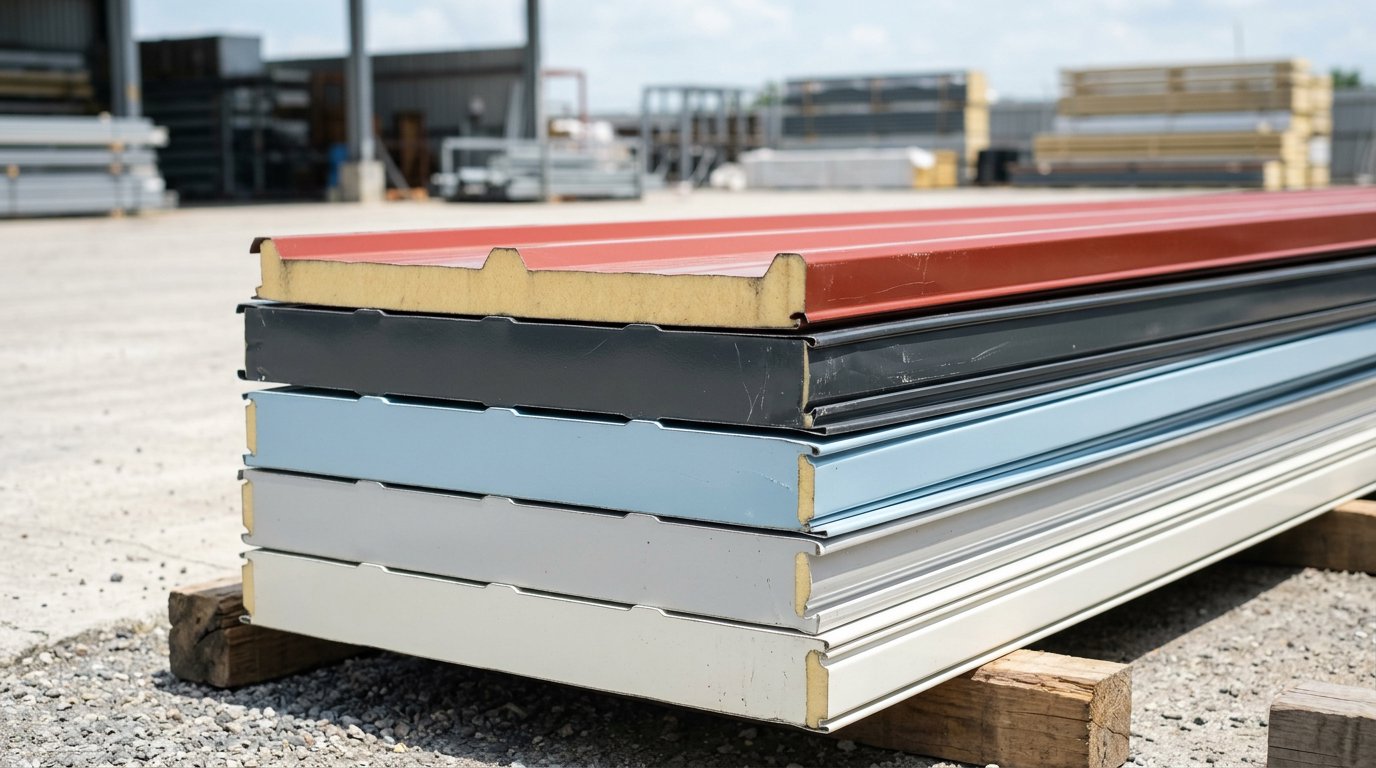
RAL codes: how to read those four digits
RAL is a German colour coding system used by nearly every panel plant as a common language. The variant used in industry is RAL Classic, which has held 216 colours since it was expanded in 2020. Each colour carries a four-digit code plus a name, and the name exists precisely so that transposed digits do not become a different colour.
The first digit marks the colour family. A leading 9 means the white and black group, which is where almost every industrial wall panel sits. RAL 9003 is Signal White, the clean white commonly used in cleanrooms and food production rooms. RAL 9002 is Grey White, slightly greyer and far more forgiving of dust. The official reference is published by the RAL institute in Germany.
PVDF and polyester: the coating differs, not the colour
Two panels can both be RAL 9003 and still age differently, because the same pigment can be bound in a different resin. Panel paint is applied by coil coating: the steel strip is painted at the steel mill before it is profiled and laminated, not brushed on at site.
The governing standard is EN 10169, Continuously organic coated (coil coated) steel flat products. It does more than name the resin. It sorts coating systems into corrosion resistance categories (RC) and ultraviolet resistance categories (Ruv), tested by the EN 13523 series of methods.
Two systems dominate quotations for Indonesian projects:
- Polyester, designated SP in EN 10169, at a nominal top coat around 25 micrometres. A worked designation example in the standard pairs it with RC3 on the face, RC2 on the reverse, and Ruv2. This is the default and cheapest option.
- PVDF, also around 25 micrometres on many data sheets. Manufacturer data sheets place it at Ruv4, the highest ultraviolet category, while usually still showing RC3.
So the real difference is neither thickness nor corrosion resistance. It sits in the Ruv column: how long the coating holds off ultraviolet light before it fades and chalks.
How long colour lasts under the Indonesian sun
The honest answer is uncomfortable: there is no independent long-term exposure study for the Indonesian climate. The circulating figures come from manufacturers, and most of them are drawn from south Florida exposure, which the industry uses as its extreme test site.
Across those sources the pattern is consistent. Polyester begins chalking within 5 to 10 years, and visible colour loss is reported in the 3 to 10 year range. PVDF is far slower. One field case in Louisiana recorded a PVDF coating with no visible fading after eight years, while another section of the same building finished in silicone-modified polyester had faded noticeably.
One sentence in the standard itself matters more than any brochure. EN 13523-10:2024, the test method for resistance to fluorescent ultraviolet radiation and water condensation, states that correlation between accelerated testing and natural weathering cannot be expected. QUV hours in a brochure are therefore not a life prediction, only a way to compare similar products.
Three local factors make Indonesia harder than most test data suggests: a sun angle that stays close to vertical year round, high humidity that lengthens surface time-of-wetness, and salt-laden coastal air across many industrial estates. West-facing walls carry the heaviest load because they take the afternoon sun.
What a colour warranty actually promises
Coating warranties almost always split in two, and the split is widely misread. The film warranty, covering peeling, blistering, and cracking, is usually the longest: for PVDF it is reported at 20 to 40 years depending on the manufacturer, and one vendor offers 45 years. The colour warranty is much shorter.
Chalk and fade cover for PVDF generally runs 10 to 30 years and depends on the colour chosen. For polyester it generally does not exceed 20 years on film and 10 years on colour. One manufacturer markets 35 years of colour performance on its PVDF finish, which is a reason to read the warranty document rather than the brochure.
What decides whether a claim gets paid is the threshold number. Fade is expressed in Hunter delta E units. One supplier table lists a limit of 5 units for PVDF and 7 units for silicone-modified polyester. Below that threshold your eye sees the colour shift, but the warranty calls it normal.
A checklist before you request a quotation
These three items make quotations comparable apple to apple, and every one of them is reasonable to ask for before a purchase order:
- Resin type and top coat thickness in micrometres, not simply the word PVDF or the phrase premium paint.
- RC and Ruv categories to EN 10169, quoted as they appear on the steel mill data sheet.
- The full warranty document: how many years on film, how many on colour, what delta E threshold applies, and whether coastal exposure is excluded.
How to read those documents is covered separately in our guide to panel certificates and datasheets. For core and thickness decisions, see the panel thickness selection guide, and for a comparison against other facade materials see our review of sandwich panel versus ACP.
Cost: what raises the price and what does not
A survey of public Indonesian supplier price lists from June to August 2026 put installed PU wall panels of 50 to 75 mm in the range of Rp350,000 to Rp550,000 per square metre, with installation labour alone at Rp150,000 to Rp230,000 per square metre. Those figures are for stock standard colours.
No supplier we checked publishes a custom colour surcharge, so we will not invent a percentage. What practice tells you is that a colour outside stock means a dedicated coil order, so what rises is the minimum volume and the lead time as well as the price.
FAQ: Frequently asked questions
Can faded panels be repainted on site?
They can, but the result is no longer a coil coating. Repainting uses field-applied paint with a shorter life and demands serious surface preparation, especially where the old coating has already chalked. For a building planned to last, choosing the right Ruv category at the start is far cheaper.
Is PVDF always the better choice?
Not always. PVDF leads on ultraviolet resistance, not on corrosion resistance, since the RC category is often identical for both. On interior walls, partitions, and room ceilings that advantage is never used. Paying for PVDF on a surface the sun never reaches is cost without benefit.
Discuss your project colour specification
If you are preparing a specification for walls, partitions, or room ceilings and are unsure which combination of RAL code and coating type suits your site, our team can weigh it together with the panel core and thickness. Tell us what you need and request a quotation through the sandwichpanels.id contact page.