

A sandwich panel quotation almost always arrives with attachments: certificates, a datasheet, and one or two test reports, and nobody reads them to the end. Buyers compare price per square metre, pick the cheapest, and never notice that the two quotations describe genuinely different products. This guide covers which numbers bind, which standards apply to insulated core panels, and the warning signs when a standard is quoted for the wrong product.
Five documents to collect before you sign
A glossy brochure is not a technical document. Before you look at any number, make sure this set is complete:
- Mill certificate for the steel facings: thickness, grade, and coating mass per coil.
- Product datasheet showing thermal conductivity and the declared U-value.
- Load and deflection tables per thickness and per span.
- Fire test report complete with a report number and the laboratory name.
- Declaration of Performance if the panel is sold with CE marking.
EN 14509 is the harmonised standard for self-supporting double-skin metal-faced insulating panels. As notified bodies Applus+ and Tecnalia explain, the manufacturer must determine the characteristics relevant to the market and then declare them through a Declaration of Performance under an AVCP scheme. The DIN project catalogue now lists drafts prEN 14509-1:2025 and prEN 14509-2:2025, which split the standard in two, but both remain drafts.
Steel mill certificate: the numbers that set the price
This is where price differences usually hide. Panel facings on the Indonesian market are typically 0.3 to 0.5 mm, and a gap of 0.05 mm changes panel stiffness, screw pull-out resistance, and raw material cost per square metre.
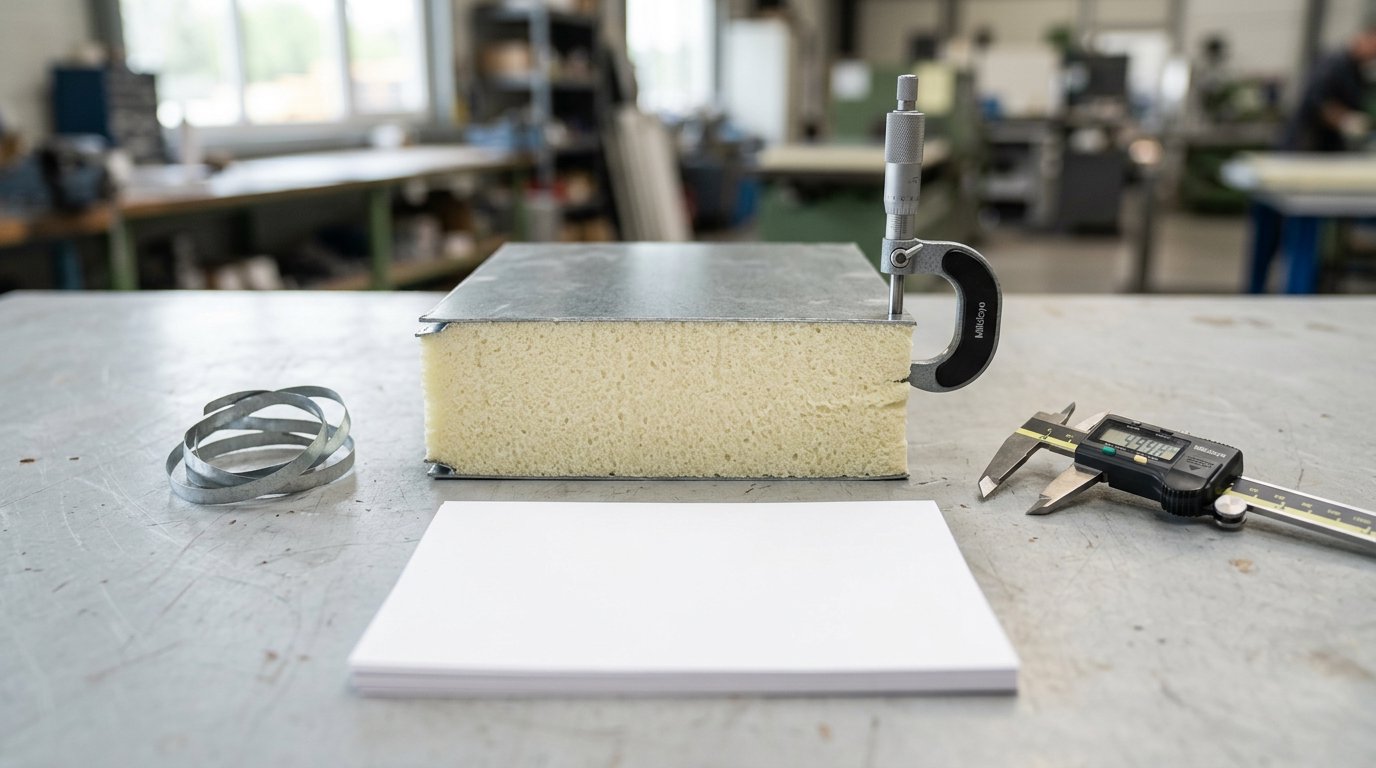
First, settle whether the quoted thickness is BMT or TCT. BMT is base metal thickness, TCT is thickness after metallic coating, APT after painting. BlueScope notes give an example: AZ150 at 0.42 mm BMT corresponds to 0.47 mm TCT, while 0.48 mm BMT becomes 0.53 mm TCT. Paint adds roughly 0.03 mm, so a quotation marked 0.45 mm may mean 0.45 mm of base steel or only about 0.40 mm. Finished thickness is checkable on site with a micrometer.
Next comes coating mass. Under EN 10346, Z275 means 275 g/m2 of zinc across both faces with a 235 g/m2 triple-spot minimum, while aluminium-zinc alloy is offered as AZ100, AZ150, and AZ185. The Indonesian reference is SNI 4096:2019 Bj LAS, managed by Technical Committee 77-01 and listed as valid in the BSN catalogue for 0.20 to 3.00 mm. Its 2007 edition is mandatory under Permenperin 39/M-IND/PER/2/2012.
Thermal and load tables: comparing like with like
Thermal conductivity on market datasheets moves inside a narrow band: EPS 0.033 to 0.038, PU and PIR 0.022 to 0.026, rockwool 0.038 to 0.042 W/mK. If one supplier prints a figure well below that band without a test report, ask for the report.
U-value is derived from thickness and conductivity. Using ISO 6946 with surface resistances of 0.17 m2K/W, a 50 mm panel lands near 0.63 W/m2K for EPS, 0.44 for PIR, and 0.70 for rockwool; at 100 mm those figures fall to 0.33, 0.23, and 0.37. All of them are design estimates, not test results.
A manufacturer's declared U-value uses the EN 14509 reference method, and that is the number which binds, so compare declaration against declaration. Load tables are likewise valid only for the support condition tested: a panel safe over a two metre span may fail at three metres. Thickness selection per room type is covered in our sandwich panel thickness guide.
Fire test reports: EN 13501-1, EN 13501-2 and TKA
EN 13501-1 assesses reaction to fire, meaning how far a product contributes to a fire through its own decomposition. The result is a class of A1, A2, B, C, D, E, or F, plus a smoke code and a flaming droplet code. B-s1,d0 therefore means a minor contribution, the lowest smoke level, and no flaming droplets.
That code says nothing about how long a wall will hold back a fire. Duration belongs to EN 13501-2: the letter E marks integrity and I marks insulation, so EI60 and EI120 mean 60 and 120 minutes. Those values apply to the complete assembly, including core, joints, fasteners, and installation orientation.
The Indonesian equivalent uses the Tingkat Ketahanan Api format. A study in the Politeknologi journal reported a cored slab meeting TKA 180/180/160 under SNI 1741:2008, three numbers for stability, integrity, and insulation. PIR panels do have a product standard, SNI 9186:2023; EPS and rockwool have none. Class-by-class reading sits in our panel fire rating guide.
Red flags on a wrong-product certificate
- No report number and no laboratory name. Nobody can verify a certificate like that.
- A standard quoted for the wrong product. SNI 8399 is titled light steel framing profile in the BSN catalogue, so it is a framing standard rather than an insulated core panel standard, and its current edition is 2025, not 2017.
- A class A claim with no standard named. China's GB 8624-2012 also uses the term Class A; the mapping to EN 13501-1 A2-s1,d0 that circulates comes from manufacturer datasheets, not from an official equivalence ruling.
- A core certificate, not a panel certificate. A loose-foam test report does not transfer to a finished panel with its facings and joints.
Verification is straightforward. KAN accredits testing laboratories against SNI ISO/IEC 17025, so check the issuing laboratory's scope in the KAN directory, then confirm the report number with that laboratory. SNI numbers and titles match in the BSN catalogue.
On cost, a mid-2026 survey of public price lists puts installed PU panel of 50 to 75 mm at IDR 350,000 to 550,000 per square metre, while installation labour without material runs IDR 150,000 to 230,000 per square metre. Watch the unit: a 1,050 mm cover width makes one linear metre equal 1.05 square metres, so a price per linear metre always looks cheaper.
If you are weighing several quotations and want the paperwork read by the people who manufacture the panels, send us your project specification. We check thickness between 50 and 150 mm, core type, and fire class for walls, partitions, and room ceilings, then quote through our consultation and quotation page.
Frequently asked questions
Does CE marking guarantee a panel suits an Indonesian project?
Not automatically. CE marking states that panel performance has been declared under EN 14509, not that the declared figures meet your project's needs. Local design requirements still decide.
How do I tell a declared U-value from a calculated one?
A declared value always carries a reference method and a document number, usually EN 14509, and appears in the DoP or an official datasheet. A self-made calculation uses only conductivity and thickness.
Is there an Indonesian SNI for EPS and rockwool panels?
As of October 2026 the only panel SNI in the BSN catalogue is SNI 9186:2023 for PIR insulation panels. For EPS and rockwool, EN 14509 and EN 13501 remain the reference.