
Why Cleanroom Certification Is Mandatory
You have invested significant capital building your cleanroom. Sandwich panels are installed, HVAC systems are running, HEPA filters are operational. But one question keeps you up at night: does your cleanroom actually meet the standard?
ISO 14644 cleanroom certification is proof that your facility can control particulate contamination at the targeted class level. Without it, pharmaceutical products face BPOM rejection, electronics manufacturing contracts can be voided, and GMP audits will fail. In Indonesia, these requirements grow stricter as CPOB regulations and industry standards continue to tighten.
This article walks you through the entire certification process — from document preparation and testing stages to critical mistakes you must avoid. The short answer: certification starts with compliant design, followed by precise installation, and validated through calibrated measurements.
What Is ISO 14644 Cleanroom Certification and When You Need It
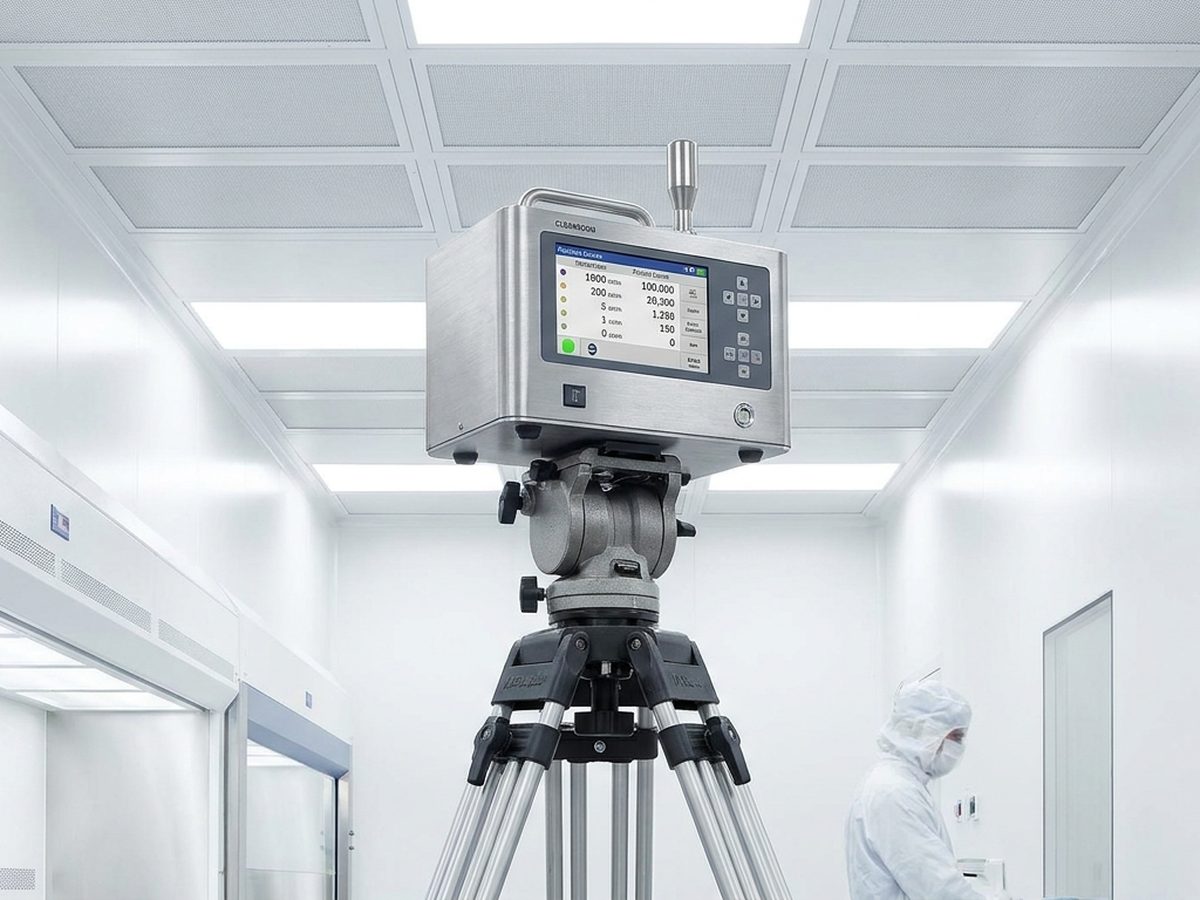
ISO 14644 cleanroom certification is a formal verification process confirming that a cleanroom meets particulate classification requirements per ISO 14644-1 international standards. The process includes airborne particle concentration measurement, airflow testing, and validation of environmental parameters including temperature, humidity, and differential pressure.
You need certification in these scenarios:
- Newly built cleanroom (commissioning certification)
- Every 6-12 months to maintain operational status (re-certification)
- After major renovation or structural repairs
- Before regulator audits such as BPOM, FDA, or ISO 9001/13485 certification
- When production process changes affect contamination levels
5 Stages of Cleanroom Certification Process
Cleanroom certification is not simply showing up and counting particles. There are 5 systematic stages:
- Preparation Stage — Review cleanroom design, determine target ISO class (ISO 5, 6, 7, or 8), identify measurement points based on room area, and ensure all HVAC and filtration systems operate normally for at least 24 hours.
- As-Built Testing Stage — Measurements taken in an empty cleanroom with no equipment or personnel. This tests whether construction and installation meet design specifications. Parameters measured: particle counts by size (≥0.1µm, ≥0.2µm, ≥0.3µm, ≥0.5µm, ≥1µm, ≥5µm).
- At-Rest Testing Stage — Cleanroom fully installed with all production equipment running, but no personnel inside. This validates that equipment does not generate contamination exceeding limits.
- Operational Testing Stage — Measurements taken during normal cleanroom operation with personnel and production processes active. This simulates real-world conditions to verify the cleanroom maintains its class during daily operations.
- Reporting and Certification Stage — All measurement data is compiled in an official certification report. If all parameters meet limits, a certificate is issued stating the cleanroom class per ISO 14644. The certificate is valid for 6-12 months before re-certification is required.
Documents and Requirements You Must Prepare
Prepare these documents before the certification team arrives:
- Cleanroom design drawings (layout plan) with dimensions and room area
- Technical specifications for wall panels and ceiling used — see our cleanroom wall materials guide
- HVAC system technical data: airflow capacity, ACPH (Air Changes Per Hour), HEPA/ULPA filter specifications
- Calibration certificates for measurement instruments (particle counter, anemometer, manometer)
- Cleanroom operational logs: temperature, humidity, differential pressure for at least the last 7 days
- Cleaning SOPs and personnel gowning procedures
- List of materials and equipment inside the cleanroom
Testing Parameters in Cleanroom Validation
Beyond particle concentration, ISO 14644 certification also tests these parameters:
- Particle Count and Size (ISO 14644-1) — Primary parameter. Sampling performed at representative points based on room area (formula: √area in m², minimum 2 points for rooms under 10m²). Particles counted in at least 3 size classes according to target ISO class.
- Airflow Velocity and Uniformity — Air velocity at the work area (especially for unidirectional cleanrooms like ISO 5). Target: 0.36-0.54 m/s at filter face.
- Differential Pressure — Pressure differences between cleanroom zones. Cleaner rooms must maintain higher pressure (minimum 10-15 Pa) to prevent contaminant infiltration.
- Temperature and Humidity — Must match process specifications. Typically 18-24°C and 40-60% RH for personnel comfort and product stability.
- HEPA/ULPA Filter Integrity — Filter leak testing using DOP/PAO test per IEST-RP-CC034 standard. Every filter must be scanned to detect leaks in media, seals, or frame.
Common Mistakes That Cause Certification Failure
Based on field experience, these are the most frequent reasons cleanrooms fail certification:
- Inadequate ACPH — Many contractors cut costs by reducing HVAC capacity. Result: insufficient air exchange to clear particles. For ISO 7, a minimum of 60 ACPH is needed; ISO 5 may require 300+ ACPH.
- Cleanroom envelope leaks — Gaps in panel joints, cable penetrations, or loose door seals compromise the controlled environment. Check our cleanroom design guide for correct construction specifications.
- HEPA filters leaking or clogged — Differential pressure exceeds design limits. Filters must be replaced when pressure drop exceeds 2x the initial value. Also refer to our HEPA filter replacement schedule guide.
- Uncalibrated instruments — An uncalibrated particle counter produces invalid data and automatically fails certification.
- Inconsistent gowning procedures — Operators with poor gowning discipline are the largest contamination source. One person without coveralls can shed millions of particles per minute.
- Incomplete documentation — Auditors check traceability. Undocumented SOPs or empty log books are major audit findings.
Products and Materials Supporting Certification
To pass certification, your cleanroom needs high-quality components:
- Cleanroom sandwich panels with PIR or Rockwool core — smooth surfaces, anti-static, and easy to clean. Joints must be tight and gap-free.
- HEPA/ULPA filters — H14 (99.995% at 0.3µm) minimum for ISO 7; U15-U17 for ISO 5-6. Choose filters with anodized aluminum frames and gel gaskets for perfect sealing.
- Hermetic doors for inter-zone access — preventing pressure loss and cross-contamination.
- Pass boxes — static or dynamic, for material transfer without opening cleanroom doors.
- Precision HVAC systems — with ±1°C temperature and ±5% RH humidity control.
Cleanroom Certification FAQ
How much does ISO 14644 cleanroom certification cost?
Costs vary by room size and number of measurement points. For a 50m² ISO 7 cleanroom, estimated costs range from USD 500-1,000 per testing session from accredited certification providers. This does not include remediation costs if parameters fail.
Is ISO 14644 certification mandatory for all industries?
Not all. Pharmaceutical and medical device industries require it due to CPOB/GMP regulations. Food industries with special hygiene claims, semiconductor manufacturing, and aerospace generally require certification. Standard warehouses or general production rooms are not required, though certification adds value for international contracts.
How long does the certification process take?
Physical testing takes 1-3 days depending on cleanroom complexity. However, document preparation and pre-testing can take 1-4 weeks. If remediation is needed after testing, additional time depends on the type of repair.
Can I perform self-certification?
For internal purposes, you can conduct independent measurements with a calibrated particle counter. However, for regulatory purposes, certification must be performed by an accredited third party (KAN in Indonesia) issuing official reports.
Conclusion: When to Start Your Certification Process
Cleanroom certification is not an expense — it is an investment ensuring your products meet quality standards and regulations. Start this process immediately after cleanroom construction is complete, or no later than 1 month before your target commercial production date.
If your cleanroom is already operational but uncertified, schedule a pre-assessment to identify gaps before formal testing. With proper preparation — quality materials, precise installation, and adequate HVAC systems — your cleanroom can pass certification on the first attempt.
Need cleanroom material consultation for certification preparation? Contact our team for sandwich panel, HEPA filter, and cleanroom component specifications compliant with ISO 14644 standards.
Inline image: particle counter testing in cleanroom environment