

A mechanical dryer turns an ordinary building into a hot, vapour-loaded pressure vessel. Air at 40-70 °C circulates for 20 to 40 hours while hundreds of litres of water evaporate from coffee, cocoa or paddy. Walls chosen carelessly will sweat, bow, or throw away heat that was paid for with diesel, LPG and biomass. This guide covers how to specify sandwich panels for agricultural drying rooms: the official moisture targets, the service temperature limit of each core, and the construction details most often missed.
The scale is not a niche. Statistics Indonesia recorded 813,345 tonnes of coffee produced in 2024, while the Ministry of Agriculture Cocoa Outlook 2025 projected 630.59 thousand tonnes of cocoa for 2025, almost entirely from smallholder plantations. Every tonne of it passes through a drying stage before it can be sold.
A Drying Room Is Cold Storage in Reverse
In cold storage, heat and vapour move from outside inward, so the vapour barrier belongs on the warm side, which is the exterior. A drying room reverses that completely. The warm side is inside, and vapour pressure within the room sits far above the yard air outside. Vapour pushes outward through every panel joint, screw hole, and gap around pipework.
The consequence only appears months later. Vapour that reaches a joint condenses when it meets the outer steel skin cooling overnight. That water is trapped inside the panel, corrodes the sheet from the hidden face, and weakens the bond between core and skin. Joint tightness in a drying room is therefore not a matter of neatness; it decides how long the panel lasts.
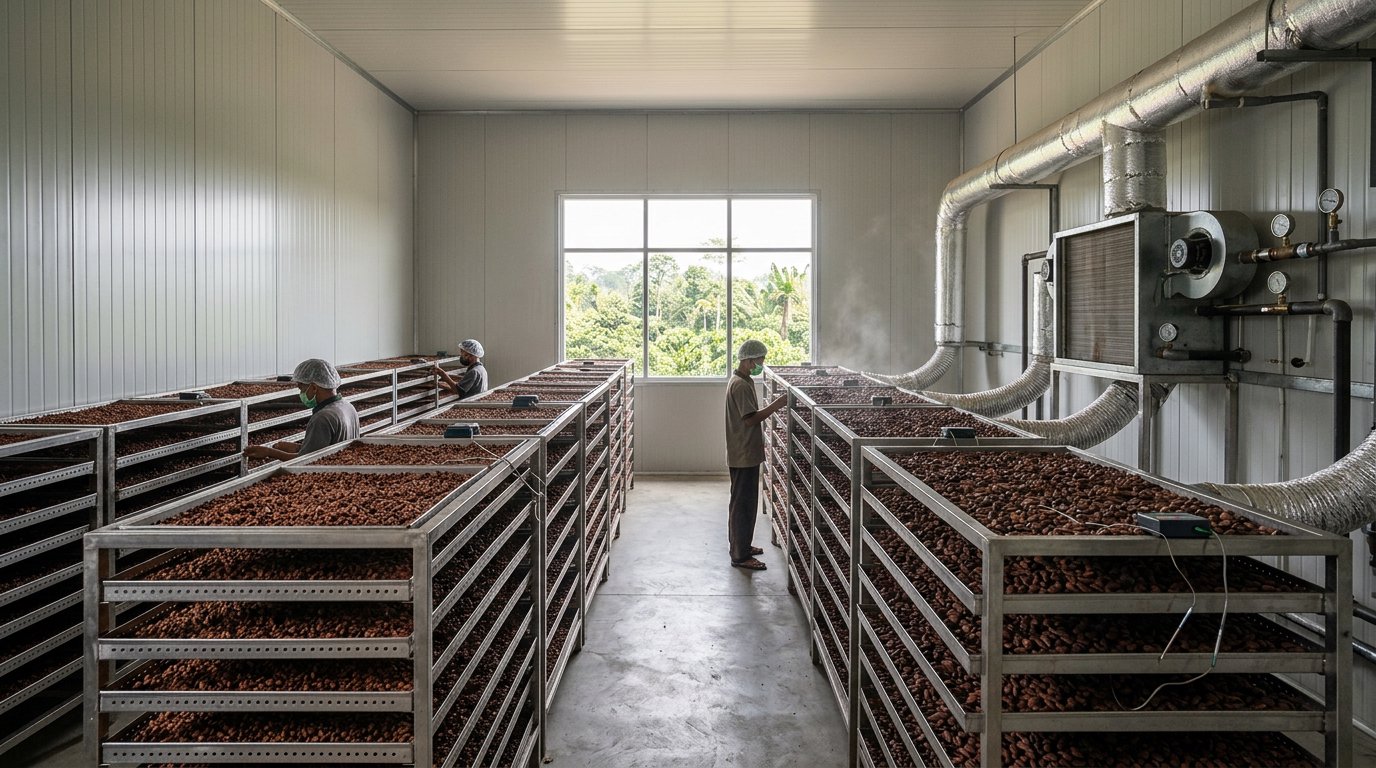
Moisture Targets and Working Temperatures by Commodity
Panel specification cannot be separated from the process it houses. The three commodities below have quality targets fixed by Indonesian National Standards, and those targets dictate how long and at what temperature the room has to run.
- Green coffee beans - maximum 12.5 percent moisture under SNI 01-2907-2008. Mechanical drying typically runs at 45-50 °C for 24 to 36 hours.
- Cocoa beans - maximum 7.5 percent moisture under SNI 2323:2008. Drying literature advises keeping air temperature below 70 °C, because bean acidity rises with hotter air.
- Milled-grade paddy - maximum 14 percent moisture for premium and medium I grades under SNI 224:2023, and 15 percent for medium II. Bed dryers commonly operate at 40-50 °C.
The highest figure on that list, 70 °C for cocoa, is the minimum design temperature for the room. Add margin, because the hottest point directly in front of the heat exchanger can run 10-15 °C above the room average. Panels in that zone usually fail first, not the ones at the far wall.
Choosing the Core: Service Temperature Decides
In cold storage, core selection is led by thermal conductivity. In a drying room the order changes. The long-term service temperature limit becomes the first requirement; conductivity, reaction to fire, and price are weighed only after that gate is passed.
- EPS - manufacturer data sheets generally cap continuous exposure near 75 °C with intermittent exposure to 82 °C. Conductivity 0.033-0.038 W/mK. Defensible for low-temperature paddy drying, risky for cocoa.
- PU and PIR - rigid polyurethane is commonly cited to roughly 110 °C, while PIR reaches the 140 °C range, and ASTM C 591 covers service up to 149 °C. Best conductivity of the three at 0.022-0.026 W/mK.
- Rockwool - mineral wool tolerates service temperatures far above anything a dryer needs and carries Euroclass A1 reaction to fire. Conductivity 0.038-0.042 W/mK, so it needs greater thickness for the same insulation value.
For cocoa and coffee dryers fired by biomass furnaces, a sensible split is rockwool on surfaces near the heat source and PIR across the remaining walls and roof. Compare the three cores in detail in our PIR, PU and EPS panel comparison, then set thickness using the wall panel size and thickness guide.
Construction Details Most Often Missed
Vapour control. The steel skin already acts as a vapour barrier as long as the joints are sealed. What matters is sealant in the joint groove, butyl tape where wall meets floor, and closure of every pipe or cable penetration. A screw driven through the inner skin without a gasket is a direct route for vapour into the core.
Thermal movement. Steel expands about 1.2 mm per metre for a 100 °C rise. An 8 metre panel taken from 30 to 70 °C grows roughly 4 mm. Fixing holes at selected supports need to be slotted, and flashings must be detailed to let the panel move rather than locking it at both ends.
Hygiene and traffic. Coved corners make it far easier to clean the husk dust and spilled beans that feed mould growth. The bottom of walls along trolley routes deserves a bumper rail or a steel kick plate around 60 centimetres high, because a panel core is not designed to absorb impact from wheels or forklift tines.
Specification Checklist Before Requesting Quotes
- State the maximum working temperature of the room, not just the commodity name.
- Ask for the continuous service temperature limit of the offered core in writing.
- Fix the skin type: oven-coated galvalume for dry areas, stainless steel where washdown occurs.
- Request load and deflection tables to EN 14509 test methods for the purlin spans you plan.
- Include the jointing system, sealant type, and wall-to-floor detail inside the scope of work.
- Separate material, accessories, and installation labour so quotations can be compared like for like.
Where the dryer is fired by a biomass furnace or shares a wall with a storage warehouse, reaction to fire also drives the choice. Classes and the tests behind them are set out in our fire rated sandwich panel guide.
FAQ
Can EPS panels be used for a coffee drying room?
Yes, provided the room air is genuinely held below the continuous service limit of the EPS core, generally around 75 °C, and panels directly in front of the heat exchanger are shielded by a deflector plate. For cocoa dryers running at 60-70 °C the margin is too thin, and PIR or rockwool is the safer answer.
What panel thickness suits a drying room?
There is no single figure. Thickness follows the inside-to-outside temperature difference, fuel cost, and structural span. As a starting point, rooms held at 50-70 °C in daily operation commonly use 75-100 mm panels, then verify against the manufacturer deflection table for the actual purlin spacing.
How does vapour control differ from cold storage?
The vapour drive runs the opposite way. Cold storage is pushed from outside in; a drying room pushes from inside out. The most critical sealing therefore sits on the internal face: joint grooves, the wall base, and every penetration must be closed tight from the hot side.