
Indonesia's seaweed downstream push now has dates attached to it. In October 2026 the Ministry of National Development Planning (Bappenas) launched the Integrated Seaweed Development Action Plan (ISDAP) 2026-2030, targeting a production increase of roughly 21 percent and an export-value jump of almost 51 percent. Processing sits with the Ministry of Industry, farming with the fisheries ministry. For owners, that means added capacity inside buildings that can survive an audit.
Walls are the component most often specified wrong. A single seaweed line carries water vapour, salty wash water, hot alkali solution, and then dry chip dust - four loads no single wall type serves well. Rendered brickwork absorbs vapour, grows mould, and sheds paint within a couple of seasons. Sandwich panels move the problem onto a coated steel surface that can be hosed, scrubbed, and dried.
Room map: seven zones, conflicting demands
The most expensive mistake is one specification for the whole plant. A washing bay is designed to stay wet; a dried-seaweed store is designed never to get damp. One thickness and one core for everything leaves some zones over-budget and others failing early.
- Receiving and sorting: wet floors and trolley traffic. Coated steel skins plus a concrete kerb about 1 metre high absorb wheel impact.
- Washing and soaking: salty water drips all shift. Tight joints and food-grade sealant decide wall life more than core thickness does.
- Alkali cooking for ATC: hot steam plus KOH or NaOH solution. The harshest zone; it needs ventilation, chemical-resistant skins, and a core that will not soften under heat.
- Neutralising and pressing: still wet, but cleaner. Partition panels keep its vapour from crossing into the alkali zone.
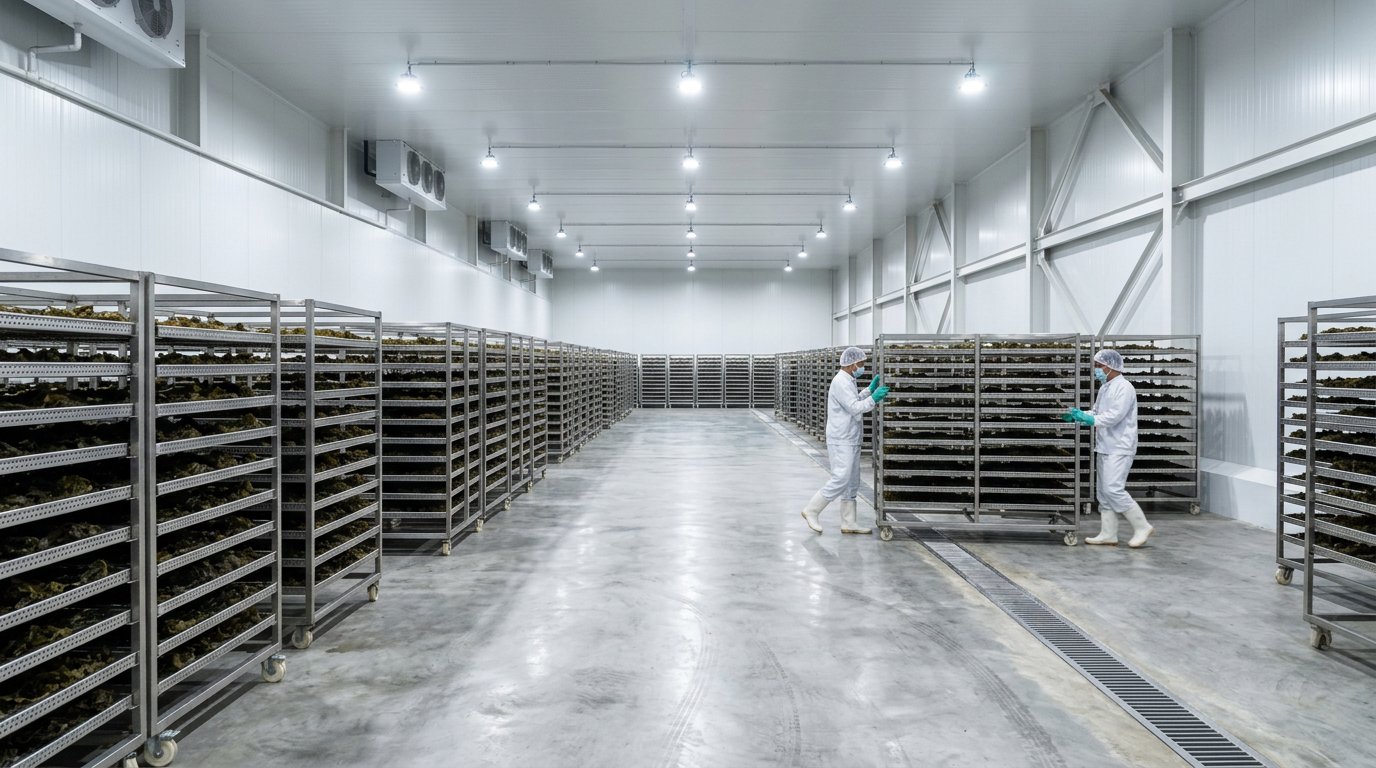
- Drying: warm and dry, with a large humidity gap against outside air. This is where insulation genuinely pays back.
- Chip milling and packing: fine dust. Flush walls and ceilings without cavities keep dust from accumulating.
- Dry store and finished goods: must stay dry and leak-free; dew-point control matters more than low temperature.
Core and thickness: chosen per zone, 50-150 mm
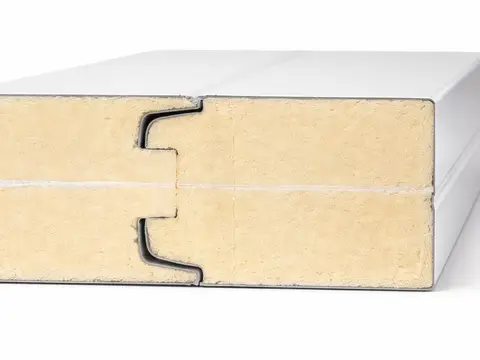
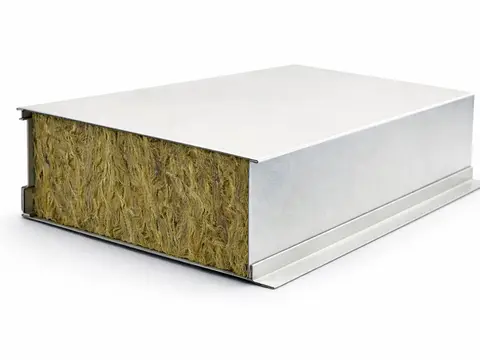
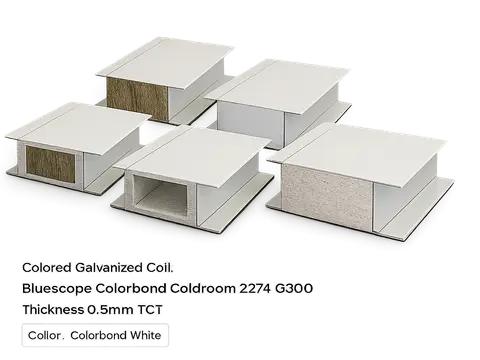
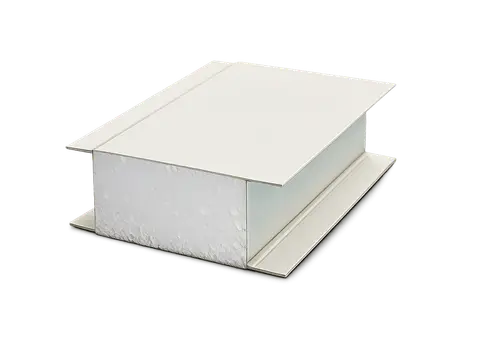
Our panel line covers walls, partitions, and room ceilings - not roof panels. Across all four cores (EPS, PU, PIR, and rockwool) the thickness we supply is 50-150 mm. That range covers every zone in a seaweed plant, including drying rooms and chilled stores, because performance depends on joint tightness and humidity control as much as on core thickness.
A practical split: office partitions and dry areas run well on EPS 50-75 mm. Drying rooms and chilled rooms suit PU or PIR 100-150 mm, which deliver more insulation per millimetre. Alkali cooking zones, boiler rooms, and corridors next to ignition sources belong in rockwool, rated A2-s1,d0 for reaction to fire and free of the softening behaviour of organic cores.
Steel skins, coatings, and coastal air
Almost every seaweed plant stands near the sea, so atmospheric corrosion runs fast. What to check in a quotation is not the word galvalume but three numbers: base metal thickness (BMT, not TCT), the metallic coating class such as AZ100, and the topcoat system. For coastal sites and wet rooms, specify a thicker chemical-resistant paint system, not standard interior paint.
In alkali zones, ordinary paint fails because of high pH rather than salt. The sensible package is a chemical-resistant coated skin on the inner face, scheduled recoating, and corner guards along trolley routes. We set out the same principle for seaside buildings in our corrosion-resistant panel guide for coastal sites.
Drying: humidity matters more than temperature
Fresh seaweed carries a great deal of water - the literature puts initial moisture in Eucheuma cottonii at about 89 percent wet basis. The part that surprises owners is that lowering relative humidity beats raising temperature. Thin-layer drying studies record a 50 percent moisture reduction reached in 80-85 minutes at 50 degrees Celsius with relative humidity held at 30 percent.
That has a direct consequence for walls. If indoor air is kept dry, every joint gap becomes a vapour path that cancels out the dehumidifier's work. Drying rooms therefore need locking-joint panels, ceiling panels tied into the walls, and neatly sealed pipe penetrations. The requirement pattern matches drying rooms for coffee, cocoa, and paddy.
Compliance: SKP, SNI, and limits we state openly
Plants aiming at export markets are generally required to hold a processing feasibility certificate (SKP). The basis we found in force is Ministerial Regulation 17/PERMEN-KP/2019, which replaced 72/2016. It requires GMP and SSOP, including floors that are smooth, crack-free, easy to clean and free of pooling water, and walls that are waterproof and easy to clean.
Product quality is measured separately. SNI 2690:2015 for dried seaweed sets maximum moisture at 30 percent. An honest caveat: some journals still quote 35 percent, and we have not verified the standard's revision status with the national standards body. Treat 30 percent as the planning figure for dryer capacity, then confirm against the original SNI document and your buyer before writing it into a contract.
Cost ranges and lead time in 2026
Supplier price surveys in 2026 put EPS panel material at roughly Rp150,000-350,000 per square metre, PU around Rp280,000-500,000, and rockwool Rp250,000-700,000, depending on core and steel thickness. Standard wall installation runs Rp65,000-95,000 per square metre, while cold-storage-grade work runs Rp150,000-250,000. These supplier figures are market estimates, not formal quotations.
For rough planning, budget three items: panel material per square metre of wall and ceiling, accessories (kerbs, flashing, sealant, doors), and labour. The method is set out in our sandwich panel price per metre guide. Panel work for one 300-500 square metre zone usually finishes in 2-4 working weeks once site dimensions are confirmed, and longer if the plant keeps producing.
FAQ
Can EPS panels be used in the alkali cooking room?
Not advisable. That zone combines hot steam with alkaline chemicals, while an EPS core is an organic material that softens at elevated temperature. Choose rockwool for its walls and ceiling, and keep EPS for partitions in dry areas. On a tight budget, prioritise rockwool on the walls bounding the hot zone rather than across the whole building.
What thickness suits a dried-seaweed warehouse?
A dry store is usually fine at 75-100 mm, because the goal is preventing condensation rather than holding sub-zero temperatures. Joint tightness, dew-point control, and a ceiling that closes off cavities matter more. If the store is mechanically cooled, step up to PU or PIR at 100-150 mm; 150 mm is the upper limit of our line for every core type.
Can panels be installed without stopping production?
Often yes, provided zones are handled in stages behind temporary separation walls. Panel work is dry and nearly waterless, so it slots into a production schedule more easily than wet masonry. Agree early on panel unloading access, working hours, and dust clean-up in food zones.
Every plant has a different mix of zones, and the right specification only emerges once the layout and capacity plan have been read. Send your drawings or room list and we will review core, thickness, and coating zone by zone while preparing a quotation. Start a consultation about your project through our contact page.