

Buildings at the edge of a shrimp pond age far faster than identical buildings on an inland industrial estate. The cause is not poor steel, it is salt. Sea spray carries chloride that settles on metal surfaces, holds moisture in place, and speeds up the electrochemical reaction. A panel that lasts more than a decade inland can show edge rust within a few seasons on the coast.
How Aggressive Coastal Air Really Is Under ISO 9223
ISO 9223:2012 sorts atmospheric aggressiveness into categories from C1 to CX, measured by the first-year corrosion rate on standard metals. For unprotected carbon steel, C3 sits between 25 and 50 µm per year, C4 between 50 and 80 µm, and C5 jumps to 80–200 µm per year. The CX category, reserved for extreme conditions, sits above that range.
Aquaculture sites usually land in C4 to C5, depending on distance to the shoreline, prevailing wind direction, and how long surfaces stay wet each day. Zinc, which forms the backbone of the protective layer on sheet steel, erodes at 2.1–4.2 µm per year in C4 and 4.2–8.4 µm in C5. That explains why thin coatings run out long before anyone expects it.
ISO 12944-2 uses the same category framework to select coating systems. In practice this means the site must be classified before anyone discusses brands or prices. Copying the specification of a warehouse in an inland estate onto a feed store beside a pond is an expensive mistake, and still a common one.
Which Buildings Carry This Risk
The scale is significant. TB Haeru Rahayu, Director General of Aquaculture at Indonesia's Ministry of Marine Affairs and Fisheries, told CNBC Indonesia on 19 February 2026 that national shrimp output runs at 1.2–1.3 million tonnes per year with an economic value near US$5.5 billion. Export value sits at US$1.6–2.2 billion annually, and roughly 67–70% still depends on the United States market.
New investment is heavy too. The ministry is preparing a 2,000-hectare integrated shrimp farming area in Waingapu, East Nusa Tenggara, worth about US$500 million or Rp7.2 trillion. The plan covers 12 clusters at 128 ponds each, targets 52,000 tonnes of vannamei shrimp per year, and includes hatcheries, a feed mill, an ice plant, and cold storage inside one estate.
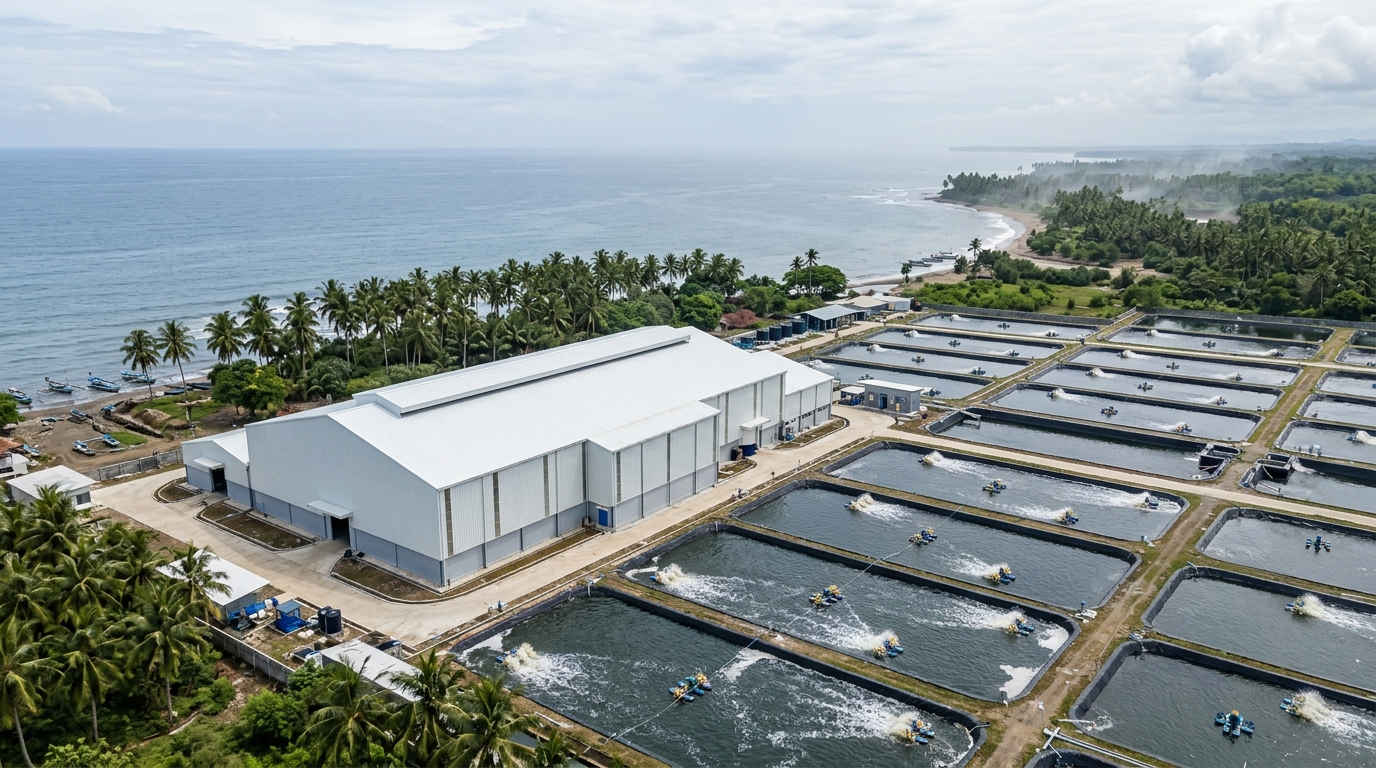
Almost every one of those support facilities has metal walls. Hatcheries, feed stores, sorting and harvest halls, ice plants, and machine rooms all sit a few hundred metres from salt water. They all use panels, and they all carry the same chloride load year round.
Refrigerated rooms carry an extra burden. Beyond salt from outside, cold storage walls face condensation on the warm side and routine washdown on the inside. That combination makes joints and wall bases the critical points, not the broad dry face of the panel.
A Specification That Makes Sense for Salt-Laden Sites
A sandwich panel is not a single product. What decides its service life on the coast is the surface system, not the core. These are the items worth locking into the technical specification before tender:
- A heavy metallic coating. In salt air, an aluminium-zinc coating at AZ150, equal to 150 g/m², gives far more reserve than the AZ50 or AZ100 commonly used inland.
- A high coil coating class. EN 10169:2022 classifies pre-painted steel into corrosion resistance categories RC1 through RC5 and RC5+. On the coast, RC5 should be the starting point rather than an upgrade.
- Ultraviolet durability. The same standard sets RUV classes. Tropical sun plus reflection off open water makes low classes fade and chalk quickly.
- Corrosion-resistant fasteners. Ordinary plated steel screws are almost always the first thing to fail. Use stainless steel with EPDM gaskets.
- A core matched to the room. PIR for refrigerated spaces, rockwool where fire performance is required, EPS for non-critical dry storage.
- Product standard compliance. EN 14509 remains the general reference for metal-faced insulating panels, including tolerances and structural performance.
For chilled and frozen rooms on a farm site, core thickness follows the room temperature rather than the location. Our guide on the difference between a blast freezer and cold storage covers that in detail.
Installation Details That Decide Panel Life
A good specification can still fail on site. On coastal projects, these five points usually decide what the building looks like after five years:
- Protect cut edges. Panel edges cut on site lose their protective layer and become the origin of red rust. Cover them with flashing and sealant instead of leaving them open.
- Keep panels off the ground. A concrete plinth of at least 30 cm stops brackish splash and wet sand from constantly hitting the wall base.
- Design decisive roof drainage. Water pooling in folds or gutters carries salt and never dries completely.
- Avoid dissimilar metal contact. Aluminium meeting steel without a separator drives fast galvanic corrosion.
- Store panels properly before installation. Wet stacks under tightly wrapped tarpaulin trap vapour rather than shed it.
We cover the wider failure patterns separately in our article on why sandwich panels rust and how to prevent it.
Routine Maintenance People Skip
In a C5 environment, washing is not cosmetic. Salt building up on a surface is not always rinsed away by rain, especially on walls under overhangs and in sheltered areas. Rinsing sheltered surfaces with fresh water two to four times a year is the cheapest maintenance an owner can carry out.
Annual inspection should concentrate on four places: screw heads, cut edges, flashing joints, and the wall base. Those are the parts that fail first. A local repair in year three costs far less than panel replacement in year eight.
Upfront Cost Against Lifetime Cost
Moving from AZ100 to AZ150, and from a mid-range paint class to RC5, does raise material cost. The comparison, however, is not against the price of a panel. It is against the cost of replacing walls on a building that is already running. Shutting a cold store or ice plant to change panels means lost production, not just extra labour.
For refrigerated capacity that is temporary or phased in later, modular options like those discussed in our piece on container cold storage and mobile cold rooms sometimes make more sense than building permanently at the most exposed spot.
FAQ
How close to the shoreline counts as high risk?
There is no single figure, because wind direction and land shape both matter. As a working rule, a site within one kilometre of open sea with strong onshore wind should be treated as C5, while areas several kilometres inland usually remain C4. Measuring chloride deposition on site gives the most accurate answer.
Is a stainless steel panel always better for a farm site?
Not always. Stainless does perform well, but it costs several times more and some grades remain vulnerable to crevice corrosion in high-chloride conditions. For most stores and process rooms, pre-painted steel at AZ150 with an RC5 class gives a more sensible balance of cost and service life.
Can old panels that have started to rust be saved without replacement?
Yes, as long as the rust is still on the surface and has not gone through the sheet. The work involves cleaning the affected area, replacing damaged screws, closing exposed cut edges, and recoating. Once there are holes or the core is wet, local panel replacement is the safer choice.
Does panel colour affect coastal durability?
It does, mainly through surface temperature and pigment stability. Dark colours absorb more heat, so expansion cycles are larger, and some pigments fade faster under high ultraviolet exposure. Lighter colours with a high RUV class generally last longer on coastal buildings.
The sandwichpanels.id team regularly handles projects on exposed sites like these, from setting the coating class to working out flashing details. The corrosivity categories referenced above are set out in ISO 9223:2012.