

This question comes up in almost every facility discussion we have with seafood and meat processors: is one large cold store enough, or do you need a separate blast freezer? Both are insulated rooms built from panels, but they do different jobs. One is a piece of process equipment, the other is a warehouse. Treating them as interchangeable usually costs you either product quality or an unexplained power bill.
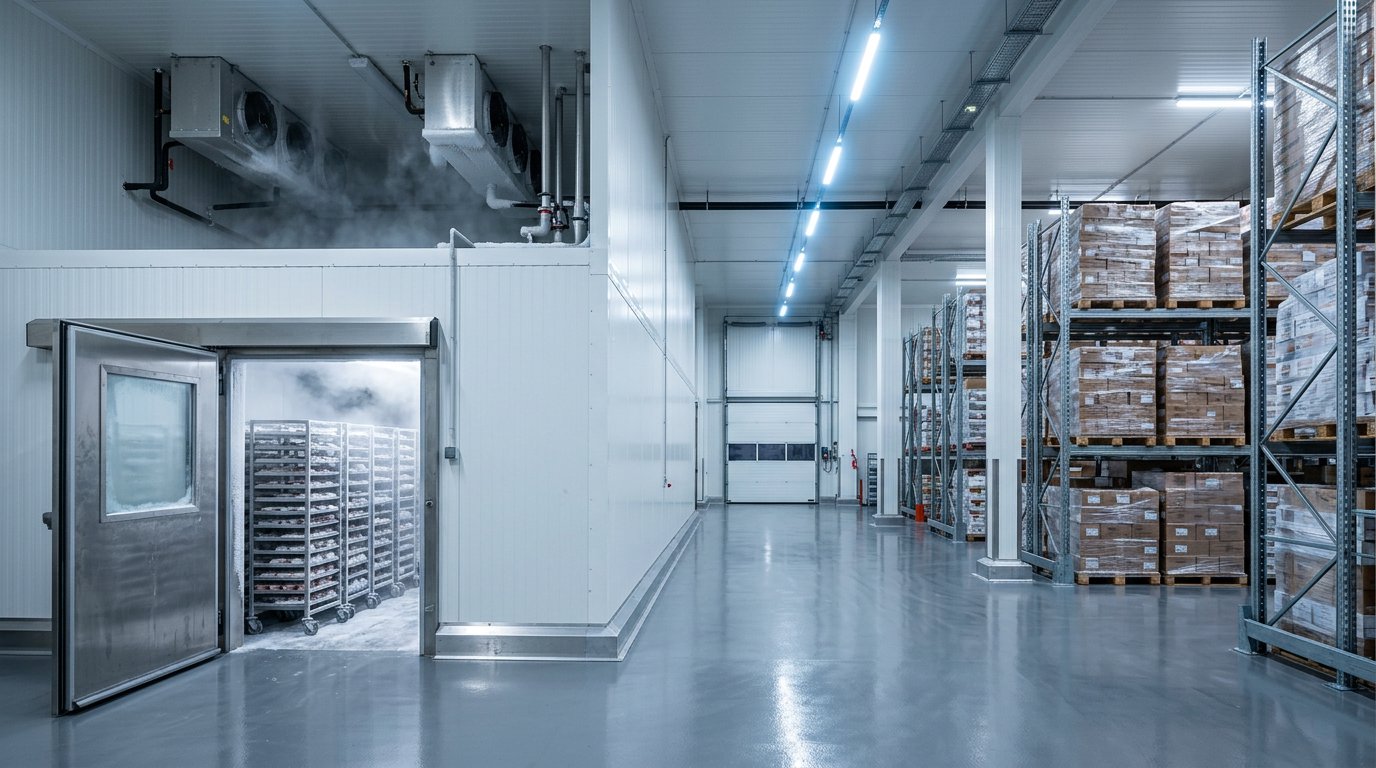
A Blast Freezer Freezes, a Cold Store Holds
A blast freezer behaves like production machinery. Fresh product goes in, and its core temperature is driven down to −18°C or lower within hours. Air at roughly −30°C to −40°C is forced across the product surface at high velocity so heat leaves quickly. Once the target is reached, the product moves out. The room is designed to be opened and emptied often.
A cold store does the opposite. It receives already-frozen product and only has to hold it steady between −18°C and −25°C for weeks or months. Its load is small but relentless: heat creeping through the envelope, heat from lights and forklifts, and outside air slipping in every time a door opens. Doors that stay shut are the ideal condition.
That difference in duty drives the whole design. A blast freezer is small in volume yet demands a large compressor; a cold store is large with a comparatively modest compressor per cubic metre. Using a cold store to freeze fresh product is the mistake we see most often in the field, and it is paid for twice, in quality and in energy.
Why Freezing Speed Decides Quality
The reason sits at cell level. As product passes through roughly −1°C to −5°C, water inside the tissue turns into ice crystals. That band is known as the zone of maximum crystallisation. Cross it slowly and the crystals grow large enough to rupture cell walls. You only see the damage at thawing: drip loss, soft texture, and weight that has quietly disappeared.
The European Union treats this speed as a legal definition. According to the regulatory summary on EUR-Lex, food may only be labelled quick-frozen if the zone of maximum crystallisation is passed as rapidly as possible. Codex Alimentarius, through CXC 8-1976, sets −18°C as the reference temperature for storing and distributing quick-frozen food, a benchmark WHO still cited in its 2026 discussions.
For Indonesian fishery products the quality reference is SNI 4110:2020 on frozen fish, while the method for measuring product core temperature is covered by SNI 01-2372.1-2006. Those are the documents auditors ask for during processing-eligibility certification, not the equipment brochure. If you export, core temperature has to be evidenced by records rather than claimed.
Refrigeration Load: The Number Most Budgets Underestimate
A blast freezer must remove two kinds of heat at once and in a hurry: sensible heat, which lowers temperature, and latent heat, which turns water into ice. Latent heat is the heavy part. Because the whole job has to finish within hours, installed capacity per cubic metre can be several times that of a cold store fighting nothing but envelope gain.
The practical consequences are worth designing for early:
- Blast freezer evaporators use tight fin spacing and powerful fans, so they need clear air space above the trolley racks.
- Defrost cycles run far more frequently because moisture from fresh product keeps forming frost on the coil.
- Floors need particular care; at very low temperatures the ground beneath the slab can freeze and heave without floor insulation or heating.
- Electrical supply must be sized from the peak freezing load, never from a daily average.
Panel Thickness: Calculate It, Do Not Guess
This is where panel choice becomes an engineering decision rather than a preference. PIR cores show thermal conductivity around 0.020–0.024 W/m·K according to panel industry data, well below EPS. Wall heat transmittance follows a simple relation: U equals lambda divided by core thickness. Using 0.022 W/m·K, the numbers become concrete enough to check any quotation against.
- 100 mm core → U ≈ 0.22 W/m²K
- 150 mm core → U ≈ 0.147 W/m²K
- 200 mm core → U ≈ 0.11 W/m²K
Now add a tropical climate. Assume 32°C outside. A cold store at −18°C gives a 50 K difference, so a 150 mm panel passes roughly 7.4 watts per square metre. A blast freezer at −35°C faces 67 K; the same 150 mm panel rises to about 9.8 W/m², and only returns to 7.4 W/m² once thickness is increased to 200 mm.
The conclusion is blunt: a colder room needs a thicker panel simply to keep envelope performance level. That arithmetic is ours and we show it openly so you can rerun it. The product standard for double-skin metal-faced insulating panels is EN 14509, which governs how thermal and structural values are tested and declared by the manufacturer.
Common panel dimensions and modules used in Indonesia are covered separately in our guide to standard sandwich panel wall sizes and thickness, while the character of each core type is compared in EPS vs PU vs rockwool.
The Order of Decisions Before You Build
If your facility takes in fresh raw material, the answer is almost always two rooms rather than one: a small blast freezer at the front, a large cold store behind it. A workable sequence looks like this:
- Fix the tonnage of fresh product per batch and the target freezing time, since those two figures size the plant.
- Lock the operating temperature of each room, then calculate the difference against ambient conditions at your site.
- Select core thickness from the U-value arithmetic above rather than from price per square metre.
- Inspect joint detailing, cam-locks and vapour sealing; humid air leakage degrades insulation faster than age does.
- Plan floor insulation and frost-heave protection from the start, because neither can be fixed once racking is installed.
For smaller volumes or projects that must relocate, modular options deserve a look first. We cover them in our article on container cold storage and mobile cold rooms.
Market Context Behind the Question
Demand is growing alongside the industry. Mordor Intelligence projects Indonesia's cold chain logistics market moving from USD 7.19 billion in 2025 to USD 7.51 billion in 2026, at a 4.23% CAGR toward USD 9.24 billion by 2031. That growth means additional freezing capacity, not merely additional refrigerated trucks.
Signals from supporting industry point the same way. The Ministry of Industry recorded machinery supporting the cold chain growing 18.75% in the second quarter of 2025, its strongest showing since 2012. Competition is no longer about who owns a cold room; it is about whose facility runs efficiently and can prove product quality during a buyer audit.
FAQ
Can a cold store be used to freeze fresh product?
Physically yes, but the result is poor. Freezing proceeds slowly, so ice crystals grow large and damage texture. Incoming fresh product also releases substantial heat and moisture, lifting room temperature and putting already-stored frozen stock at risk. For any routine volume, a separate blast freezer is almost always cheaper over the life of the facility.
How thick should panels be for a −35°C blast freezer?
A reasonable starting point is a 150–200 mm PIR core, and 200 mm if you want envelope performance equal to a −18°C cold store built with 150 mm. The final figure still has to come from a load calculation, because site conditions, exposed wall area, door traffic and target freezing time all influence it.
What is the difference between a blast freezer and a blast chiller?
A blast chiller only brings cooked or fresh product down to roughly 0–4°C for short-term storage, without freezing it. A blast freezer pushes past the freezing point until the core reaches −18°C. Both rely on high-velocity airflow, but target temperature, plant capacity and required panel thickness differ substantially.