

Coconut downstream processing is a headline agenda in Indonesia again in 2026. The Investment Minister stated that a coconut processing plant worth Rp1.66 trillion in Morowali is targeted for completion this year, and the World Coconut Day 2026 report from Manado drew industry players from 21 countries. For plant owners, the queue for new production rooms keeps growing.
The part most often postponed in planning is the walls and ceilings. Yet panel decisions at this stage determine whether your VCO filling room, desiccated coconut line, and warehouse pass a hygiene audit or become a repeat finding.
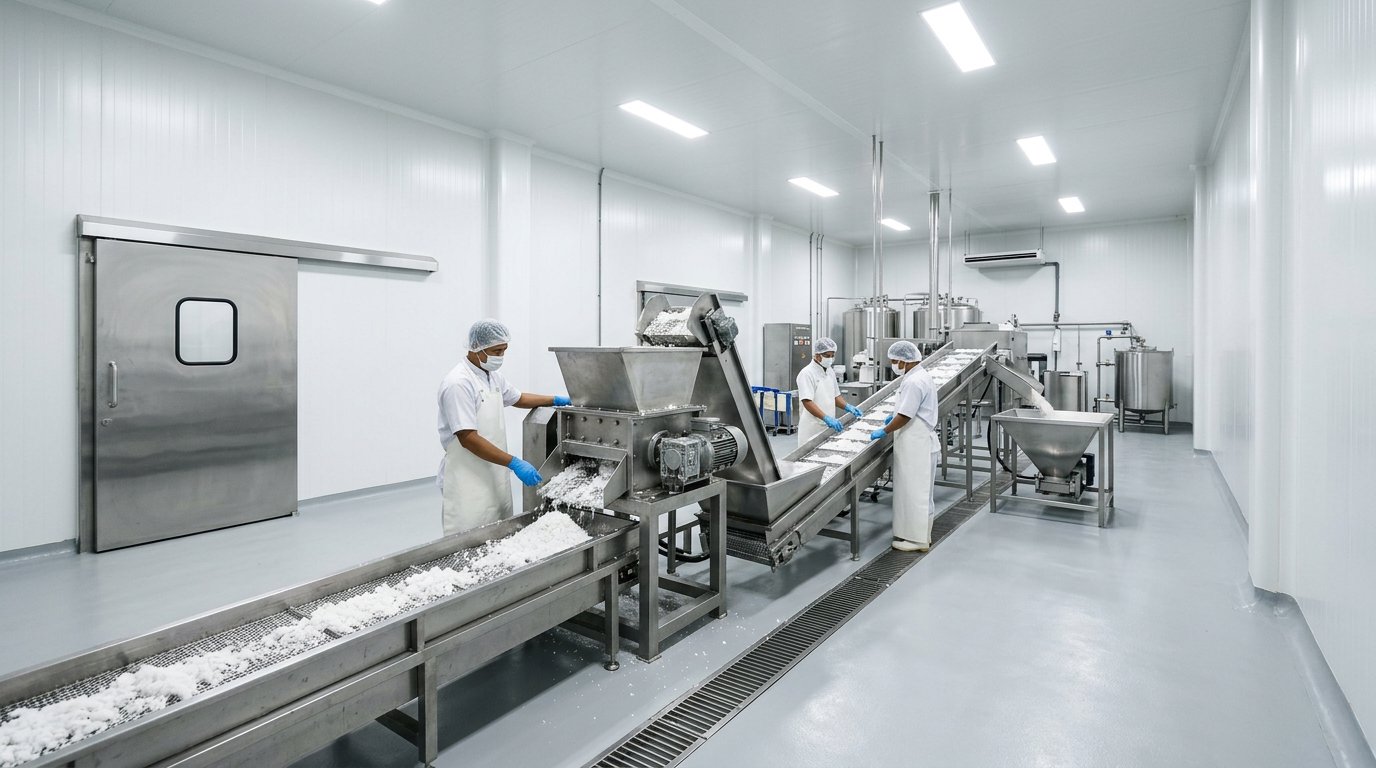
Mapping the rooms: wet side, dry side, warehouse
Coconut processing splits into two sides that must not mix. The wet side handles de-husking, splitting, washing, and shredding; the dry side handles drying, size grading, and packing. Industry literature puts final desiccated coconut moisture near three percent; take the binding figure from your buyer specification.
That separation is not cosmetic: humid air drifting from the wet side into the packing room lets dried product pick up moisture again. Partition walls must run tight to the ceiling, not stop at chest height.
Rooms usually built with panels in a coconut plant:
- Shredding and coconut milk pressing rooms, wet and frequently pressure washed.
- Drying and product cooling rooms, dry and running hot.
- Packing rooms for desiccated coconut or coconut flour.
- VCO and coconut milk filling rooms, with the tightest hygiene demands.
- Dry goods warehouses plus chilled rooms for fresh coconut and coconut water.
What CPPOB says about production room walls
Indonesia's binding reference is CPPOB, the national good manufacturing practice for processed food, set by Minister of Industry Regulation Number 75/M-IND/PER/7/2010 and promulgated in State Gazette Number 358 of 2010. Its technical guidance sits in the annex.
Widely circulated CPPOB training material and checklists state that production room walls should be water resistant, smooth, flat, light coloured, non-flaking, at least two metres high, with wall-to-wall junctions that form no dead corners. That is a secondary summary: read the official annex before copying it into a tender specification.
The same principles underpin international food hygiene guidance published by Codex Alimentarius. Pre-painted steel skins meet the smooth, flat, light-coloured surface requirement without plastering or periodic repainting.
Product quality standards drive the room class
A VCO filling room needs tighter control than a copra store. SNI 7381:2008 sets the quality requirements for virgin coconut oil, and secondary sources record a maximum moisture content of 0.2 percent and a peroxide value limit of 2 meq per kilogram. Confirm the current edition with BSN.
For desiccated coconut, one journal citing the SNI reports around 61 percent fat, though we could not verify that product's SNI number from a primary source; pull it from the BSN database. High fat means oily residue clinging to walls, so the surface must survive repeated washing.
Core, thickness, and U value
Our panel line covers external walls, partitions, and room ceilings. Wide-span roof structures and canopies are handled by separate covering materials outside this panel line. Thicknesses run from 50 to 150 millimetres across every core: EPS, PU, PIR, and rockwool.
Design U value estimates by the ISO 6946 method, in W/m2K: EPS 50 mm 0.63 and 100 mm 0.33; PIR 50 mm 0.44 and 100 mm 0.23; rockwool 50 mm 0.70 and 100 mm 0.37. Manufacturer declared values use the EN 14509 reference method, so treat them as a first pass. Market steel skins run 0.3 to 0.5 millimetres with 1,000 or 1,050 millimetre cover widths.
For chilled rooms holding fresh coconut and coconut water, supplier guidance uses 80 millimetres for a chiller near zero degrees, and 100 to 140 millimetres for a freezer at minus 18 to minus 20 degrees.
Coating and joints for oily areas
What meets coconut milk splash and oil vapour is the paint on the steel skin, not the core. The EN 10169 coil coating standard separates paint classes: polyester suits dry rooms, while PVDF holds up better where pressure washing and cleaning agents are routine.
In wet areas, set the room corrosivity category to ISO 12944 before choosing paint class and fasteners. What fails most often is not the panel but cut edges, pipe penetrations, and joint silicone. Ask for food grade sealant and stainless edge protection wherever a washdown lance reaches.
The drying room is the fire-sensitive point
Coconut drying works with hot air, fine dust, and oil residue, a combination that raises fire risk above a packing room. For drying room walls and those adjoining them, a rockwool core fits better than an organic core.
Ask for a reaction to fire class tested to EN 13501-1, with the test report. A fire claim without a test method and report number is unusable at verification, and it is the item most often missing from the cheapest quotation.
Cost range, lead time, and documents
Public supplier price lists from June to August 2026 put installed PU panels 50 to 75 millimetres thick at Rp350,000 to Rp550,000 per square metre, and installation labour without material at Rp150,000 to Rp230,000 per square metre. Both ranges move with steel prices and location.
One note of caution on capacity: industry reporting in 2026 recorded a whole coconut supply crisis that pushed some processing plants to close. Plan rooms that can be extended in stages: panel partitions can be dismantled and relocated without touching the main structure, their real advantage over masonry.
Before signing, collect the panel datasheet with declared U value, the reaction to fire test report, the steel mill certificate, and the paint specification with coating thickness. How to read them is in our certificate and datasheet guide, while wall surface requirements appear in food production wall standards and the UHT dairy plant case.
FAQ: Frequently asked questions
Can one panel type serve the whole coconut plant?
Not advisable. The drying room is better served by a rockwool core given its heat load and fire risk, while packing rooms and dry warehouses suit a thinner EPS or PU core. Levelling every room to the highest specification only raises cost without benefit.
How long does panel wall installation take for one production room?
It depends on area, height, and floor readiness. Base flatness and utility routing must be ready first, because panel walls go up fast but do not forgive an uneven floor. A firm schedule is best calculated once layout drawings and room heights exist.
Plan your coconut production rooms
Every coconut plant has a different mix of wet rooms, dry rooms, and warehousing, and the panel specification should follow that mix, not a price list. Share your layout, target capacity, and product range, then discuss your needs and request a quotation through our contact page. We map thickness, core, and paint class room by room before the budget is locked.