

Nickel downstream parks are expanding quickly, but their buildings age far faster than an ordinary factory. Acid mist, sulphur-bearing dust, sea air and tropical humidity all act on the same site at once. This guide covers how to specify sandwich panels for HPAL, RKEF and precursor plants: reading corrosivity classes, setting a sensible substrate and coating, and closing the installation details that usually fail first.
The scale of Indonesia's nickel downstream push in 2026
The Indonesian Nickel Miners Association (APNI) recorded Rp71 trillion of realised downstream nickel investment in the first half of 2026 — Rp41.5 trillion in the first quarter and Rp29.4 trillion in the second, as reported by Bisnis.com on 13 August 2026. That translates into hundreds of thousands of square metres of new process buildings, reagent stores, electrical rooms and site offices.
The estates themselves show the scale. PT IMIP in Bahodopi, Morowali covers roughly 4,000 hectares and recorded 97,427 active workers in July 2026, excluding some 20,000 outsourced staff. Weda Bay Industrial Park in Central Halmahera is planned at 2,000 hectares. Both sit directly on the coastline — the worst possible mix of marine chloride and industrial pollutants.
On the supply side, the Ministry of Energy and Mineral Resources set the 2026 nickel ore work plan (RKAB) at 260–270 million tonnes, down from the 379 million tonnes approved for 2025. Thinner margins put building maintenance under scrutiny. Replacing corroded cladding within five years is an avoidable loss that starts at the specification stage.
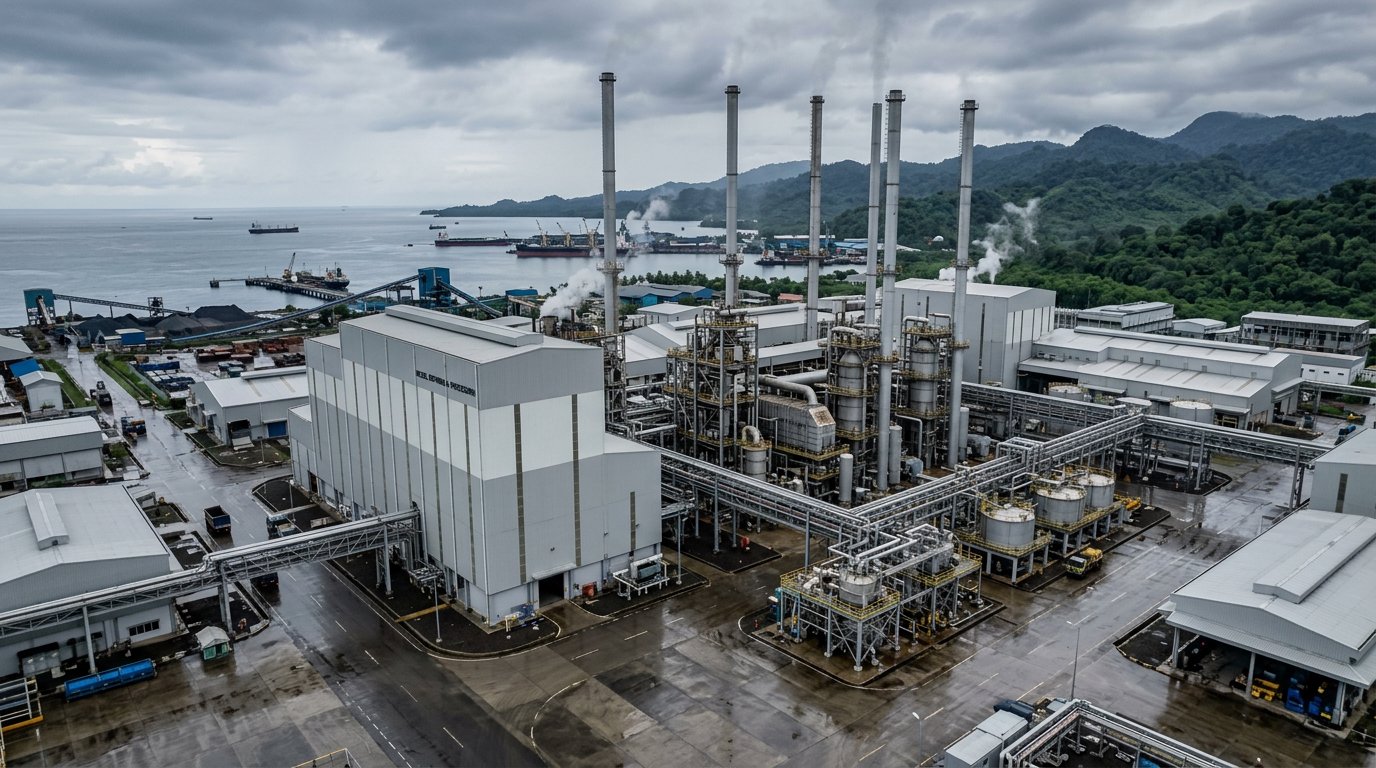
Where the chemical exposure actually comes from
Not every building on one estate faces the same risk. Mapping exposure sources zone by zone is far more useful than applying a single panel specification across the whole site.
HPAL plants dissolve laterite ore with sulphuric acid inside pressurised autoclaves. Process literature places operating conditions in the range of 250–270 °C at roughly 45–50 bar. Acid consumption is substantial: about 250–450 kg of sulphuric acid per tonne of ore.
Research published in Hydrometallurgy shows nickel recovery rising from around 70% to above 94% as acid dosage climbs across that range. The building consequence is direct: acid tanks, dilution areas and lime neutralisation units release acid mist that attacks both the zinc layer and the organic paint on a panel skin.
The RKEF route behaves differently. Electric furnaces and rotary kilns generate radiant heat, dust and sulphur gases from ore and fuel. Here the concern is not only corrosion but surface temperature and fire risk in material stores — the same reasoning behind fire-rated panels for hazardous material warehouses.
Downstream segments add another layer. Four battery cathode material plants are being developed at IMIP; PT Huayue Nickel Cobalt runs at 70,000 tonnes of nickel-cobalt per year and PT QMB New Energy Material at 50,000 tonnes per year. Precursor production rooms handle nickel sulphate solutions and ammonia, so wall surfaces must be tight, non-porous and easy to clean.
It is worth stating that the focus here is chemical resistance, not humidity control. Low dew-point dry rooms are covered separately in our guide to sandwich panels for EV battery plants and dry rooms.
- Acid tank and dilution zone: sulphuric acid mist, low pH, periodic spillage.
- Autoclave and heat exchanger zone: heat, steam, acidic condensate.
- Neutralisation and tailings zone: lime slurry, high humidity, particle abrasion.
- Precursor and nickel sulphate zone: metal salt solutions, ammonia, hygiene demands.
- External envelope across the site: marine chloride, heavy rainfall, tropical UV.
Read the corrosivity class before naming a panel brand
ISO 9223:2012 classifies atmospheric corrosivity from C1 (very low) to C5 (very high), plus a CX category for extreme marine and marine-industrial environments. Classification uses three measured parameters: time of wetness, sulphur dioxide deposition and chloride deposition. Estates such as Morowali and Weda Bay meet all three at once.
ISO 12944, the standard for corrosion protection of steel structures by protective paint systems, was revised in 2018. The revision removed the older C5-I (industrial) and C5-M (marine) split and replaced it with C5 for onshore environments and CX for offshore and extreme industrial exposure. The practical takeaway: stop writing C5-I in new project specifications.
For the panel itself, the usual product reference is EN 14509, covering self-supporting double skin metal faced insulating panels. That standard governs mechanical, thermal and reaction-to-fire testing — not chemical resistance. Chemical resistance data must therefore be requested separately from the coating datasheet rather than assumed to sit inside the panel certificate.
One practical note: ask the consultant to assign a corrosivity class per zone rather than one class for the entire site. An office block 1.5 km from the acid tanks does not need the same specification as a reagent store beside the neutralisation unit.
A realistic panel specification for nickel plants
- Substrate. Galvalume with an AZ150 coating (150 g/m²) as the baseline for the external envelope. In zones with direct acid spillage, consider stainless skins or additional protection on the lower metre of wall.
- Coating. European coil coating producers generally place 25 µm PVDF at UV resistance class RUV 4 and corrosion resistance class RC 3 under the EN 10169 classification. Thick plastisol of around 200 µm offers better mechanical durability and cut-edge protection.
- Panel core. Rockwool for hot and fire-exposed areas such as RKEF halls, electrical rooms and material stores. PIR for refrigerated rooms and buildings with demanding insulation targets.
- Joints. Hidden screw systems or tongued joints with chemically resistant sealant, rather than exposed through-fixings on the weather side.
- Fasteners. Stainless AISI 316 (A4) screws and rivets with EPDM washers. Ordinary galvanised fixings will corrode long before the panel does.
Cut-edge detailing is routinely overlooked yet decisive. A panel cut on site loses its coating protection exactly where water collects most often. In C5 and CX classes, exposed edges are the most common starting point for rust found during a third-year inspection.
Installation, seismic design and maintenance intervals
Central Sulawesi and Halmahera sit on an active seismic belt, so the supporting structure must follow SNI 1726:2019, the Indonesian code for earthquake resistance design of buildings. Lightweight panels help here: lower wall mass reduces the inertial forces the steel frame has to carry.
For maintenance, a reasonable cycle in C5 to CX environments is washing the envelope every 6–12 months with clean water to dissolve salt and sulphate deposits, plus a coating inspection every 3–5 years. Periodic washing is also a common condition for keeping a coating warranty valid — a point we cover in our discussion of sandwich panel warranties and maintenance contracts.
Three habits shorten panel life most in nickel estates: storing panels in the open before installation, fitting flashings the wrong way round so they trap water, and swapping stainless screws for galvanised ones to save cost. The coastal corrosion pattern mirrors what we described for corrosion-resistant panels in coastal buildings.
FAQ
Is standard galvalume panel enough for an HPAL plant?
For offices and support buildings well away from acid mist sources, AZ150 galvalume with polyester paint is usually adequate. For process buildings, acid tank areas and anything on the shoreline, that specification is too light. Move up to a PVDF or plastisol system and use stainless A4 fasteners.
How long does panel coating last in Morowali or Weda Bay?
There is no single figure. ISO 12944 makes paint system durability dependent on corrosivity class, surface preparation and dry film thickness. What is certain is that in C5 to CX classes, service life without periodic maintenance falls well short of brochure values measured in C3 conditions.
Should precursor rooms use the same specification as acid tank areas?
No. Precursor rooms demand hygienic surfaces, tight joints and easy cleaning. Acid tank areas demand chemical resistance and far more robust edge detailing. Applying one specification to both means overpaying in one place and under-protecting in another.
The sandwichpanels.id team routinely translates a process zone map into a building-by-building panel specification, covering substrate, coating and joint details matched to the corrosivity class of the site.